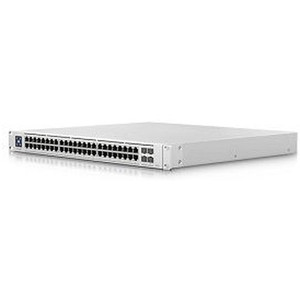
Ubiquiti ES-48-500W 48-Port PoE+ Managed Switch
Overview
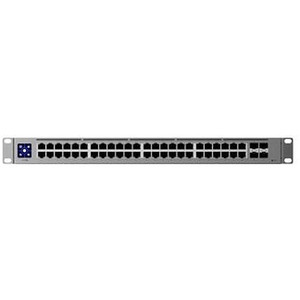
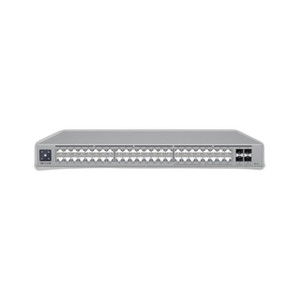
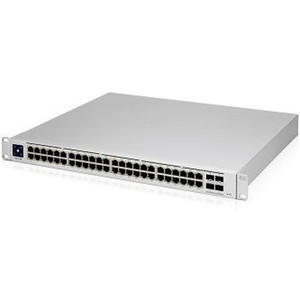
The Ubiquiti ES-48-500W is a 1U rackmount Layer 2/3 managed switch built for enterprise access and distribution deployments. It combines 48 Gigabit Ethernet ports with a 500W PoE+ power budget, eliminating the need for separate power injection when deploying dozens of access points, IP cameras, or other powered edge devices. The ES-48-500W pairs these 48 ports with dual 10 Gigabit SFP+ uplink ports and dual 1 Gigabit SFP ports, delivering 140 Gbps total switching capacity and 104.16 million packets per second (Mpps) forwarding rate. Weighing 16.25 lbs and consuming just 1U of rack space, this is practical density for multi-building campuses, service provider customer premise equipment (CPE) aggregation, and top-of-rack (ToR) data center roles.
Key Features
- 70 Gbps non-blocking throughput: Full-duplex Gigabit fabric means all 48 ports can saturate simultaneously without congestion — important if you're aggregating traffic from dozens of cameras or access points feeding a single upstream core switch.
- 500W PoE+ budget across all 48 ports: Each port delivers up to 34.2W via PoE+ (IEEE 802.3at), so you can power high-draw devices like motorized PTZ cameras or dual-radio access points directly without external injection. That's roughly 10–15 fully powered edge devices per switch depending on wattage; scale that across 48 ports and you eliminate dozens of separate power supplies from a typical campus rollout.
- Passive PoE compatibility (17W per port): If legacy powered devices remain in your infrastructure, the ES-48-500W negotiates Passive PoE automatically — no reconfiguration needed, reducing swapout friction during migrations.
- Dual 10G SFP+ uplinks: Connect to core switches or redundant upstream infrastructure at 10 Gbps each, with zero latency penalty. Link aggregation (LAG) support lets you bond both 10G ports for 20 Gbps of failover-protected trunk capacity.
- Layer 2/3 routing and VLAN support: Configure static routes, VLAN segmentation, and port-based traffic policies. Isolate camera traffic from guest networks or segregate IoT devices — all without requiring a separate Layer 3 device.
- Web GUI, CLI, SNMP, and serial console management: Out-of-band RJ45 serial console provides emergency access if in-band network connectivity fails. SNMP integration feeds directly into existing NOC monitoring platforms or Grafana stacks, so your existing dashboards pick up port stats and power usage immediately.
Deployment Scenarios
In multi-building campuses, install the ES-48-500W in a main distribution frame or secondary equipment room to aggregate 48 powered endpoints (cameras, APs, sensors) and trunk upward via 10G SFP+ links. The 500W power budget means you're not bottlenecking edge device deployment — a common constraint with smaller switches. For service providers managing customer premise equipment, the combination of high port density and PoE capacity makes the ES-48-500W an efficient CPE aggregation point, reducing truck rolls to customer sites to pull/replace power supplies. In data center roles, the 70 Gbps non-blocking fabric and 10G uplinks deliver deterministic east-west performance for storage-heavy workloads without oversubscription headaches.
Consult the PoE planning guide if you're sizing power budgets across multiple switches or mixing high-draw devices like heating-enabled outdoor cameras with standard APs.
Network Integration and Compatibility
The ES-48-500W integrates seamlessly into managed network switches and existing Ubiquiti or third-party ecosystems. SNMP v1/v2/v3 support means no special drivers or proprietary management tools — standard syslog and trap receivers ingest alarms. SFP+ and SFP uplink ports accept any qualified transceiver matched to your fiber infrastructure, avoiding vendor lock-in. Passive PoE compatibility allows gradual migration from legacy to standards-based powered devices without flag-day cutover risk. The dual RJ45 console port and Ethernet management interface provide out-of-band control independent of production traffic.
Installation and Commissioning
Mount the ES-48-500W in a standard 19-inch rack using 1U of vertical space. Ensure adequate intake and exhaust airflow — typical data center or equipment room conditions suit it well. Connect PoE devices directly to any RJ45 port; the switch auto-negotiates power delivery and compliance. For uplinks, use qualified SFP+ (10G) or SFP (1G) transceivers appropriate to your cabling runs — multimode or singlemode fiber, direct-attach copper, whatever your infrastructure supports. Assign an IP address via DHCP discovery, then log into the web GUI or serial console for configuration. Standard 19-inch rack rails fit the 16.25 lb chassis securely.
Frequently Asked Questions
Q: Can I connect the ES-48-500W directly to a fiber core switch without media converters?
A: Yes, if your core switch has SFP+ ports. Insert a 10G SFP+ transceiver (multimode or singlemode, depending on your fiber plant) into one of the ES-48-500W's SFP+ uplink ports, connect to the core's SFP+ port, and configure link aggregation if you want both 10G ports active for redundancy. No converters needed.
Q: What happens if I exceed 500W of PoE load across the switch?
A: The ES-48-500W enforces a hard power budget. If you try to power devices beyond 500W total, the switch will refuse to allocate power to new requests or begin de-allocating from lower-priority ports. Plan your deployment carefully — use a PoE calculator or power audit before deployment to avoid surprises.
Q: Does the ES-48-500W support dynamic VLAN assignment (voice VLAN, etc.)?
A: Yes. VLAN configuration is available via web GUI or CLI. Port-based and IP-based tagging are supported, allowing you to isolate camera, voice, guest, and management traffic without additional devices.
Q: What is the maximum cable run distance from the ES-48-500W to a PoE device?
A: Standard Gigabit Ethernet over copper supports up to 100 meters (328 ft) of UTP/FTP cabling. PoE+ power delivery is also rated for 100 meters; voltage drop becomes a constraint beyond that. If you need longer runs, use PoE extenders or fiber uplinks from the switch, then PoE out of a closer access point or injector.
Q: Can I upgrade or downgrade the firmware on the ES-48-500W remotely?
A: Yes, through the web GUI or CLI. Ubiquiti publishes firmware updates periodically. Download the image to your management machine, then upload it via the web interface or TFTP. Serial console access is available if remote access fails during an upgrade.
Q: Is the ES-48-500W NDAA compliant or appropriate for U.S. federal deployments?
A: Ubiquiti is a Taiwan-based manufacturer. If your deployment requires NDAA Section 889 compliance or has U.S. government restrictions, you will need to verify Ubiquiti's current status with your procurement or compliance team — this is not something a reseller can guarantee independently.
Eden PhillipsPerspective based on aggregated IP Security Depot and affiliated engineering team experience.
The Ubiquiti ES-48-500W occupies a real gap in the mid-market access-switch category. You get 48 Gigabit ports with a genuinely useful 500W PoE budget in a single 1U form factor — that's the constraint most IT teams hit first when planning a floor or building. The dual 10G SFP+ uplinks are not overkill either; if you're deploying 30–40 IP cameras plus access points on a single switch and feeding that back to a core, you want more than 1 Gbps of northbound capacity to avoid bottleneck complaints from camera recordings or controller sync traffic.
Technical Highlights:
- 70 Gbps non-blocking throughput: All 48 ports can run simultaneously at full line rate without packet loss. In practice, this means you don't need to worry about oversubscription math — cameras, APs, and sensors can all upload concurrently without the switch becoming a bottleneck. Real deployment benefit: faster failover detection and lower latency for time-sensitive analytics or access control traffic.
- 500W total PoE+ budget at 34.2W per port: Enough to support roughly 12–15 high-draw devices (motorized PTZ cameras, multi-radio APs, environmental sensors with heating) simultaneously. Compare that to consumer-grade switches capped at 90W or smaller managed switches at 250W — the ES-48-500W actually scales with enterprise edge density.
- Dual 10G SFP+ plus dual 1G SFP uplinks: Use the 10G ports for your primary and backup core links, or bond them for 20 Gbps aggregate if your core supports it. The two 1G SFP ports give you flexibility for out-of-band management links or legacy fiber integration without forcing replacement of existing infrastructure.
Deployment Considerations:
- PoE budget arithmetic is mandatory: The ES-48-500W enforces a hard 500W cap. If you deploy 48 devices drawing 11W each, you'll hit exactly 528W and the switch will deny power to the last few devices. Build a power audit spreadsheet before ordering and size your edge device mix accordingly. This is not a limitation — it's actually preventing overloads — but it forces planning you might skip with unlimited power supplies.
- Fiber uplink provisioning: If your core is 10G fiber and you don't already have qualified SFP+ transceivers on hand, budget 2–4 weeks for procurement depending on your supplier. Multimode optics are faster to source than singlemode; ask your infrastructure team what your fiber plant supports before installation day.
- Serial console access in tight spaces: The RJ45 console port is invaluable if you rack this in a dense area without reliable in-band management access during commissioning. Bring a serial adapter and test console connectivity before declaring the deployment complete.
Position the ES-48-500W for campus access-layer or service provider CPE aggregation roles where port density and PoE budget are your binding constraints. If you're replacing four or five smaller switches with fragmented PoE budgets, the consolidation alone pays for itself in reduced rack space and power overhead. For data center environments with strict oversubscription limits, the 70 Gbps non-blocking architecture and 10G uplinks make it a legitimate ToR alternative to much larger, costlier chassis platforms.