
Geovision APOE0811 vs Geovision APOE0811: Specification Comparison
Both products are the GeoVision GV-APOE0811 8-port PoE+ managed gigabit switch, positioned for IP camera and networked security device deployments. The comparison is between two distributor-channel variants — SKU GV-APOE0811 (distributor SKU 84-APOE081-301U) and SKU GV-APOE0811-140 (distributor SKU 140-APOE81W-000) — that share the same physical footprint and port count but differ in documented total PoE power budget, cable-category classification, and VMS compatibility disclosure. Buyers selecting between these two should weigh power budget, management depth, and integration requirements.
In This Guide
- How do the PoE port count, power budget, and per-port delivery compare?
- Do the physical build, weight, and mounting options differ between the two variants?
- Which variant offers stronger management features and third-party integration documentation?
- Which should you choose: the APOE0811 or the APOE0811?
- Side-by-Side Specs
- FAQ
How do the PoE port count, power budget, and per-port delivery compare?
Both variants provide 8 PoE+ ports operating at the 802.3at standard (up to 30W per port) plus 2 dedicated gigabit uplink ports. Port speed on both is 10/100/1000 Mbps auto-negotiating.
The critical differentiator is total power budget: SKU GV-APOE0811-140 explicitly specifies a 140W total PoE power budget in its specs. SKU GV-APOE0811 does not document a total power budget figure — installers cannot confirm the chassis watt ceiling from the available spec data alone.
For a deployment with 8 ports each drawing near-maximum 802.3at load (e.g., PTZ cameras with heaters), the 140W ceiling on the -140 variant becomes a hard constraint to plan against. The absence of a stated budget on the base SKU is a spec gap that requires datasheet verification before deployment.
Do the physical build, weight, and mounting options differ between the two variants?
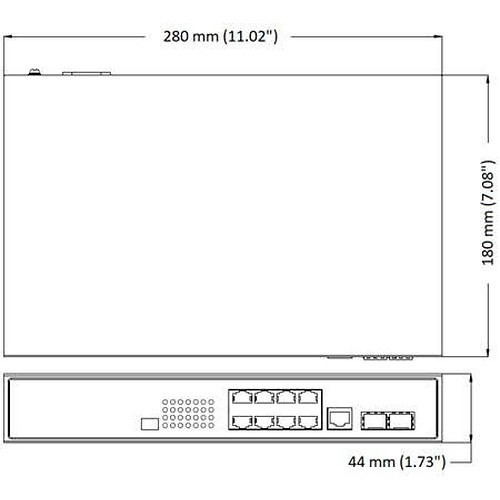
Dimensions are identical on both units: 12.00 x 8.00 x 3.00 in. Housing color is White on both.
Weight differs slightly: the base GV-APOE0811 is listed at 4 lb, while the GV-APOE0811-140 is listed at 3.75 lb — a 0.25 lb difference that is unlikely to be operationally significant but does indicate these are distinct physical units or production runs.
Mounting options show a documented difference: GV-APOE0811-140 specifies wall or rack-mount capability, while GV-APOE0811 is described as rack/shelf mountable. The -140 variant's explicit wall-mount option may matter for camera-closet or on-wall enclosure installs where rack infrastructure is absent.
Which variant offers stronger management features and third-party integration documentation?
Both variants share a common management baseline: VLAN, QoS, and port mirroring. The base GV-APOE0811 additionally documents link aggregation (LACP or static — specific protocol not specified) in its spec data; the GV-APOE0811-140 does not list link aggregation.
VMS and standards compatibility is only documented for the GV-APOE0811-140, which lists ONVIF Profile S compliance. The base GV-APOE0811 carries no VMS compatibility or ONVIF notation in its available specs.
Cable category classification differs: GV-APOE0811 is filed under 'Accessories,' while GV-APOE0811-140 is filed under 'IPPTZCam,' suggesting the -140 variant is positioned and validated specifically for PTZ camera power and integration use cases. The -140 also carries an explicit 'Compatibility: Yes' field, though the spec does not enumerate specific third-party NVR or VMS platforms beyond ONVIF Profile S.
Which should you choose: the APOE0811 or the APOE0811?
Our take: The GV-APOE0811-140 is the stronger choice when the deployment involves PTZ cameras, requires a documented total power budget, or demands confirmed ONVIF Profile S compatibility. The -140 variant is the only one with a stated 140W PoE power budget — a critical planning figure when sizing multi-camera installs — and it alone documents ONVIF Profile S support and explicit wall-mount capability. The base GV-APOE0811 counters with a documented link aggregation feature absent from the -140's spec sheet and weighs 0.25 lb more, which may reflect minor hardware differences. Both carry a 3-year warranty and identical port counts. Choose GV-APOE0811-140 for PTZ-heavy, power-budget-sensitive, or ONVIF-dependent installations; revisit GV-APOE0811 if link aggregation to an upstream core switch is required and total PoE wattage can be confirmed via its separate datasheet.
Side-by-Side Comparison
Spec-for-spec, from manufacturer data.
| Specification | Geovision APOE0811 | Geovision APOE0811 |
|---|---|---|
| SKU | GV-APOE0811 | GV-APOE0811-140 |
| Distributor SKU | 84-APOE081-301U | 140-APOE81W-000 |
| PoE Ports | 8 (802.3at) | 8 (802.3at) |
| Uplink Ports | 2 Gigabit | 2 Gigabit |
| Port Speed | 10/100/1000 Mbps | 10/100/1000 Mbps |
| Total PoE Power Budget | — | 140W |
| VLAN | Yes | Yes |
| QoS | Yes | Yes |
| Port Mirroring | Yes | Yes |
| Link Aggregation | Yes | — |
| ONVIF Profile S | — | Yes |
| Mounting | Rack/shelf | Wall or rack |
| Weight | 4 lb | 3.75 lb |
| Dimensions (in) | 12.00 x 8.00 x 3.00 | 12.00 x 8.00 x 3.00 |
| Housing Color | White | White |
| Warranty | 3-Year | 3-Year |
Frequently Asked Questions
Which should you choose: the APOE0811 or the APOE0811?
The GV-APOE0811-140 is the stronger choice when the deployment involves PTZ cameras, requires a documented total power budget, or demands confirmed ONVIF Profile S compatibility. The -140 variant is the only one with a stated 140W PoE power budget — a critical planning figure when sizing multi-camera installs — and it alone documents ONVIF Profile S support and explicit wall-mount capability. The base GV-APOE0811 counters with a documented link aggregation feature absent from the -140's spec sheet and weighs 0.25 lb more, which may reflect minor hardware differences. Both carry a 3-year warranty and identical port counts. Choose GV-APOE0811-140 for PTZ-heavy, power-budget-sensitive, or ONVIF-dependent installations; revisit GV-APOE0811 if link aggregation to an upstream core switch is required and total PoE wattage can be confirmed via its separate datasheet.
Which switch supports more total PoE wattage — the GV-APOE0811 or the GV-APOE0811-140?
Only the GV-APOE0811-140 documents a total PoE power budget: 140W across all 8 ports. The base GV-APOE0811 does not specify a total power budget in the available spec data, so installers should consult its datasheet at /content/product-datasheets/GV-APOE0811.pdf before sizing a deployment with high-draw devices.
Can either switch be wall-mounted in a camera closet without a rack?
The GV-APOE0811-140 explicitly lists wall or rack-mount as mounting options. The base GV-APOE0811 is documented as rack/shelf mountable only — wall-mount is not listed in its available specs. Verify with the respective datasheets if wall-mount hardware is a firm requirement.
Does either switch confirm ONVIF compatibility for use with third-party NVRs?
Yes — the GV-APOE0811-140 is documented as ONVIF Profile S compatible, making it suitable for multi-vendor IP camera and NVR environments. The base GV-APOE0811 carries no ONVIF or VMS compatibility notation in its available spec data.
More Network Switch Comparisons
- Vivotek IHT-1271 vs TP-Link SG3210XHP-M2
- Vivotek IHT-1271 vs TP-Link S4500-8GP2F
- Vivotek IHT-1271 vs TP-Link SG1210P
- Vivotek IHT-1271 vs Allied Telesis AT-x530L-10GHXm-10
- Vivotek IHT-1271 vs Vivotek GEV-108A-130
- Vivotek IHT-1271 vs Vivotek IHT-1000
Network Switch Buying Guides
Get a Second Opinion on Your Camera Choice
Share your site layout, coverage goals, and budget. Our team will validate the camera selection, flag anything we would change, and recommend products that match the use case.