
Geovision APOE081-301U vs Geovision POE0812-000: Specification Comparison
Both the Geovision APOE081-301U and the Geovision POE0812-000 are 8-port PoE+ Gigabit network switches from the same manufacturer, each targeting IP camera installations. The APOE081-301U uses fixed copper uplinks, while the POE0812-000 adds rack-mount hardware and SFP fiber uplink slots. This comparison examines total PoE power budget, physical deployment form factor, and uplink/expansion options — the three axes that most differentiate these two units in a real surveillance network design.
In This Guide
- How does the PoE power budget differ between the APOE081-301U and the POE0812-000, and what does that mean for camera loads?
- Which switch is better suited to rack-mount infrastructure versus freestanding or wall-mount deployments?
- What uplink and long-run connectivity options does each switch offer, and how does that affect network topology choices?
- Which should you choose: the APOE081-301U or the POE0812-000?
- Side-by-Side Specs
- FAQ
How does the PoE power budget differ between the APOE081-301U and the POE0812-000, and what does that mean for camera loads?
The POE0812-000 carries an explicitly specified total PoE budget of 119 W across its 8 ports, with an additional spec noting 95 W power watts — indicating the aggregate power envelope available to connected devices. Both units support IEEE 802.3at PoE+ at up to 30 W per port.
The APOE081-301U does not specify a total PoE power budget in the provided specifications. It confirms 802.3at PoE+ delivery of up to 30 W per port across all 8 Gigabit ports, but no aggregate wattage figure is listed. Buyers powering high-draw devices such as PTZ cameras or multi-sensor units on multiple ports simultaneously cannot verify the APOE081-301U's budget from the available spec data alone.
For installations where total simultaneous PoE draw is a design constraint — common in 8-camera deployments mixing PTZ and fixed cameras — the POE0812-000's documented 119 W budget provides a concrete planning figure that the APOE081-301U's specs do not.
Which switch is better suited to rack-mount infrastructure versus freestanding or wall-mount deployments?
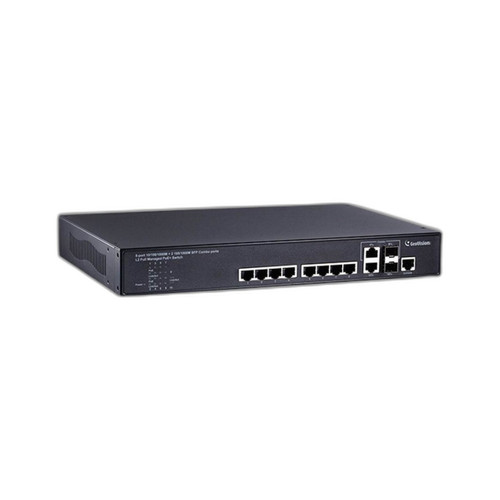
The POE0812-000 is specified as a rack-mount unit. This makes it directly compatible with standard 19-inch equipment racks in server rooms, telecom closets, or structured wiring enclosures, where cable management and physical security of network equipment are priorities.
The APOE081-301U does not list a mount type in the provided specifications. No rack-mount designation, DIN-rail mention, or wall-mount bracket spec is present. Its cable category is listed as 'Accessories,' which may suggest a more compact or unmanaged desktop-class deployment profile, but this cannot be confirmed from the specs alone.
For integrators building out rack-based head-end closets or co-locating the switch with NVR/server equipment in a rack, the POE0812-000's rack-mount form factor is a direct fit. The APOE081-301U's physical mounting options remain unspecified from the data provided.
What uplink and long-run connectivity options does each switch offer, and how does that affect network topology choices?
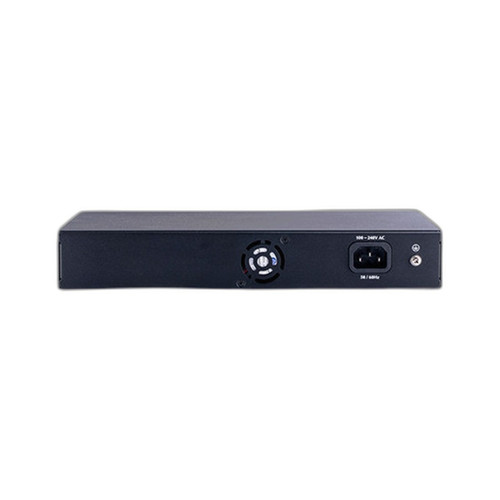
The POE0812-000 provides two open SFP slots that accept optional fiber transceivers. This enables long-distance fiber uplinks to a core switch or NVR — relevant in large campuses, multi-building deployments, or installations where electrical isolation between network segments is required. SFP flexibility also allows selection of single-mode or multi-mode fiber based on run length.
The APOE081-301U provides two dedicated Gigabit copper uplink ports supporting daisy-chaining to a core switch or NVR. These are fixed RJ-45 Gigabit interfaces. No fiber or SFP capability is listed in the specifications.
Both switches support 10/100/1000BaseT on downstream ports per the specifications, maintaining backward compatibility with older 10/100 Mbps cameras. The POE0812-000's SFP slots represent the key differentiator for installations requiring fiber backbone connectivity, while the APOE081-301U's dual Gigabit copper uplinks are adequate for shorter copper-run topologies.
Which should you choose: the APOE081-301U or the POE0812-000?
Our take: The POE0812-000 is the stronger choice when the installation requires a documented PoE power budget, rack-mount integration, or fiber uplink capability. Its 119 W total PoE budget is a concrete engineering figure for sizing camera loads; its rack-mount form factor integrates directly into structured wiring closets; and its two SFP slots add fiber uplink flexibility absent from the APOE081-301U. The APOE081-301U confirms 30 W per-port 802.3at delivery and dual Gigabit copper uplinks, but its total PoE budget is unspecified and no mount type is listed — two gaps that complicate formal system design. For compact, copper-only deployments where rack mounting is not required and total PoE draw per the connected camera set stays within typical single-switch limits, the APOE081-301U may suffice, particularly for mixed-brand IP camera platforms given its stated compatibility with Axis, Hikvision, and Dahua devices.
Side-by-Side Comparison
Spec-for-spec, from manufacturer data.
| Specification | Geovision APOE081-301U | Geovision POE0812-000 |
|---|---|---|
| Brand | Geovision | Geovision |
| MPN | 84-APOE081-301U | 140-POE0812-000 |
| Type | 8-Port PoE+ Network Switch | 8-Port PoE+ Network Switch |
| PoE Standard | IEEE 802.3at (PoE+) | IEEE 802.3at (PoE+) |
| PoE Per-Port Max | 30 W | 30 W (802.3at) |
| Total PoE Budget | — | 119 W |
| Power Watts | — | 95 W |
| PoE Downstream Ports | 8 | 8 |
| Port Speed | 1000 Mbps (Gigabit) | 10/100/1000BaseT |
| Uplink Ports | 2 × Gigabit copper (RJ-45) | 2 × SFP (fiber-capable) |
| Fiber / SFP Support | — | Yes (2 open SFP slots) |
| Mount Type | — | Rack-mount |
| Form Factor | — | Network Switch |
| Compatible Devices | IP (Axis, Hikvision, Dahua cited) | IP-based |
| Connectivity | Ethernet | Ethernet |
| Datasheet | /content/product-datasheets/84-APOE081-301U.pdf | /content/product-datasheets/140-POE0812-000.pdf |
Frequently Asked Questions
Which should you choose: the APOE081-301U or the POE0812-000?
The POE0812-000 is the stronger choice when the installation requires a documented PoE power budget, rack-mount integration, or fiber uplink capability. Its 119 W total PoE budget is a concrete engineering figure for sizing camera loads; its rack-mount form factor integrates directly into structured wiring closets; and its two SFP slots add fiber uplink flexibility absent from the APOE081-301U. The APOE081-301U confirms 30 W per-port 802.3at delivery and dual Gigabit copper uplinks, but its total PoE budget is unspecified and no mount type is listed — two gaps that complicate formal system design. For compact, copper-only deployments where rack mounting is not required and total PoE draw per the connected camera set stays within typical single-switch limits, the APOE081-301U may suffice, particularly for mixed-brand IP camera platforms given its stated compatibility with Axis, Hikvision, and Dahua devices.
Is the APOE081-301U or the POE0812-000 better for a deployment mixing PTZ and fixed cameras with high power draw?
The POE0812-000 is preferable in that scenario because it publishes a 119 W total PoE budget, giving you a concrete figure to verify against your camera power requirements. The APOE081-301U does not specify a total PoE budget in the available specifications, so simultaneous full-load calculations cannot be confirmed from the provided data.
Can either switch connect to a fiber backbone or remote fiber uplink?
Only the POE0812-000 supports fiber connectivity. It includes two open SFP slots that accept optional fiber transceivers for long-run or electrically isolated uplinks. The APOE081-301U provides two dedicated Gigabit copper uplink ports only; no SFP or fiber capability is listed in its specifications.
Which switch fits into a standard equipment rack alongside an NVR or server?
The POE0812-000 is specified as a rack-mount unit, making it a direct fit for 19-inch equipment racks. The APOE081-301U does not list a mount type in the provided specifications, so rack compatibility cannot be confirmed from the available data.
More Network Switch Comparisons
- Vivotek IHT-1271 vs TP-Link SG3210XHP-M2
- Vivotek IHT-1271 vs TP-Link S4500-8GP2F
- Vivotek IHT-1271 vs TP-Link SG1210P
- Vivotek IHT-1271 vs Allied Telesis AT-x530L-10GHXm-10
- Vivotek IHT-1271 vs Vivotek GEV-108A-130
- Vivotek IHT-1271 vs Vivotek IHT-1000
Network Switch Buying Guides
Get a Second Opinion on Your Camera Choice
Share your site layout, coverage goals, and budget. Our team will validate the camera selection, flag anything we would change, and recommend products that match the use case.