
CyberPower CP1500PFCLCD vs APC by Schneider Electric SMT1500J: Specification Comparison
Both the CyberPower CP1500PFCLCD and the APC SMT1500J are 1500 VA line-interactive pure sine wave tower UPS units targeting small-to-medium business servers, workstations, and networking equipment operating on standard AC power. This comparison evaluates runtime and capacity, outlet configuration and protection features, and management interfaces and certifications—the three axes most relevant to IT buyers and integrators selecting a 1500 VA UPS for a protected equipment rack or desktop server environment.
In This Guide
- Which UPS delivers more usable runtime and output capacity at load?
- How do the two units compare on outlet count, surge protection, and auxiliary features?
- Which unit offers stronger remote management capabilities and compliance credentials?
- Which should you choose: the CP1500PFCLCD or the SMT1500J?
- Side-by-Side Specs
- FAQ
Which UPS delivers more usable runtime and output capacity at load?
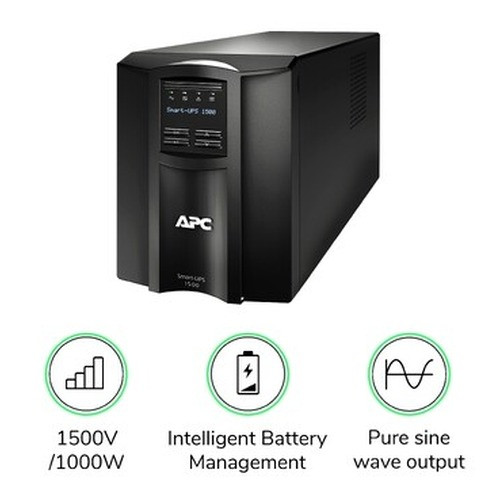
The CP1500PFCLCD is rated at 1500 VA / 1000 W, while the SMT1500J is rated at 1500 VA / 980 W—a 20 W difference in real watt capacity that is negligible in practice. Runtime differences are more significant: the CP1500PFCLCD provides 2.5 minutes at full load (1000 W) and 10 minutes at half load (500 W). The SMT1500J provides 7 minutes at full load and 24 minutes at half load. At both load points the SMT1500J delivers substantially longer runtime—nearly three times longer at full load and 2.4 times longer at half load.
The SMT1500J's runtime advantage almost certainly reflects a larger internal battery capacity, though the exact battery specification (Ah rating) is not stated in the provided SMT1500J specs. The CP1500PFCLCD spec explicitly lists two 12 V / 9 Ah sealed lead-acid cells. Buyers whose primary goal is extended bridge time during outages—protecting a server through a prolonged blackout rather than just a brief dip—will find the SMT1500J's runtime profile markedly superior. The CP1500PFCLCD's recharge time is not stated in its provided specs; the SMT1500J specifies a 4-hour recharge time.
How do the two units compare on outlet count, surge protection, and auxiliary features?
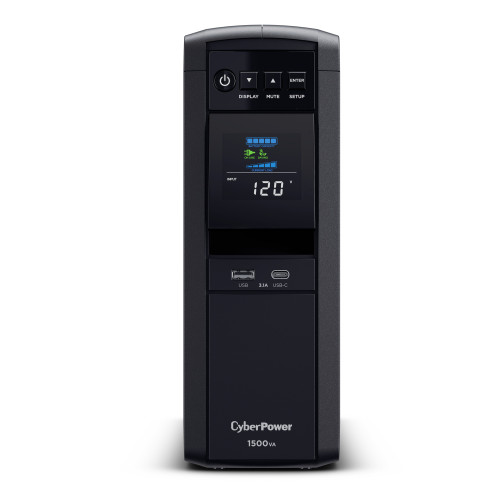
The CP1500PFCLCD provides 12 NEMA 5-15R outlets: 6 with battery backup plus surge protection and 6 with surge protection only. The SMT1500J provides 8 NEMA 5-15R outlets, with no split between backup and surge-only outlets specified beyond the total count of 8 power output connectors. Buyers who need to protect more devices simultaneously or want dedicated surge-only ports for lower-priority peripherals will find the CP1500PFCLCD's 12-outlet layout more flexible.
The CP1500PFCLCD includes RJ45 Ethernet (10/100/1000 Mbps) data line surge protection and two USB charging ports (Type-A + Type-C, 5 V / 2.4 A combined)—neither feature is listed in the SMT1500J's provided specifications. The SMT1500J specifies a surge energy rating of 459 joules and a circuit breaker for overload protection; the CP1500PFCLCD's surge joule rating is not provided in the supplied specs. The SMT1500J also specifies operating humidity range (0–95%) and an audible alarm at 45 dBA; those figures are absent from the CP1500PFCLCD's provided specifications.
Which unit offers stronger remote management capabilities and compliance credentials?
Both units support USB and RS-232/serial management interfaces and both output a pure sine wave under line-interactive topology. The CP1500PFCLCD adds SNMP/HTTP management capability via an optional RMCARD205 accessory card, enabling network-based monitoring without a dedicated management server. The SMT1500J includes one SmartSlot expansion bay, APC's proprietary slot standard that supports optional network management cards and other accessories; the specific cards compatible with the SmartSlot are not enumerated in the provided specs.
On certifications, the CP1500PFCLCD carries UL 1778, cUL 107.3, FCC Class B, RoHS, and ENERGY STAR. The SMT1500J carries UL 1449, UL 1778, VCCI Class A ITE, RoHS Exemption 7b, and REACH. The FCC Class B listing on the CP1500PFCLCD is relevant for residential and mixed-use environments; the SMT1500J's VCCI Class A ITE designation is suited to commercial/industrial IT environments. The CP1500PFCLCD provides a 3-year limited warranty and a $500,000 connected equipment guarantee; the SMT1500J carries a 2-year limited warranty and no connected equipment guarantee figure is stated in its provided specs.
Which should you choose: the CP1500PFCLCD or the SMT1500J?
Our take: The SMT1500J is the stronger choice when runtime is the primary purchase criterion—it provides 7 minutes at full load and 24 minutes at half load versus the CP1500PFCLCD's 2.5 minutes and 10 minutes respectively, a difference that can determine whether a controlled shutdown completes successfully. The CP1500PFCLCD counters with a higher outlet count (12 vs. 8), built-in RJ45 Ethernet surge protection not listed on the SMT1500J, a longer 3-year warranty versus the SMT1500J's 2-year term, and a stated $500,000 connected equipment guarantee absent from the SMT1500J's provided specs. For IT environments running light loads on many devices—edge switches, access control panels, cameras—the CP1500PFCLCD's outlet density and network port protection add practical value. For server rooms where a single high-draw server must survive a prolonged outage, the SMT1500J's runtime advantage is decisive. Both units are suitable for 120 VAC North American environments; the SMT1500J's 100 V input nominal also targets Japanese markets.
Side-by-Side Comparison
Spec-for-spec, from manufacturer data.
| Specification | CyberPower CP1500PFCLCD | APC by Schneider Electric SMT1500J |
|---|---|---|
| Capacity (VA / W) | 1500 VA / 1000 W | 1500 VA / 980 W |
| Topology | Line Interactive | Line Interactive |
| Output Waveform | Pure Sine Wave | Sine Wave |
| Input Voltage Nominal | 120 VAC | 100 VAC |
| Input Voltage Range | 88–144 VAC | 80–123 VAC (adjustable 70–125 VAC) |
| Runtime at Full Load | 2.5 min at 1000 W | 7 min at full load |
| Runtime at Half Load | 10 min at 500 W | 24 min at half load |
| Battery Recharge Time | — | 4 hours |
| Total Outlets | 12 × NEMA 5-15R | 8 × NEMA 5-15R |
| Battery Backup Outlets | 6 | — |
| Surge-Only Outlets | 6 | — |
| Data Line Protection | RJ45 Ethernet (10/100/1000 Mbps) | — |
| Management Interfaces | USB, Serial (DB9), SNMP/HTTP (optional card) | RS-232, USB, SmartSlot (optional card) |
| Display | Multifunction Color LCD | LCD |
| Warranty | 3 Year Limited | 2 Year Limited |
| Connected Equipment Guarantee | $500,000 | — |
| Certifications | UL1778, cUL 107.3, FCC Class B, RoHS, ENERGY STAR | UL 1449, UL 1778, VCCI Class A ITE, RoHS Exemption 7b, REACH |
| Weight | 24.9 lb | 61.95 lb |
Frequently Asked Questions
Which should you choose: the CP1500PFCLCD or the SMT1500J?
The SMT1500J is the stronger choice when runtime is the primary purchase criterion—it provides 7 minutes at full load and 24 minutes at half load versus the CP1500PFCLCD's 2.5 minutes and 10 minutes respectively, a difference that can determine whether a controlled shutdown completes successfully. The CP1500PFCLCD counters with a higher outlet count (12 vs. 8), built-in RJ45 Ethernet surge protection not listed on the SMT1500J, a longer 3-year warranty versus the SMT1500J's 2-year term, and a stated $500,000 connected equipment guarantee absent from the SMT1500J's provided specs. For IT environments running light loads on many devices—edge switches, access control panels, cameras—the CP1500PFCLCD's outlet density and network port protection add practical value. For server rooms where a single high-draw server must survive a prolonged outage, the SMT1500J's runtime advantage is decisive. Both units are suitable for 120 VAC North American environments; the SMT1500J's 100 V input nominal also targets Japanese markets.
Which UPS will keep my server running longer during a power outage—the CP1500PFCLCD or the SMT1500J?
Based on the provided specifications, the SMT1500J delivers significantly longer runtime: 7 minutes at full load (980 W) and 24 minutes at half load, compared to the CP1500PFCLCD's 2.5 minutes at full load (1000 W) and 10 minutes at half load. If runtime during an extended outage is your priority, the SMT1500J has a clear advantage at both load points.
Does either UPS support network-based monitoring without buying extra hardware?
Neither unit provides built-in network monitoring out of the box based on the supplied specs. Both include USB and serial (RS-232/DB9) interfaces as standard. The CP1500PFCLCD supports SNMP/HTTP management via the optional RMCARD205 accessory card. The SMT1500J includes one SmartSlot expansion bay that accepts optional APC network management cards. In both cases, remote network monitoring requires purchasing and installing an add-on card.
Which unit protects more devices and includes better surge coverage for data lines?
The CP1500PFCLCD offers 12 NEMA 5-15R outlets (6 battery+surge, 6 surge-only) versus the SMT1500J's 8 NEMA 5-15R outlets, giving the CyberPower unit an edge for protecting more connected devices. The CP1500PFCLCD also includes RJ45 Ethernet (10/100/1000 Mbps) data line surge protection, which is not listed in the SMT1500J's provided specifications. The SMT1500J specifies a 459-joule surge energy rating; the CP1500PFCLCD's joule rating is not stated in its provided specs.
More UPS Comparisons
- APC by Schneider Electric SMX1500RMI2U vs CyberPower PRL1500RT2UC
- APC by Schneider Electric SMX1500RMI2U vs CyberPower BRG1500AVRLCD2
- APC by Schneider Electric SMX1500RMI2U vs CyberPower PR1500LCD
- APC by Schneider Electric SMX1500RMI2U vs APC by Schneider Electric BR1500MS2
- APC by Schneider Electric SMX1500RMI2U vs APC by Schneider Electric SMTL1500RM3UCUS
- CyberPower PRL1500RT2UC vs APC by Schneider Electric BR1500MS2
UPS Buying Guides
Get a Second Opinion on Your Camera Choice
Share your site layout, coverage goals, and budget. Our team will validate the camera selection, flag anything we would change, and recommend products that match the use case.