
APC by Schneider Electric SMX1500RMI2U vs APC by Schneider Electric SMTL1500RM3UCUS: Specification Comparison
Both units are 1500VA rack-mount line-interactive UPS systems from APC by Schneider Electric, squarely in the same class and device type. The SMX1500RMI2U is a 230 V AC model from the Smart-UPS Extended Runtime line using sealed lead-acid chemistry, while the SMTL1500RM3UCUS is a 120 V AC TAA-compliant Smart-UPS with lithium-ion chemistry and a short-depth rack form factor. Buyers in facilities planning, IT procurement, and physical-security integration will cross-shop these when evaluating runtime longevity, battery replacement cycles, rack footprint, and input voltage requirements.
In This Guide
- Which UPS delivers more usable power and how do runtime and recharge characteristics differ?
- How do battery type, expected service life, and long-term ownership cost compare?
- How do rack footprint, connectivity, certifications, and operating environment specifications compare?
- Which should you choose: the SMX1500RMI2U or the SMTL1500RM3UCUS?
- Side-by-Side Specs
- FAQ
Which UPS delivers more usable power and how do runtime and recharge characteristics differ?
The SMX1500RMI2U is rated at 1500 VA / 1200 W with a maximum configurable power of 1200 W. The SMTL1500RM3UCUS lists a maximum configurable power of 1350 W / 1440 VA — slightly higher on watts but lower on stated VA ceiling. Note that the SMTL1500RM3UCUS spec sheet does not separately state a nominal rated VA/W output figure distinct from its configurable maximum, so a direct apples-to-apples watts comparison carries some uncertainty.
Battery chemistry drives a meaningful recharge difference: the lead-acid SMX1500RMI2U requires approximately 3 hours to recharge, while the lithium-ion SMTL1500RM3UCUS reaches full charge in approximately 2 hours — a 33% faster recovery after an outage. The SMTL1500RM3UCUS also provides higher battery charging power at 154 W versus 103 W rated for the SMX1500RMI2U, supporting that faster recharge rate. Neither spec sheet supplies a runtime table in the provided data; actual runtime at a given load is not comparable from the specs as presented.
Output voltage distortion for both models is specified as less than 5% THD, and both output a sine wave synchronized to mains at 50/60 Hz ±3 Hz, confirming equivalent output power quality for connected loads.
How do battery type, expected service life, and long-term ownership cost compare?
This is the sharpest differentiator between the two models. The SMX1500RMI2U uses a sealed lead-acid battery with an expected service life of 3–5 years and a specified replacement battery unit of APCRBC115. The SMTL1500RM3UCUS uses lithium-ion chemistry rated for 5–10 years — up to twice the service life. Over a 10-year deployment window, the lead-acid model may require two battery replacements versus zero or one for the lithium-ion model, with associated labor, disposal, and parts costs.
The SMTL1500RM3UCUS battery volt-amp-hour capacity is specified at 310 VAh. The SMX1500RMI2U does not provide a VAh figure in the supplied specs. Weight provides an indirect proxy for battery mass: the SMX1500RMI2U weighs 24.82 kg (54.7 lb) versus 19.5 kg (43 lb) for the SMTL1500RM3UCUS, consistent with lead-acid being denser than lithium-ion for comparable energy storage.
The SMX1500RMI2U spec notes an 'Extended Run' designation and includes one free expansion slot, suggesting external battery pack support for extended runtime — a feature not mentioned in the SMTL1500RM3UCUS specs as provided.
How do rack footprint, connectivity, certifications, and operating environment specifications compare?
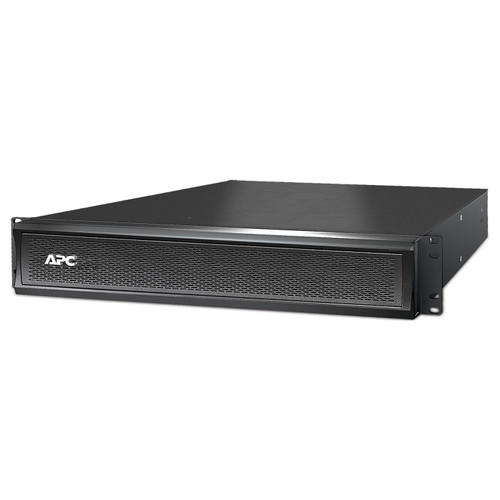
The SMX1500RMI2U occupies 2U of rack space. The SMTL1500RM3UCUS is a 3U unit with a short-depth chassis measuring 11.89 inches (302 mm) deep — depth is not specified for the SMX1500RMI2U in the provided data. The SMTL1500RM3UCUS physical dimensions are 131 mm H × 438 mm W × 302 mm D. The SMX1500RMI2U lists only a height dimension of 89 mm (consistent with 2U) in the provided specs; full dimensional data is otherwise absent.
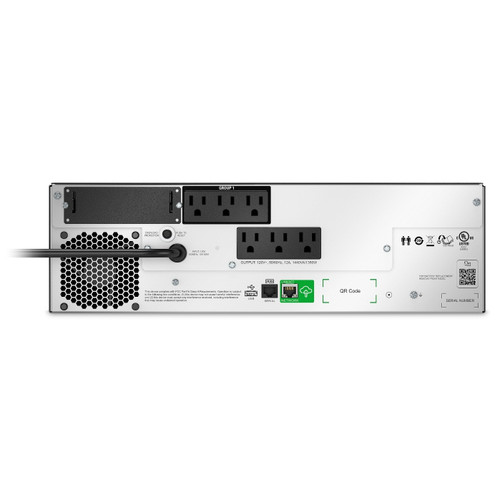
Connectivity differs at the interface level: the SMX1500RMI2U provides a serial port, USB port, and one available expansion slot. The SMTL1500RM3UCUS lists RJ-45 Serial, Smart-Slot, and USB — adding SmartConnect cloud management capability implied by the 'SmartConnect' designation in the product name, though specific SmartConnect feature specs are not detailed in the provided data. Output receptacles are specified only for the SMX1500RMI2U: 8× IEC 320 C13 plus 2× IEC jumper outlets; the SMTL1500RM3UCUS outlet configuration is not listed in the provided specs.
The SMX1500RMI2U is a 230 V AC input unit (IEC 320 C14 inlet, 10 A) certified for CE, CSA, EAC, RCM, and UK PSTI markets. The SMTL1500RM3UCUS is a 120 V AC unit (North American market, TAA-compliant) with approvals under CSA C22.2 No. 107.3, UL 1778, UL 1973, FCC Part 15 Class A, and NOM — the two units serve entirely different mains voltage markets. Both specify an operating elevation of 0–10,000 ft and operating relative humidity of 0–95%. The SMX1500RMI2U adds a storage altitude of up to 15,240 m versus 7,620 m (25,000 ft) for the SMTL1500RM3UCUS. Acoustic output is 40 dBA for the SMX1500RMI2U; not specified for the SMTL1500RM3UCUS. Heat dissipation is virtually identical: 133 BTU/hr (SMX1500RMI2U) versus 135 BTU/hr (SMTL1500RM3UCUS).
Surge energy rating is 645 J for the SMX1500RMI2U and 680 J for the SMTL1500RM3UCUS. Noise filtering IEEE surge let-through is stated as 5% for the SMX1500RMI2U and 0.3% for the SMTL1500RM3UCUS — the SMTL1500RM3UCUS specifies significantly lower surge let-through, which is favorable for sensitive connected equipment.
Which should you choose: the SMX1500RMI2U or the SMTL1500RM3UCUS?
Our take: The SMX1500RMI2U is the stronger choice when the installation is on a 230 V AC mains infrastructure and rack space is limited to 2U, while the SMTL1500RM3UCUS is the correct selection for 120 V AC North American deployments requiring a longer battery service life and TAA compliance. Three concrete spec deltas are decisive: (1) battery life — lithium-ion in the SMTL1500RM3UCUS is rated 5–10 years versus 3–5 years lead-acid in the SMX1500RMI2U, directly reducing total lifecycle replacement cost; (2) recharge time — 2 hours versus 3 hours favors the SMTL1500RM3UCUS for faster post-outage recovery; (3) surge let-through — 0.3% IEEE versus 5% IEEE gives the SMTL1500RM3UCUS meaningfully better transient suppression. These two models are not substitutes: input voltage (230 V vs 120 V) makes the choice geography-driven before any feature comparison applies.
Side-by-Side Comparison
Spec-for-spec, from manufacturer data.
| Specification | APC by Schneider Electric SMX1500RMI2U | APC by Schneider Electric SMTL1500RM3UCUS |
|---|---|---|
| Input Voltage | 230 V AC | 120 V AC |
| Input Connection | IEC 320 C14 | Not specified in provided specs |
| Input Current | 10 A | Not specified in provided specs |
| Rated Power (VA) | 1500 VA | Not separately stated (max configurable: 1440 VA) |
| Rated Power (W) | 1200 W | Not separately stated (max configurable: 1350 W) |
| UPS Topology | Line Interactive | Line Interactive |
| Waveform Type | Sine Wave | Sine Wave |
| Output Voltage | 230 V AC | Not specified in provided specs |
| Output Voltage Distortion | Less than 5% | Less than 5% |
| Battery Type | Lead-Acid | Lithium-Ion |
| Expected Battery Life | 3–5 years | 5–10 years |
| Typical Recharge Time | 3 hours | 2 hours |
| Battery Charge Power | 103 W | 154 W |
| Surge Energy Rating | 645 J | 680 J |
| IEEE Surge Let-Through | 5% | 0.3% |
| Transfer Time | Not specified in provided specs | 6 ms typical / 10 ms maximum |
| Rack Units | 2U | 3U |
| Unit Weight | 24.82 kg (54.7 lb) | 19.5 kg (43 lb) |
| Heat Dissipation | 133 BTU/hr | 135 BTU/hr |
| Connectivity Ports | Serial, USB, 1 expansion slot | RJ-45 Serial, Smart-Slot, USB |
| Output Outlets | 8× IEC 320 C13 + 2× IEC jumper | Not specified in provided specs |
| TAA Compliant | Not specified | Yes |
| Noise Acoustic Level | 40 dBA | Not specified in provided specs |
| Replacement Battery | APCRBC115 | Not specified in provided specs |
| Operating Temperature | Not specified in provided specs | 0° to 40°C (32° to 104°F) |
| Storage Temperature | -15° to 45°C | -10° to 40°C |
Frequently Asked Questions
Which should you choose: the SMX1500RMI2U or the SMTL1500RM3UCUS?
The SMX1500RMI2U is the stronger choice when the installation is on a 230 V AC mains infrastructure and rack space is limited to 2U, while the SMTL1500RM3UCUS is the correct selection for 120 V AC North American deployments requiring a longer battery service life and TAA compliance. Three concrete spec deltas are decisive: (1) battery life — lithium-ion in the SMTL1500RM3UCUS is rated 5–10 years versus 3–5 years lead-acid in the SMX1500RMI2U, directly reducing total lifecycle replacement cost; (2) recharge time — 2 hours versus 3 hours favors the SMTL1500RM3UCUS for faster post-outage recovery; (3) surge let-through — 0.3% IEEE versus 5% IEEE gives the SMTL1500RM3UCUS meaningfully better transient suppression. These two models are not substitutes: input voltage (230 V vs 120 V) makes the choice geography-driven before any feature comparison applies.
Can I use either of these UPS units in a North American 120 V AC facility?
Only the SMTL1500RM3UCUS is designed for 120 V AC input and carries North American approvals (UL 1778, CSA C22.2 No. 107.3, FCC Part 15 Class A). The SMX1500RMI2U is specified for 230 V AC input with an IEC 320 C14 inlet and holds CE, UK PSTI, and other international certifications — it is not rated for 120 V AC mains. Input voltage is a hard constraint, not a configuration preference.
Which model will cost less to maintain over a 10-year rack deployment?
Based on specified battery life alone, the SMTL1500RM3UCUS lithium-ion battery is rated for 5–10 years versus 3–5 years for the lead-acid APCRBC115 in the SMX1500RMI2U. Over a decade, the SMX1500RMI2U may require one to two battery replacements (parts, labor, and disposal) while the SMTL1500RM3UCUS may require none or one. Actual total cost of ownership depends on local labor rates and battery pricing, which are not in the provided specs.
Is the SMTL1500RM3UCUS suitable for government or federally funded projects requiring TAA compliance?
Yes. The SMTL1500RM3UCUS is explicitly designated TAA-compliant in its product name and specifications, making it appropriate for US federal procurement and projects subject to the Trade Agreements Act. The SMX1500RMI2U spec sheet does not mention TAA compliance, and its certification set (CE, UK PSTI, EAC, RCM) targets international markets rather than US federal procurement requirements.
More UPS Comparisons
- APC by Schneider Electric SMX1500RMI2U vs CyberPower PRL1500RT2UC
- APC by Schneider Electric SMX1500RMI2U vs CyberPower BRG1500AVRLCD2
- APC by Schneider Electric SMX1500RMI2U vs CyberPower PR1500LCD
- APC by Schneider Electric SMX1500RMI2U vs APC by Schneider Electric BR1500MS2
- CyberPower PRL1500RT2UC vs APC by Schneider Electric BR1500MS2
- CyberPower PRL1500RT2UC vs APC by Schneider Electric SMTL1500RM3UCUS
UPS Buying Guides
Get a Second Opinion on Your Camera Choice
Share your site layout, coverage goals, and budget. Our team will validate the camera selection, flag anything we would change, and recommend products that match the use case.