
Best Rackmount UPS for a Data Center
Rackmount UPS for data center and IDF racks — 3 kVA and up, online topology, extended-runtime battery options, and SNMP management cards.

Eden Phillips
Networking & Infrastructure Specialist · Working integrator
Bottom line
For data center and IDF rack deployments, online double-conversion topology is the non-negotiable baseline — it conditions power continuously rather than switching on sag, which matters for sensitive networking and compute gear. Match kVA class to your actual load plus a 20–25% headroom buffer, confirm your runtime requirements drive battery extension decisions, and treat SNMP management as a required feature, not an upgrade, for any rack you can't physically reach in seconds. The six models listed here span 3 kVA through 10 kVA and cover the most common rackmount deployment scenarios in commercial IDF, MDF, and edge data center environments.
What This Setup Needs
Rackmount UPS selection for data center and IDF racks is an exercise in matching topology, capacity, runtime, power architecture, and manageability to your specific load profile and facility constraints — get any one of these wrong and you either over-spend or under-protect.
- Topology (Online Double-Conversion vs. Line-Interactive): Online double-conversion regenerates output power continuously from the inverter — the load never sees raw utility voltage and there is zero transfer time on outage. Line-interactive is cheaper but has a 4–8 ms transfer window and passes through conducted noise between corrections. For racks housing switches, servers, or storage, online topology is the correct choice.
- kVA/kW Capacity and Power Factor: Size to your actual measured load (use a clamp meter, not nameplate totals) plus 20–25% headroom for efficiency and future adds. Note the difference between VA and watts: a 3000VA unit at 0.9 power factor delivers 2,700W — spec the watt figure against your load, not the VA headline.
- Input/Output Voltage and Step-Down Transformers: IDF and edge racks fed from 208V branch circuits but running 120V ITE equipment need a step-down transformer — either integral to the UPS or as a separate bypass unit. Confirm input voltage compatibility before ordering; a 120V UPS on a 208V circuit without transformation is a wiring problem, not a UPS problem.
- Extended Runtime and External Battery Compatibility: Standard internal batteries typically deliver 5–10 minutes at full load. If your recovery or generator-start SLA requires 20–30+ minutes, verify the UPS supports external battery modules (EBM/XR) and confirm rack U-space for them. Runtime curves are published by the manufacturer — consult them at your actual load, not rated load.
- SNMP/Network Management Card: In any data center environment you must be able to query UPS status, configure shutdown sequences, and receive SNMP traps from your NMS — remotely, without physical access. Some units ship with a management card slot and require a separately purchased card; others include it. Confirm which applies before purchasing.
- Form Factor and Rack Unit Height: 2U is the standard for 3–5 kVA units; larger kVA classes may step to 3U or more. In dense IDF enclosures where every U counts, verify the UPS height including any cable management clearance. Also confirm output receptacle type and quantity match your PDU or direct-connected load.
- Certifications and Warranty: Confirm UL 1778 listing for the installation environment. For healthcare, finance, or government sites, verify any additional compliance requirements. Factor in warranty length and whether on-site service contracts are available — a UPS protecting $200K of active network gear should carry a multi-year service agreement.
Our Picks
Selected from our catalog by spec-fit. All channel-direct and factory-new — not ranked by price.
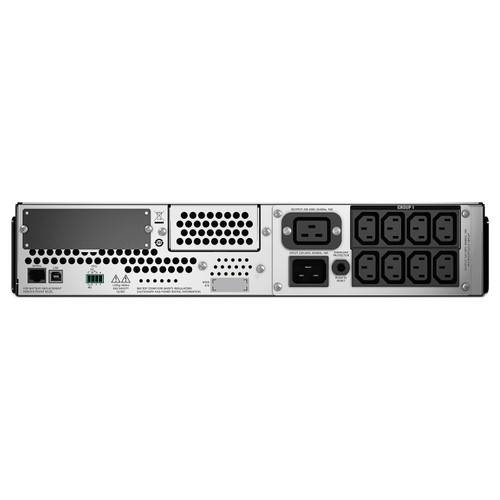
APC by Schneider Electric SMT3000RMI2U
3000VA
The APC Smart-UPS SMT3000RMI2U is a 3000VA line-interactive rackmount unit in a 2U form factor, well-suited for IDF closets and edge racks where budget is a constraint and the connected load — managed switches, access layer gear, small NVRs — can tolerate the line-interactive transfer window. It supports APC's SmartConnect and optional Network Management Cards for SNMP visibility, and its wide ecosystem of compatible external battery modules makes runtime extension straightforward.
View product →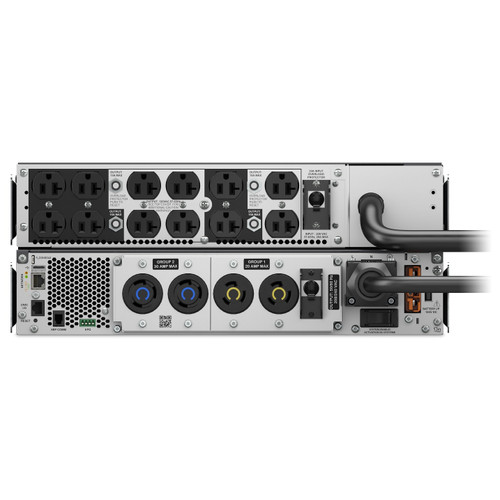
APC by Schneider Electric SRTL5KRM2UT-5KRMTF
5kVA
The APC Smart-UPS SRTL5KRM2UT-5KRMTF is a 5kVA online double-conversion unit with an integral step-down transformer that accepts 208V input and delivers 120V output — a strong fit when your branch circuit infrastructure runs 208V but your IDF or edge rack load is 120V ITE equipment such as switches, servers, and cameras. The 2U chassis keeps the footprint compact, and the online topology means zero transfer time and full input voltage conditioning for sensitive loads.
View product →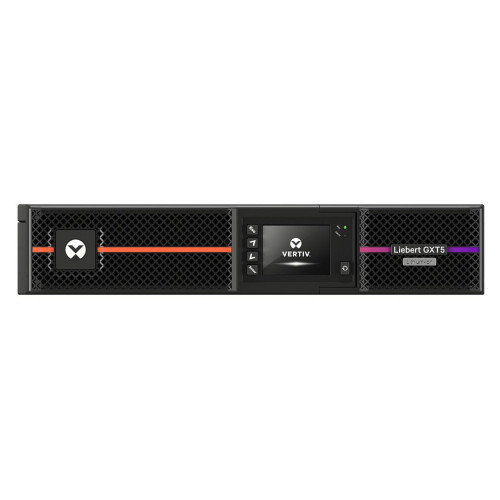
Vertiv GXT5-3000LVRT2UXL
3000VA
The Vertiv Liebert GXT5-3000LVRT2UXL is a 3000VA online double-conversion unit with USB, serial, and SNMP connectivity included, making it well-suited for data center and IDF racks where you need true online protection at 3kVA with management interfaces ready without additional card purchases. Its extended battery module support and Vertiv's Liebert monitoring ecosystem make it a strong fit for environments already standardized on Vertiv infrastructure.
View product →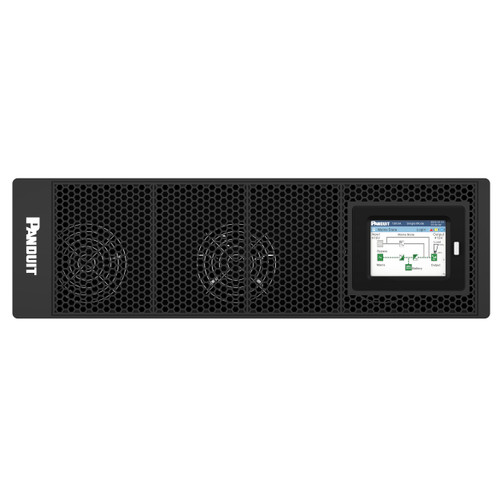
Panduit U10N32V
10kVA
The Panduit U10N32V is a 10kVA rackmount UPS well-suited for MDF, main distribution, or core data center racks where aggregate load from high-density switching, server clusters, or storage exceeds what a 3–5kVA unit can cover. At this capacity class, it is a strong fit for consolidating protection across multiple high-draw devices in a single chassis rather than deploying multiple smaller units per rack.
View product →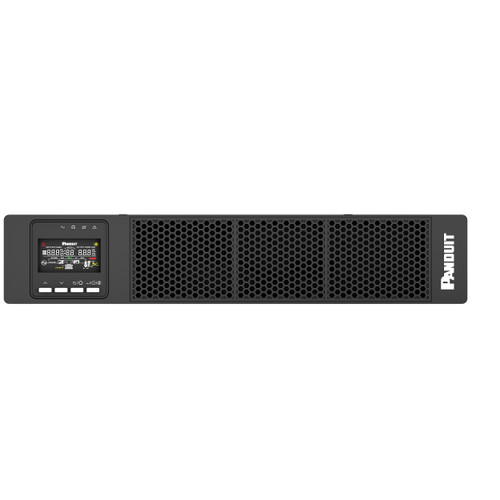
Panduit U03S12L
3kVA
The Panduit U03S12L is a 3kVA AC rackmount UPS with Ethernet connectivity, making it well-suited for IDF and edge deployments where network-accessible management is required and physical access for status checks is not practical. Its Ethernet management interface fits naturally into environments where SNMP-based NMS monitoring is the operational standard and a management card slot approach would add unnecessary complexity.
View product →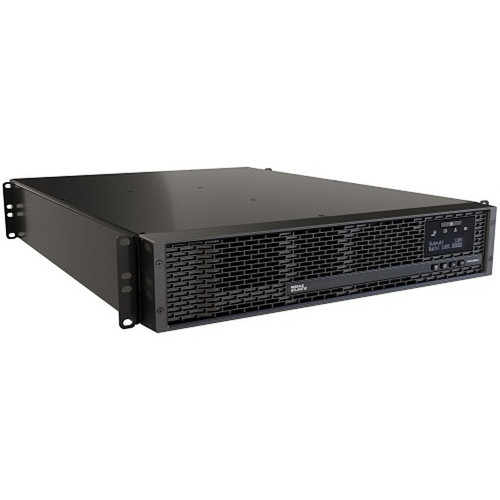
Middle Atlantic OL3000R-2
3000VA
The Middle Atlantic OL3000R-2 is a 3000VA online double-conversion rackmount UPS rated for 0°–40°C operating temperature, making it a strong fit for IDF closets, security equipment rooms, and AV/IT racks where ambient temperature management is imperfect and line-interactive topology would introduce unacceptable transfer risk. Middle Atlantic's integration-focused design makes it particularly well-suited for custom rack builds where cable management and form-factor consistency with other Middle Atlantic enclosure products are priorities.
View product →Frequently Asked Questions
What is the difference between online double-conversion and line-interactive UPS for rack use?
Online double-conversion continuously powers the load from the inverter — utility power charges the battery, the inverter powers the load, and there is zero transfer time during an outage or voltage anomaly. Line-interactive corrects voltage sags and surges using an autotransformer but passes utility power directly to the load under normal conditions, switching to battery in 4–8 ms on outage. For racks with managed switches, servers, or storage, online topology is preferred because it also eliminates conducted noise and harmonic distortion on the output. Line-interactive is an acceptable cost trade-off for less sensitive loads like IP cameras or access control panels.
How do I size a UPS for my data center or IDF rack?
Measure your actual load with a clamp meter or PDU with metering — nameplate totals on equipment routinely overstate real draw by 40–60%. Add 20–25% headroom above your measured watt load for efficiency losses and future adds. Convert to VA by dividing watts by the UPS power factor (typically 0.9 for modern online units). Then select the next standard capacity tier above your calculated VA requirement. For example, a 1,900W measured load at 0.9 PF = approximately 2,111VA — a 3000VA unit at that power factor gives you roughly 700W of headroom.
Do I need a step-down transformer UPS if my branch circuit is 208V but my equipment is 120V?
Yes. If your PDU or UPS input is wired to a 208V branch circuit but your connected equipment — servers, switches, NVRs — requires 120V, you need a step-down transformer in the power path. Some UPS models integrate this transformer (like the SRTL5KRM2UT-5KRMTF), which simplifies the installation. Others require a separate transformer module. Never assume a 120V UPS will auto-adapt to 208V input — it will not, and connecting it incorrectly will damage both the UPS and the connected load.
What does SNMP management on a UPS actually give me in a data center environment?
SNMP management lets your network management system (NMS) poll UPS status variables — input voltage, output load percentage, battery state of charge, estimated runtime, temperature — and receive SNMP traps for alarm conditions like on-battery, low battery, and overload. Combined with shutdown agents installed on protected servers, it enables graceful OS-level shutdown before battery depletion during extended outages. In any rack you cannot reach within minutes, this is operationally essential, not optional. Verify whether the unit ships with a network management card or requires one purchased separately.
How much runtime can I expect from a 3kVA rackmount UPS at data center load?
Runtime depends entirely on actual load, not rated capacity. A 3kVA online UPS at 50% load (roughly 1,350W for a 0.9 PF unit) typically delivers 8–12 minutes on internal batteries. At 100% load, that drops to 3–5 minutes. If your generator start and transfer SLA is 30+ seconds, internal runtime is adequate for most deployments; if you are covering extended outages or have no generator, external battery modules are required. Always consult the manufacturer's published runtime curve at your specific watt load — do not estimate.
Can I add external battery modules later to extend runtime?
Most commercial-grade rackmount UPS units in the 3–10kVA class support external battery modules (EBMs or XR packs) that connect to a dedicated battery bus on the UPS. However, compatibility is model-specific — not every battery module works with every UPS, and some units limit the number of EBMs that can be stacked. Verify EBM compatibility and maximum expansion capacity before purchasing if extended runtime is a project requirement. Also account for the additional rack U-space and weight of battery modules in your rack planning.
Related Resources
- UPS comparisons — head-to-head spec matchups
- UPS Buying Guide for Network & Security Systems
- Best UPS for a Network Rack or NVR
- Best UPS for a Server Room
- All product comparisons
Speccing this for a project?
Send us your requirements and our senior specialists will confirm specs, compatibility, availability and pricing — free, usually within one business day. Channel-direct, factory-new, serving commercial integrators since 2014.
Get a Free QuoteComparing for a project?
Send us the models you are weighing and our team will confirm specs, compatibility, availability, and pricing — free, usually within one business day.