
CyberPower CP1350PFCLCD vs APC by Schneider Electric BR1350MS: Specification Comparison
Both the CyberPower CP1350PFCLCD and the APC BR1350MS are 1350 VA line-interactive tower UPS units designed for desktop workstations, small servers, and network gear operating on 120 V North American power. Each delivers pure/simulated sine wave output with automatic voltage regulation, making them natural cross-shop candidates for buyers seeking runtime protection and power conditioning at the sub-1.5 kVA tier. This comparison examines runtime and watt capacity, outlet layout and protection features, and connectivity plus management software—the three axes that most differentiate this product class.
In This Guide
Which UPS delivers more usable runtime and watt capacity for your load?
The CP1350PFCLCD is rated at 880 W, giving it 70 W more usable watt capacity than the BR1350MS's 810 W. At half load (440 W), CyberPower specifies 8 minutes of runtime; at full load (880 W) it drops to 2 minutes. APC does not publish a runtime curve in the provided specifications—only hold times of 8–10 ms are listed, which describe transfer time, not sustained battery runtime. Buyers who need to confirm runtime for a specific wattage load will need to consult APC's runtime charts separately, as that data is absent from the BR1350MS spec sheet provided here.
The 70 W advantage on the CP1350PFCLCD matters primarily when loads sit close to the rated ceiling. A workstation drawing 750–800 W leaves tighter headroom on the BR1350MS. Both units share the same 1350 VA apparent-power ceiling, so power-factor-corrected (PFC) active power supplies—common in modern workstations—will extract roughly similar peak apparent power from either unit.
How do outlet count, surge joule rating, and line protection compare?
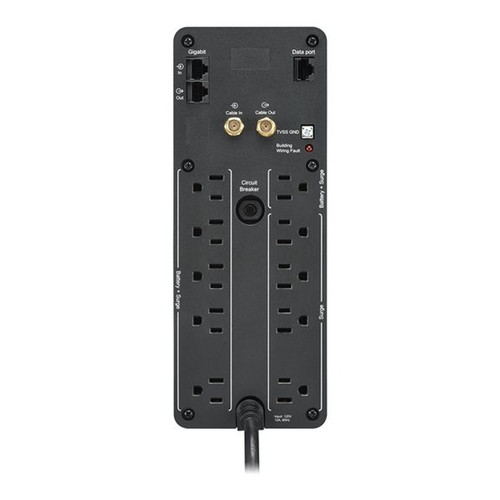
The CP1350PFCLCD provides 12 NEMA 5-15R outlets: 6 battery-backed and 6 surge-only. The BR1350MS's outlet count and battery-backed breakdown are not stated in the provided specifications. APC publishes a surge energy rating of 1,080 J and explicitly lists coax and network surge protection, as well as EMI/RFI noise filtering and an audible alarm. CyberPower lists RJ45 10/100/1000 Mbps network protection but does not publish a joule rating in the provided spec sheet.
APC's noise level is rated at 45 dB, and the BR1350MS maximum input operating voltage ceiling is 147 V versus CyberPower's 144 V—a minor difference. Both units confirm automatic voltage regulation. EMI/RFI filtering is explicitly confirmed for the BR1350MS; the CP1350PFCLCD specification does not mention EMI/RFI filtering. Buyers protecting audio, broadcast, or sensitive lab equipment where conducted noise matters should note this gap in the CyberPower documentation.
Which unit offers better connectivity and software management options?
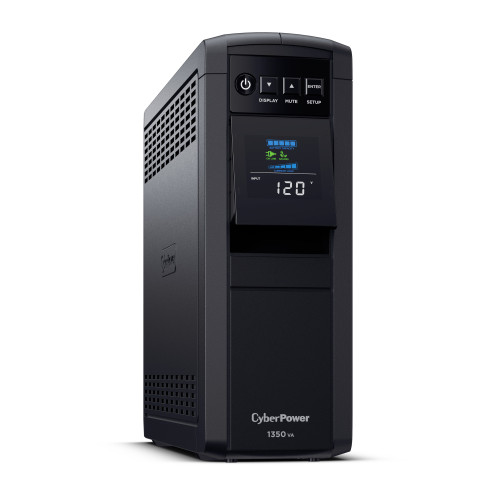
The CP1350PFCLCD includes USB, relay contacts, and RJ45 network protection ports, paired with a multifunction color LCD display and CyberPower's PowerPanel Personal software supporting Windows, macOS, and Linux. The color LCD enables at-a-glance monitoring of load, battery charge, input voltage, and estimated runtime without a connected computer.
The BR1350MS specification provided here does not list USB, serial, or network management card ports, software bundle, or a front-panel display. APC's broader product line commonly offers these features, but they cannot be attributed to this model from the data supplied. Buyers requiring OS-agnostic graceful shutdown software or local visual monitoring should verify BR1350MS connectivity specs directly with APC before purchase, as those details are absent from the provided documentation.
Which should you choose: the CP1350PFCLCD or the BR1350MS?
Our take: The CP1350PFCLCD is the stronger choice when verified watt capacity, outlet count, display feedback, and cross-platform software are priorities. CyberPower's 880 W rating beats the BR1350MS's 810 W by 70 W, its 12-outlet layout (6 battery + 6 surge) versus an unspecified BR1350MS outlet count gives installers more flexibility, and its color LCD plus PowerPanel Personal for Windows/macOS/Linux provides immediate local monitoring and graceful shutdown capability—none of which are confirmed in the BR1350MS spec sheet provided. The BR1350MS holds a narrow edge in explicitly confirmed surge joule rating (1,080 J), documented EMI/RFI noise filtering, and a stated noise level of 45 dB—useful for environments sensitive to conducted interference. Buyers deploying APC-centric infrastructure with existing APC management software ecosystems may prefer the BR1350MS for platform continuity, but should independently verify its runtime curve, outlet layout, and connectivity options before committing.
Side-by-Side Comparison
Spec-for-spec, from manufacturer data.
| Specification | CyberPower CP1350PFCLCD | APC by Schneider Electric BR1350MS |
|---|---|---|
| Topology | Line Interactive | Line Interactive |
| Capacity (VA) | 1350 VA | 1350 VA |
| Capacity (Watts) | 880 W | 810 W |
| Output Waveform | Pure Sine Wave | Sine |
| Input Voltage Range | 88–144 VAC | 88–147 VAC |
| Transfer Time | <10 ms | 8–10 ms |
| Total Outlets | 12 × NEMA 5-15R | — |
| Battery-Backed Outlets | 6 × NEMA 5-15R | — |
| Surge-Only Outlets | 6 × NEMA 5-15R | — |
| Surge Energy Rating (J) | — | 1,080 J |
| EMI/RFI Filtering | — | Yes |
| Noise Level | — | 45 dB |
| Connectivity | USB, Relay Contacts, RJ45 | — |
| Display | Multifunction Color LCD | — |
| Management Software | PowerPanel Personal (Win/macOS/Linux) | — |
| Certifications | UL 1778, cUL, FCC Class B, RoHS, ENERGY STAR | — |
Frequently Asked Questions
Which should you choose: the CP1350PFCLCD or the BR1350MS?
The CP1350PFCLCD is the stronger choice when verified watt capacity, outlet count, display feedback, and cross-platform software are priorities. CyberPower's 880 W rating beats the BR1350MS's 810 W by 70 W, its 12-outlet layout (6 battery + 6 surge) versus an unspecified BR1350MS outlet count gives installers more flexibility, and its color LCD plus PowerPanel Personal for Windows/macOS/Linux provides immediate local monitoring and graceful shutdown capability—none of which are confirmed in the BR1350MS spec sheet provided. The BR1350MS holds a narrow edge in explicitly confirmed surge joule rating (1,080 J), documented EMI/RFI noise filtering, and a stated noise level of 45 dB—useful for environments sensitive to conducted interference. Buyers deploying APC-centric infrastructure with existing APC management software ecosystems may prefer the BR1350MS for platform continuity, but should independently verify its runtime curve, outlet layout, and connectivity options before committing.
Does the CP1350PFCLCD or BR1350MS give me more runtime for a typical workstation load?
The CP1350PFCLCD specifies 8 minutes at 440 W (half load) and 2 minutes at its full 880 W rating. The BR1350MS runtime curve is not provided in the available specifications—only an 8–10 ms transfer hold time is listed. For a confirmed runtime figure on the BR1350MS at your specific wattage, you will need to consult APC's published runtime charts directly.
Which UPS is better if I need to protect network equipment from surges and line noise?
The BR1350MS explicitly states a 1,080 J surge energy rating, coax and network surge protection, and EMI/RFI noise filtering. The CP1350PFCLCD lists RJ45 10/100/1000 Mbps network protection but does not publish a joule rating or confirm EMI/RFI filtering in the provided spec sheet. If documented line-noise filtering is a hard requirement, the BR1350MS has the edge based on available data.
Can I monitor and manage either UPS from my PC without proprietary hardware?
The CP1350PFCLCD includes USB connectivity and ships with PowerPanel Personal software for Windows, macOS, and Linux, enabling graceful shutdown and monitoring. The BR1350MS specification provided does not list a USB port, management interface, or bundled software. Buyers needing OS-agnostic software-driven management should confirm BR1350MS connectivity with APC before purchase.
More UPS Comparisons
- APC by Schneider Electric BN1350M2-CA vs CyberPower CP1350PFCLCD
- APC by Schneider Electric BN1350M2-CA vs Vertiv PSA6-1350LVT
- APC by Schneider Electric BN1350M2-CA vs APC by Schneider Electric BN1350M2
- APC by Schneider Electric BN1350M2-CA vs APC by Schneider Electric BR1350MS
- CyberPower CP1350PFCLCD vs APC by Schneider Electric BN1350M2
- CyberPower CP1350PFCLCD vs APC by Schneider Electric BX1350M
UPS Buying Guides
Get a Second Opinion on Your Camera Choice
Share your site layout, coverage goals, and budget. Our team will validate the camera selection, flag anything we would change, and recommend products that match the use case.