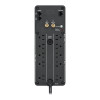
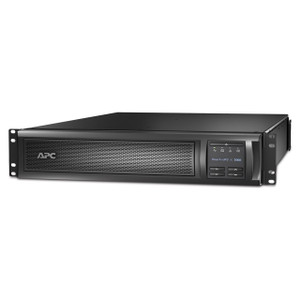
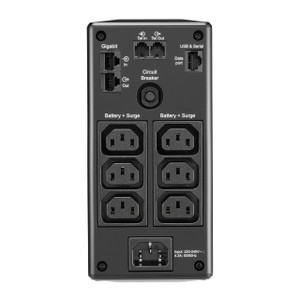
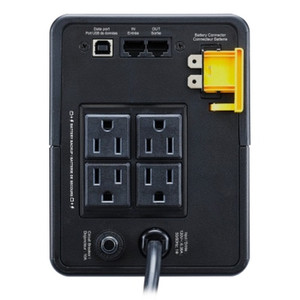
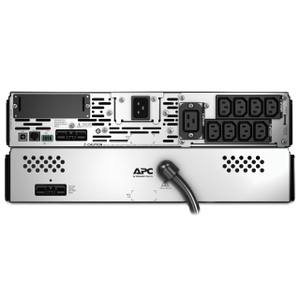
APC by Schneider Electric BR1350MS Line-Interactive Tower UPS — 1350VA / 810W
Overview
The APC BR1350MS is a 1350VA / 810W line-interactive tower UPS engineered for business workstations, network closets, security NVR stacks, and point-of-sale systems that cannot tolerate even a momentary power interruption. At its core is a pure sine wave output — not the stepped approximation you find on entry-level units — which matters when you're protecting active PFC power supplies found in modern servers, NVRs, and audio-sensitive equipment. Automatic Voltage Regulation (AVR) corrects input swings between 88 V and 147 V without touching the battery, so routine brownouts and overvoltages don't erode your runtime reserve over time. For integrators speccing power protection into UPS and power protection systems, the BR1350MS sits at the practical sweet spot between desktop-class and rack-mounted infrastructure UPS units.
Key Features
- 810 W / 1350 VA Output Capacity: Enough headroom to carry a mid-range NVR with four to six drives, a PoE switch, and a workstation simultaneously — or a single high-draw server through a graceful shutdown sequence. Running loads at 60–75% of rated capacity (roughly 486–607 W) maximizes runtime; overloading past 810 W trips the overload alarm.
- Pure Sine Wave Output: Active PFC power supplies — standard in modern rack servers, Axis/Hanwha/i-PRO NVRs, and enterprise workstations — require a clean sine wave to operate correctly. Stepped approximation waveforms from cheaper UPS units can cause these PSUs to buzz, throttle, or shut off entirely. The BR1350MS delivers a true sine wave on battery, eliminating that risk.
- Automatic Voltage Regulation (88–147 V range): AVR steps voltage up or down within a 59-volt window without switching to battery. In environments with chronic undervoltage (older commercial buildings, long cable runs from the panel), this extends battery life significantly versus units that switch to battery on every sag.
- 1080 J Surge Energy Rating with Coax and Network Protection: The 1080-joule surge clamp handles most utility-level transients. Critically, the BR1350MS also includes surge protection on coax and network ports — useful for camera head-end equipment where unprotected RJ-45 and coax runs from outdoor cameras are a real surge path.
- Line-Interactive Topology: Sits between offline (no regulation) and online double-conversion (always on inverter). Transfer time is 8–10 ms — fast enough for nearly all standard ATX and server power supplies, which hold up 16–20 ms on their own capacitors. If your load requires zero-transfer-time protection, an online double-conversion unit is the correct call instead.
- EMI/RFI Noise Filtering: Filters conducted noise on the input line before it reaches connected equipment. Relevant in industrial or mixed-use electrical environments where variable-frequency drives, HVAC compressors, or fluorescent lighting introduce line noise that can cause intermittent resets on sensitive network gear.
- 45 dB Noise Level: Quieter than a typical office printer at idle. In open-plan offices or reception areas where the UPS lives near staff, 45 dB is unobtrusive — roughly equivalent to a quiet conversation at distance.
- Audible Alarm System: On-battery, overload, and low-battery conditions all trigger distinct audible alerts. No dedicated monitoring software required for basic fault awareness — useful in small deployments without a full DCIM stack.
- USB Connectivity: USB interface enables graceful OS shutdown via APC's PowerChute software before the battery is fully depleted — critical for NVR systems where abrupt power loss risks database corruption on recording drives. Compatible with standard UPS monitoring integrations.
Integration and Compatibility
The BR1350MS integrates with APC's PowerChute software suite via USB for automated shutdown sequencing, runtime monitoring, and event logging. The 120 V / 60 Hz single-phase output and NEMA outlet format are standard for North American IT and security deployments. At 12 A maximum output current, confirm your connected load's aggregate draw stays below that figure — a mix of a mid-range NVR (3–5 A), a PoE switch (2–4 A), and a workstation (4–6 A) approaches the ceiling. For deeper power protection planning in multi-device security head-end closets, verify per-outlet load distribution. The tower form factor fits on a shelf, under a desk, or beside rack equipment — it is not rack-mountable in this configuration. Integrators deploying network video recorders alongside this unit should confirm NVR PSU compatibility with sine wave output; virtually all commercial NVRs qualify, but it is worth verifying against manufacturer specs for any custom-built Linux appliances. For larger installations requiring extended runtime or rack-mount form factor, consider a higher-VA model within the APC by Schneider Electric Back-UPS Pro or Smart-UPS line. A compatible PoE switch sized to the camera count should be protected on the same UPS circuit to avoid losing network connectivity when utility power drops.
Frequently Asked Questions
Q: What is the difference between line-interactive and online double-conversion UPS topology, and which does the BR1350MS use?
A: The BR1350MS uses line-interactive topology. In this mode, the inverter corrects voltage sags and surges (AVR) while on utility power, and transfers to battery within 8–10 ms when utility fails. Online double-conversion runs all power through the inverter continuously, providing zero transfer time, but at higher cost and energy use. For most commercial IT and security loads — NVRs, switches, workstations — 8–10 ms transfer time is within the hold-up specification of the equipment's own power supply, making line-interactive the practical choice.
Q: Does the BR1350MS output a pure sine wave or a stepped sine wave?
A: The BR1350MS outputs a pure sine wave when running on battery. This is important for active PFC power supplies, which are standard in modern servers, NVRs, and workstations. A stepped approximation waveform can cause these PSUs to malfunction or shut down under battery power.
Q: What input voltage range does the AVR on the BR1350MS handle without switching to battery?
A: The automatic voltage regulation handles input voltages from 88 V to 147 V — a 59-volt correction window — without switching to battery. The unit only switches to battery when utility voltage falls outside this range.
Q: What surge protection does the BR1350MS include beyond the main outlets?
A: In addition to the 1080-joule surge rating on the power outlets, the BR1350MS includes surge protection on coax and network (RJ-45) ports. This protects connected equipment from surges entering via antenna or data cable runs — a common vulnerability in camera head-end and network closet installations.
Q: Can the BR1350MS be rack-mounted?
A: No. The BR1350MS is a tower-form-factor unit designed for shelf or floor placement. It is not rack-mountable in its standard configuration. For rack-mount UPS requirements, a different model in the APC line is required.
Q: What is the transfer time to battery when utility power fails?
A: The BR1350MS transfers to battery in 8–10 ms. Standard ATX and server power supplies maintain output for 16–20 ms on their internal capacitors, so the connected equipment experiences no interruption during the transfer.
The spec I keep coming back to on the BR1350MS is the pure sine wave output paired with that 88–147 V AVR window. In practice, that combination means you're not burning battery cycles on the routine voltage sags that plague older commercial buildings — and when you do hit a real outage, the equipment on the other end gets the clean waveform it was designed for, not a choppy approximation that trips modern active PFC supplies.
Technical Highlights:
- Pure Sine Wave on Battery: Active PFC PSUs in current-generation NVRs and servers require true sine wave output to operate correctly under battery power. The BR1350MS delivers this natively — no compatibility asterisks.
- 1080 J Surge with Coax + Network Ports: Most competing units in this class only surge-protect the power outlets. The BR1350MS extends that 1080-joule rating to coax and RJ-45 ports, closing the surge ingress path from outdoor camera and data cable runs.
- 8–10 ms Transfer Time: Sits comfortably within the 16–20 ms hold-up of standard ATX power supplies. Equipment on this unit will not see a power interruption during the utility-to-battery transition under normal operating conditions.
Deployment Considerations:
- At 12 A maximum output, budget your connected load carefully: a mid-range NVR, a PoE switch, and a workstation can collectively approach that ceiling. Measure actual draw before commissioning — nameplate wattage on NVRs frequently overstates real-world consumption, but drives spin-up current can spike briefly at boot.
- The tower form factor means this is a shelf or floor unit — it cannot be rack-mounted. If your head-end is a 2U-and-below rack closet, spec a rack-mount APC model instead; the BR1350MS will not fit in a standard EIA enclosure without an optional conversion kit (verify separately).
The BR1350MS is the right pick for a small-to-mid security head-end: an NVR with four to eight cameras, a PoE switch, and a management workstation sharing a single UPS circuit in a branch office or retail back room where rack space isn't available and clean power on battery is non-negotiable.