
CyberPower CP1350PFCLCD vs APC by Schneider Electric BX1350M: Specification Comparison
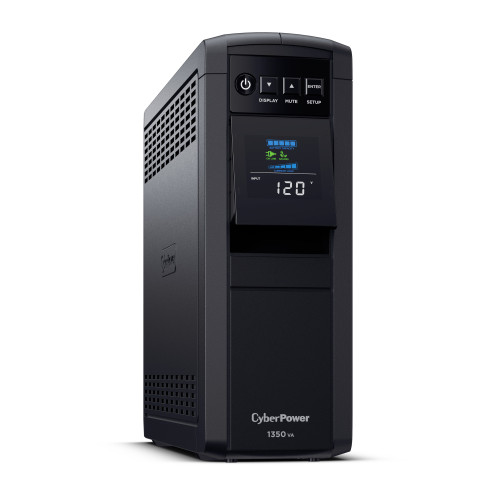
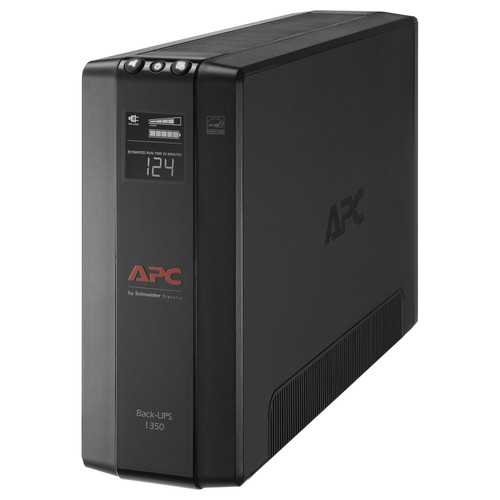
Both the CyberPower CP1350PFCLCD and the APC BX1350M are 1350VA line-interactive UPS units in compact tower form factors, designed for desktop workstations, small servers, network equipment, and home-office setups running on 120V North American power. This comparison evaluates their power delivery and output quality, runtime and battery characteristics, and connectivity and management capabilities — the three dimensions most critical when selecting a 1350VA UPS for edge IT or workgroup protection.
In This Guide
- Which UPS delivers more usable watts and a cleaner output waveform?
- How long will each UPS keep equipment running, and how does battery configuration compare?
- Which unit offers better outlet count, connectivity options, and management software?
- Which should you choose: the CP1350PFCLCD or the BX1350M?
- Side-by-Side Specs
- FAQ
Which UPS delivers more usable watts and a cleaner output waveform?
The CP1350PFCLCD is rated at 880W while the BX1350M is rated at 810W — a 70W (roughly 8.6%) advantage for the CyberPower unit at the same VA rating. This difference matters when load calculations are tight.
On waveform, the CP1350PFCLCD is explicitly specified as Pure Sine Wave output. APC lists the BX1350M waveform as 'Sine,' but does not specify whether this is true sine wave or a stepped approximation during battery operation. For loads that require or prefer pure sine — active PFC power supplies, medical-grade equipment, or sensitive electronics — the CP1350PFCLCD's clearly documented pure sine output is the safer selection.
Both units regulate output voltage to 120V. The CP1350PFCLCD specifies a ±5% output tolerance. No equivalent output voltage tolerance figure is provided in the BX1350M specs. The CP1350PFCLCD's input operating range is 88–144V; the BX1350M's is 88–139V, a marginally narrower high-side window.
How long will each UPS keep equipment running, and how does battery configuration compare?
The CP1350PFCLCD provides 2 minutes of runtime at full load (880W) and 8 minutes at half load (440W). Its battery configuration is explicitly documented as two 12V/7Ah sealed lead-acid cells. No runtime figures at specific wattage loads are provided in the BX1350M specs, making a direct runtime comparison impossible from the available data.
The BX1350M lists a battery recharge time of 16 hours. No battery recharge time is specified for the CP1350PFCLCD in the provided specs. The BX1350M uses Sealed Lead Acid (VRLA) technology; the CP1350PFCLCD also uses sealed lead-acid, though the BX1350M does not disclose cell count or Ah rating.
For buyers who need to calculate ride-through time for a specific load, the CP1350PFCLCD's published runtime table and disclosed battery capacity (14Ah total across two cells) provide a concrete basis for planning. The BX1350M's runtime data is absent from the provided specification set.
Which unit offers better outlet count, connectivity options, and management software?
The CP1350PFCLCD provides 12 total NEMA 5-15R outlets: 6 battery-backed and 6 surge-only. The BX1350M lists 5 NEMA 5-15R outlets total; the breakdown between battery-backed and surge-only outlets is not specified in the provided data. For installations protecting multiple devices — a workstation, monitor, NAS, and network switch simultaneously — the CP1350PFCLCD's 6 battery-backed outlets offer substantially more protected capacity.
On data-line protection, both units include a single RJ45 port for 10/100/1000Base-T Ethernet protection. The CP1350PFCLCD additionally specifies relay contacts as a connectivity option; the BX1350M does not list relay contacts.
The CP1350PFCLCD ships with PowerPanel Personal software supporting Windows, macOS, and Linux. No bundled management software is listed in the BX1350M's specification set. The CP1350PFCLCD features a multifunction color LCD display; the BX1350M lists an LCD display and audible alarms (on-battery, low-battery, overload). The CP1350PFCLCD carries UL 1778, cUL, FCC Class B, RoHS, and ENERGY STAR certifications; comparable certification data is not provided for the BX1350M.
Which should you choose: the CP1350PFCLCD or the BX1350M?
Our take: The CP1350PFCLCD is the stronger choice when load power draw, outlet count, waveform purity, and software management are primary selection criteria. Concretely: it delivers 880W versus the BX1350M's 810W — a 70W advantage at the same VA class; it provides 12 outlets (6 battery-backed) versus the BX1350M's 5 outlets with no disclosed backup/surge split; and it explicitly documents a pure sine wave output with published runtime figures (8 minutes at 440W) and cross-platform PowerPanel software, none of which are confirmed in the BX1350M's available specs. The BX1350M discloses a 16-hour recharge time, a surge energy rating of 789J, and a maximum output current of 12A — data points absent from the CP1350PFCLCD's provided specs. The BX1350M may suit buyers within APC's existing ecosystem or those for whom brand standardization drives procurement, but based strictly on the provided specifications, the CP1350PFCLCD offers more documented capability at this VA tier.
Side-by-Side Comparison
Spec-for-spec, from manufacturer data.
| Specification | CyberPower CP1350PFCLCD | APC by Schneider Electric BX1350M |
|---|---|---|
| Topology | Line Interactive | Line Interactive |
| VA Rating | 1350 VA | 1350 VA (1.35 kVA) |
| Watt Rating | 880 W | 810 W |
| Output Waveform | Pure Sine Wave | Sine (type not specified in provided specs) |
| Input Voltage Range | 88–144 VAC | 88–139 V |
| Output Voltage | 120 VAC ± 5% | 120 V |
| Total Outlets | 12 × NEMA 5-15R | 5 × NEMA 5-15R |
| Battery-Backed Outlets | 6 × NEMA 5-15R | — |
| Surge-Only Outlets | 6 × NEMA 5-15R | — |
| Surge Energy Rating | — | 789 J |
| Runtime at Full Load | 2 min at 880W | — |
| Runtime at Half Load | 8 min at 440W | — |
| Battery | 2 × 12V / 7Ah Sealed Lead-Acid | Sealed Lead Acid (VRLA); capacity not specified |
| Battery Recharge Time | — | 16 h |
| Data-Line Protection | RJ45 10/100/1000 Mbps | RJ45 10/100/1000Base-T(X) |
| Management Software | PowerPanel Personal (Win/macOS/Linux) | — |
| Display | Multifunction Color LCD | LCD |
| Certifications | UL 1778, cUL 107.3, FCC Class B, RoHS, ENERGY STAR | — |
| Form Factor | Mini-Tower | Compact Tower |
| Weight | 22.7 lb | — |
Frequently Asked Questions
Which should you choose: the CP1350PFCLCD or the BX1350M?
The CP1350PFCLCD is the stronger choice when load power draw, outlet count, waveform purity, and software management are primary selection criteria. Concretely: it delivers 880W versus the BX1350M's 810W — a 70W advantage at the same VA class; it provides 12 outlets (6 battery-backed) versus the BX1350M's 5 outlets with no disclosed backup/surge split; and it explicitly documents a pure sine wave output with published runtime figures (8 minutes at 440W) and cross-platform PowerPanel software, none of which are confirmed in the BX1350M's available specs. The BX1350M discloses a 16-hour recharge time, a surge energy rating of 789J, and a maximum output current of 12A — data points absent from the CP1350PFCLCD's provided specs. The BX1350M may suit buyers within APC's existing ecosystem or those for whom brand standardization drives procurement, but based strictly on the provided specifications, the CP1350PFCLCD offers more documented capability at this VA tier.
Does either UPS support active PFC power supplies found in modern workstations and servers?
The CP1350PFCLCD explicitly outputs Pure Sine Wave, which is compatible with active PFC power supplies. The BX1350M lists its waveform as 'Sine' but does not confirm in the provided specs whether this is true sine wave during battery operation. Buyers powering active PFC loads should verify APC's full technical documentation before selecting the BX1350M.
How many devices can I plug into each UPS and how many will stay on during a power outage?
The CP1350PFCLCD has 12 NEMA 5-15R outlets, of which 6 are battery-backed and 6 are surge-only. The BX1350M has 5 NEMA 5-15R outlets, but the provided specifications do not indicate how many of those 5 are battery-backed versus surge-only.
Which UPS integrates better with a mixed OS environment for automated graceful shutdown?
The CP1350PFCLCD includes PowerPanel Personal software with documented support for Windows, macOS, and Linux. No bundled management software or OS compatibility information is listed in the BX1350M's provided specifications. Buyers requiring cross-platform graceful shutdown should confirm software availability with APC directly before purchasing the BX1350M.
More UPS Comparisons
- APC by Schneider Electric BN1350M2-CA vs CyberPower CP1350PFCLCD
- APC by Schneider Electric BN1350M2-CA vs Vertiv PSA6-1350LVT
- APC by Schneider Electric BN1350M2-CA vs APC by Schneider Electric BN1350M2
- APC by Schneider Electric BN1350M2-CA vs APC by Schneider Electric BR1350MS
- CyberPower CP1350PFCLCD vs APC by Schneider Electric BN1350M2
- CyberPower CP1350PFCLCD vs APC by Schneider Electric BR1350MS
UPS Buying Guides
Get a Second Opinion on Your Camera Choice
Share your site layout, coverage goals, and budget. Our team will validate the camera selection, flag anything we would change, and recommend products that match the use case.