
CyberPower CP1350PFCLCD vs APC by Schneider Electric BN1350M2: Specification Comparison
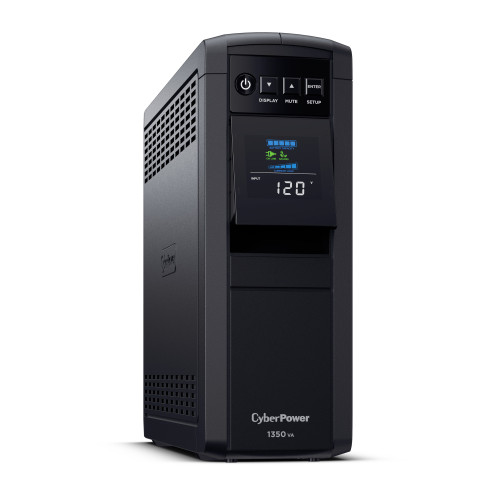
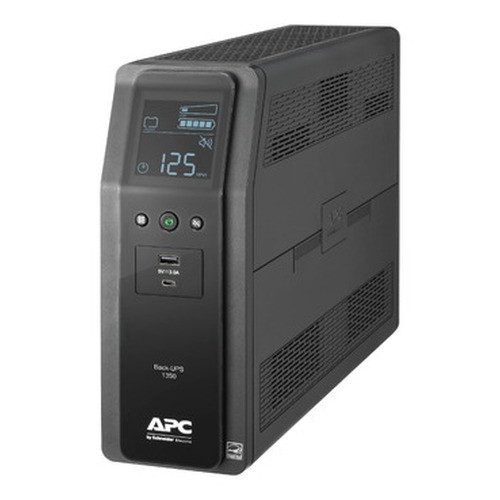
Both the CyberPower CP1350PFCLCD and the APC BN1350M2 are 1350 VA line-interactive UPS units in a desktop/mini-tower form factor, targeting small office, workstation, and network-closet applications that require clean power conditioning and short-term battery backup at the 120 VAC / 1350 VA tier. The comparison covers three decision-critical axes for this class of UPS: real power capacity and output waveform quality; runtime and battery characteristics; and connectivity, protection features, and software ecosystem.
In This Guide
- Which unit delivers more usable watts and cleaner output waveform?
- How do the units compare on runtime, battery specifications, and recharge characteristics?
- Which unit offers broader connectivity, surge protection, and management software support?
- Which should you choose: the CP1350PFCLCD or the BN1350M2?
- Side-by-Side Specs
- FAQ
Which unit delivers more usable watts and cleaner output waveform?
The CP1350PFCLCD is rated at 880 W, giving it a power factor of approximately 0.65 (880 W ÷ 1350 VA). The BN1350M2 is rated at 810 W, a power factor of approximately 0.60. That 70 W difference is meaningful when sizing against a load near the watt ceiling rather than the VA ceiling.
The more significant differentiator is output waveform. The CP1350PFCLCD produces a pure sine wave on battery, which is required by active PFC power supplies found in most modern servers, workstations, and network equipment. The BN1350M2 produces a simulated (stepped approximation) sine wave on battery. Equipment with active PFC power supplies can malfunction, shut down, or sustain damage when fed a simulated sine wave, making this a hard compatibility constraint rather than a preference.
Both units operate on 120 VAC nominal input with similar operating ranges: the CP1350PFCLCD accepts 88–144 VAC; the BN1350M2 accepts 88–139 VAC. The CP1350PFCLCD's wider upper bound (144 VAC vs. 139 VAC) provides marginally more high-voltage ride-through before switching to battery.
How do the units compare on runtime, battery specifications, and recharge characteristics?
At full rated load, the CP1350PFCLCD provides approximately 2 minutes of runtime at 880 W; the BN1350M2 provides approximately 2.6 minutes at 810 W. The BN1350M2's longer full-load runtime reflects its lower watt ceiling rather than a larger battery — it is simply drawing less power at 'full load.'
At half load, the CP1350PFCLCD provides 8 minutes at 440 W, while the BN1350M2 provides 10.4 minutes at approximately 405 W. Again, the load points differ, so the runtimes are not directly apples-to-apples.
The CP1350PFCLCD specifies its battery explicitly: 2 × 12 V / 7 Ah sealed lead-acid cells (168 VAh total). The BN1350M2 lists 153 VAh and identifies the replacement battery as APCRBC162, but does not disclose individual cell voltage or Ah rating. Recharge time is not stated for the CP1350PFCLCD; the BN1350M2 specifies 16 hours to full recharge, which is notably long for a unit of this class.
Which unit offers broader connectivity, surge protection, and management software support?
For surge protection joule rating, only the BN1350M2 publishes a figure: 1,080 joules. The CP1350PFCLCD does not state a joule rating in the provided specifications.
Both units provide USB connectivity and RJ45 data-line protection. The BN1350M2 adds coaxial (coax in/out) protection and a serial port via RJ45, plus 2 USB charging ports. The CP1350PFCLCD adds relay contacts for integration with building management or generator systems — a feature absent from the BN1350M2 spec. The CP1350PFCLCD specifies RJ45 protection rated to 10/100/1000 Mbps (Gigabit); the BN1350M2 lists RJ45 data-line protection but does not specify a speed rating.
Outlet count differs: the CP1350PFCLCD provides 12 outlets (6 battery-backed, 6 surge-only); the BN1350M2 provides 10 outlets (6 battery-backed, 4 surge-only), including 2 transformer-spaced positions. The CP1350PFCLCD ships with PowerPanel Personal software supporting Windows, macOS, and Linux. The BN1350M2's software is not specified in the provided data.
Both carry ENERGY STAR and FCC certifications. The CP1350PFCLCD adds UL 1778 and cUL 107.3; the BN1350M2 adds cTUVus and NOM. The BN1350M2 specifies a noise level of 45 dBA; the CP1350PFCLCD does not publish an acoustic rating. The BN1350M2 also specifies 5% noise filtering; no equivalent figure is provided for the CP1350PFCLCD.
Which should you choose: the CP1350PFCLCD or the BN1350M2?
Our take: The CP1350PFCLCD is the stronger choice when the protected equipment includes active PFC power supplies — which describes virtually all modern workstations, servers, and network appliances. Its pure sine wave output on battery is a hard requirement for those loads, while the BN1350M2's simulated sine wave can trigger shutdowns or hardware faults in the same equipment. Beyond waveform, the CP1350PFCLCD delivers 70 W more usable capacity (880 W vs. 810 W) and adds 2 additional outlets (12 vs. 10), including relay contacts for generator or BMS integration absent from the BN1350M2. The BN1350M2 holds advantages in disclosed surge joule rating (1,080 J, vs. not stated for CyberPower), coaxial line protection, USB charging ports, and a published acoustic spec (45 dBA). Its 16-hour recharge time is a notable operational drawback. Buyers running legacy equipment tolerant of simulated sine wave, needing coax protection, or prioritizing a published surge joule rating may find the BN1350M2 adequate; for any modern active-PFC load, the CP1350PFCLCD is the correct selection.
Side-by-Side Comparison
Spec-for-spec, from manufacturer data.
| Specification | CyberPower CP1350PFCLCD | APC by Schneider Electric BN1350M2 |
|---|---|---|
| UPS Topology | Line Interactive | Line Interactive |
| Capacity (VA) | 1350 VA | 1350 VA |
| Capacity (Watts) | 880 W | 810 W |
| Output Waveform (On Battery) | Pure Sine Wave | Simulated Sine Wave |
| Transfer Time | <10 ms | 8–10 ms |
| Total Outlets | 12 × NEMA 5-15R | 10 × NEMA 5-15R |
| Battery-Backed Outlets | 6 × NEMA 5-15R | 6 × NEMA 5-15R |
| Surge-Only Outlets | 6 × NEMA 5-15R | 4 × NEMA 5-15R |
| Runtime at Full Load | ~2 min at 880 W | ~2.6 min at 810 W |
| Runtime at Half Load | ~8 min at 440 W | ~10.4 min at ~405 W |
| Battery (Chemistry / Spec) | Sealed Lead-Acid, 2×12V/7Ah | Lead-Acid, 153 VAh (APCRBC162) |
| Recharge Time | — | 16 Hours |
| Surge Joule Rating | — | 1,080 Joules |
| Connectivity | USB, Relay Contacts, RJ45 (Gigabit) | USB, Serial via RJ45, RJ45, Coax |
| Display | Multifunction Color LCD | LCD |
| Certifications | UL 1778, cUL 107.3, FCC Class B, ENERGY STAR, RoHS | cTUVus, FCC, NOM, ENERGY STAR |
| Management Software | PowerPanel Personal (Win/macOS/Linux) | — |
| Form Factor | Mini-Tower | Mini-Tower |
| Dimensions (W×H×D) | 3.9 × 11.0 × 14.0 in | 3.94 × 10.24 × 14.49 in |
| Weight | 22.7 lb | 29 lb (package weight) |
| Input Voltage Range | 88–144 VAC | 88–139 VAC |
| Noise Level | — | 45 dBA |
Frequently Asked Questions
Which should you choose: the CP1350PFCLCD or the BN1350M2?
The CP1350PFCLCD is the stronger choice when the protected equipment includes active PFC power supplies — which describes virtually all modern workstations, servers, and network appliances. Its pure sine wave output on battery is a hard requirement for those loads, while the BN1350M2's simulated sine wave can trigger shutdowns or hardware faults in the same equipment. Beyond waveform, the CP1350PFCLCD delivers 70 W more usable capacity (880 W vs. 810 W) and adds 2 additional outlets (12 vs. 10), including relay contacts for generator or BMS integration absent from the BN1350M2. The BN1350M2 holds advantages in disclosed surge joule rating (1,080 J, vs. not stated for CyberPower), coaxial line protection, USB charging ports, and a published acoustic spec (45 dBA). Its 16-hour recharge time is a notable operational drawback. Buyers running legacy equipment tolerant of simulated sine wave, needing coax protection, or prioritizing a published surge joule rating may find the BN1350M2 adequate; for any modern active-PFC load, the CP1350PFCLCD is the correct selection.
Can I use either of these UPS units with a modern desktop PC or workstation that has an active PFC power supply?
The CP1350PFCLCD is compatible with active PFC power supplies because it outputs a pure sine wave on battery. The BN1350M2 outputs a simulated sine wave on battery, which is documented to cause instability, unexpected shutdowns, or damage in equipment with active PFC power supplies. If your workstation or server uses an active PFC supply — which is standard on virtually all units manufactured in the last decade — the CP1350PFCLCD is the appropriate choice; the BN1350M2 carries meaningful compatibility risk for those loads.
Which unit gives me more runtime to safely shut down my equipment during a power outage?
At half load, the CP1350PFCLCD provides 8 minutes at 440 W and the BN1350M2 provides 10.4 minutes at approximately 405 W. However, those half-load watt points differ (440 W vs. ~405 W), so the comparison is not exact. At full rated wattage, the CP1350PFCLCD runs approximately 2 minutes at 880 W versus 2.6 minutes at 810 W for the BN1350M2. Neither unit is designed for extended ride-through; both are sized for graceful shutdown. The BN1350M2's 16-hour recharge time should also factor into availability planning after a discharge event.
Does either unit protect my coaxial cable or TV/antenna line in addition to network and power connections?
Only the BN1350M2 specifies coaxial (coax in/out) protection in its provided specifications. The CP1350PFCLCD includes RJ45 network protection (rated to 10/100/1000 Mbps Gigabit) and relay contacts, but coaxial protection is not listed in its specifications. If coax surge protection is a requirement — for example, in a small office with a cable modem or security DVR connected via coax — the BN1350M2 has the documented feature; the CP1350PFCLCD does not.
More UPS Comparisons
- APC by Schneider Electric BN1350M2-CA vs CyberPower CP1350PFCLCD
- APC by Schneider Electric BN1350M2-CA vs Vertiv PSA6-1350LVT
- APC by Schneider Electric BN1350M2-CA vs APC by Schneider Electric BN1350M2
- APC by Schneider Electric BN1350M2-CA vs APC by Schneider Electric BR1350MS
- CyberPower CP1350PFCLCD vs APC by Schneider Electric BR1350MS
- CyberPower CP1350PFCLCD vs APC by Schneider Electric BX1350M
UPS Buying Guides
Get a Second Opinion on Your Camera Choice
Share your site layout, coverage goals, and budget. Our team will validate the camera selection, flag anything we would change, and recommend products that match the use case.