
APC by Schneider Electric BN1350M2-CA vs CyberPower CP1350PFCLCD: Specification Comparison
Both the APC BN1350M2-CA and CyberPower CP1350PFCLCD are 1350 VA line-interactive desktop UPS units designed for workstations, home offices, and small network equipment operating on 120 V North American circuits. They occupy the same VA class and device category, making them direct cross-shop candidates. The comparison focuses on the three dimensions that most influence a purchasing decision at this tier: power capacity and waveform quality, runtime and battery characteristics, and connectivity plus management features.
In This Guide
- Which UPS delivers more usable watts and a cleaner output waveform for sensitive loads?
- How does each unit compare on runtime, battery configuration, and recharge time?
- Which unit offers broader connectivity, data-line protection, and management software?
- Which should you choose: the BN1350M2-CA or the CP1350PFCLCD?
- Side-by-Side Specs
- FAQ
Which UPS delivers more usable watts and a cleaner output waveform for sensitive loads?
The CyberPower CP1350PFCLCD is rated at 880 W versus the APC BN1350M2-CA at 810 W — a 70 W (roughly 8.6%) advantage at the same 1350 VA nameplate. This matters when powering equipment that draws near the unit's continuous-load ceiling.
The waveform difference is more significant for sensitive electronics. The CP1350PFCLCD produces a pure sine wave output, which is required by many active PFC power supplies found in modern workstations, servers, and medical-grade equipment. The BN1350M2-CA outputs a stepped approximation to a sine wave (simulated sine wave), which can cause instability or noise with active-PFC loads and is generally suited to less sensitive equipment.
Both units operate at 120 V input with transfer times under 10 ms (APC specifies 8 ms typical / 10 ms maximum; CyberPower specifies less than 10 ms), so neither has a meaningful edge on transfer speed. APC specifies an input range of 88–139 V; CyberPower specifies 88–144 V, giving the CP1350PFCLCD a marginally wider high-voltage tolerance.
How does each unit compare on runtime, battery configuration, and recharge time?
CyberPower publishes explicit runtime figures: 2 minutes at full load (880 W) and 8 minutes at half load (440 W). APC does not list runtime figures in the provided specifications for the BN1350M2-CA, so a direct numeric comparison at equivalent loads is not possible from the available data.
CyberPower discloses its battery configuration as two 12 V / 7 Ah sealed lead-acid batteries (total 168 Wh theoretical capacity). APC specifies only 'lead-acid battery' and a 10 W charger with a 16-hour recharge time; battery Ah capacity is not listed in the provided specifications. The 16-hour recharge time for the APC is notably long and relevant for environments where frequent outages are possible.
APC lists a battery life expectancy of 3–5 years. CyberPower does not provide an expected battery life figure in the provided specifications. Both use sealed lead-acid chemistry, which is industry standard at this price tier.
Which unit offers broader connectivity, data-line protection, and management software?
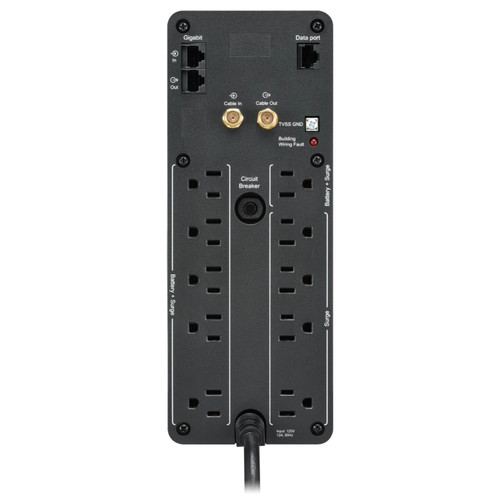
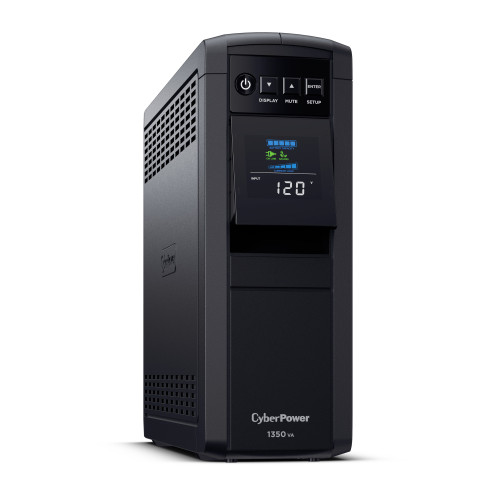
The CP1350PFCLCD includes a USB port, relay contacts, RJ45 network protection rated for 10/100/1000 Mbps, and a multifunction color LCD display. It also ships with PowerPanel Personal software supporting Windows, macOS, and Linux. The BN1350M2-CA offers USB charging ports (quantity not specified beyond 'two') and coaxial/CATV data-line protection; a management display is not listed in the provided specifications.
On outlets, the CP1350PFCLCD provides 12 total NEMA 5-15R outlets (6 battery-backed, 6 surge-only). The BN1350M2-CA provides 10 outlets (6 NEMA 5-15R battery-backed, 4 NEMA 5-15R surge-only). The APC unit's coaxial protection covers CATV/satellite/modem/audio-video lines, a feature not listed for the CyberPower.
APC lists a surge energy rating of 1080 J and full-time multi-pole noise filtering. CyberPower does not state a joule rating in the provided specifications. APC certifications include ENERGY STAR V2.0, NOM, and TUV C-US; CyberPower certifications include UL 1778, cUL 107.3, FCC Class B, RoHS, and ENERGY STAR — both carry North American safety marks, but the certification bodies differ.
Which should you choose: the BN1350M2-CA or the CP1350PFCLCD?
Our take: The CP1350PFCLCD is the stronger choice when the connected load includes active-PFC power supplies or any equipment requiring a pure sine wave. Its 880 W capacity (vs. 810 W), pure sine wave output, 12-outlet count (vs. 10), Gigabit RJ45 network-port protection, color LCD display, and cross-platform PowerPanel software represent measurable advantages for workstation or small-network deployments where waveform quality and management visibility matter. The BN1350M2-CA's notable advantages are its coaxial/CATV data-line protection, a stated 1080 J surge rating, a 3-year repair-or-replace warranty with explicit terms, and TUV C-US certification — relevant for AV setups or buyers requiring that specific certification body. APC's recharge time of 16 hours is a practical disadvantage in outage-prone environments. CyberPower does not disclose battery expected life; APC specifies 3–5 years. Choose the BN1350M2-CA for AV/cable-connected equipment on a Canadian-NOM-required deployment; choose the CP1350PFCLCD for active-PFC workstation or network-rack loads where waveform purity is required.
Side-by-Side Comparison
Spec-for-spec, from manufacturer data.
| Specification | APC by Schneider Electric BN1350M2-CA | CyberPower CP1350PFCLCD |
|---|---|---|
| VA Rating | 1350 VA | 1350 VA |
| Watt Rating | 810 W | 880 W |
| Topology | Line Interactive | Line Interactive |
| Output Waveform | Stepped sine wave (simulated) | Pure sine wave |
| Input Voltage Range | 88–139 V | 88–144 V |
| Transfer Time | 8 ms typical / 10 ms max | <10 ms |
| Total Outlets | 10 (6 battery + 4 surge) | 12 (6 battery + 6 surge) |
| Runtime at Full Load | — | 2 min at 880 W |
| Runtime at Half Load | — | 8 min at 440 W |
| Battery Configuration | Lead-acid (Ah not specified) | 2 × 12 V / 7 Ah sealed lead-acid |
| Battery Recharge Time | 16 hours | — |
| Battery Life Expectancy | 3–5 years | — |
| Surge Energy Rating | 1080 J | — |
| Data Line Protection | Coaxial (CATV/modem/AV) | RJ45 10/100/1000 Mbps |
| Display | — | Multifunction color LCD |
| Management Software | — | PowerPanel Personal (Win/macOS/Linux) |
| USB Ports | 2 USB charging ports | 1 USB (monitoring/management) |
| Certifications | ENERGY STAR V2.0, NOM, TUV C-US | UL 1778, cUL 107.3, FCC Class B, RoHS, ENERGY STAR |
| Warranty | 3 years repair or replace | Manufacturer warranty (duration not specified in provided specs) |
| Weight | 10.4 kg (22.9 lb) | 22.7 lb (10.3 kg) |
| Dimensions (W×H×D) | 10 × 26 × 36.8 cm | 3.9 × 11.0 × 14.0 in |
Frequently Asked Questions
Which should you choose: the BN1350M2-CA or the CP1350PFCLCD?
The CP1350PFCLCD is the stronger choice when the connected load includes active-PFC power supplies or any equipment requiring a pure sine wave. Its 880 W capacity (vs. 810 W), pure sine wave output, 12-outlet count (vs. 10), Gigabit RJ45 network-port protection, color LCD display, and cross-platform PowerPanel software represent measurable advantages for workstation or small-network deployments where waveform quality and management visibility matter. The BN1350M2-CA's notable advantages are its coaxial/CATV data-line protection, a stated 1080 J surge rating, a 3-year repair-or-replace warranty with explicit terms, and TUV C-US certification — relevant for AV setups or buyers requiring that specific certification body. APC's recharge time of 16 hours is a practical disadvantage in outage-prone environments. CyberPower does not disclose battery expected life; APC specifies 3–5 years. Choose the BN1350M2-CA for AV/cable-connected equipment on a Canadian-NOM-required deployment; choose the CP1350PFCLCD for active-PFC workstation or network-rack loads where waveform purity is required.
Can I use either UPS with a modern gaming PC or workstation that has an active-PFC power supply?
The CP1350PFCLCD is the appropriate choice for active-PFC power supplies because it outputs a pure sine wave. The BN1350M2-CA produces a stepped approximation to a sine wave, which can cause issues — including shutdowns or PSU damage — with active-PFC loads. If your workstation PSU requires a true sine wave input, select the CP1350PFCLCD.
Which UPS gives me more outlets and better network protection?
The CP1350PFCLCD provides 12 NEMA 5-15R outlets (6 battery-backed, 6 surge-only) and includes RJ45 protection rated for 10/100/1000 Mbps. The BN1350M2-CA provides 10 outlets (6 battery-backed, 4 surge-only) and includes coaxial/CATV data-line protection instead of Ethernet protection. If you need to protect a network switch or router's Ethernet port, the CyberPower unit is the better fit; if you need to protect a cable modem or AV coaxial connection, the APC unit covers that line type.
How do the warranties compare between the APC BN1350M2-CA and the CyberPower CP1350PFCLCD?
APC specifies a 3-year repair-or-replace warranty with explicit terms. CyberPower lists only 'Manufacturer Warranty' in the provided specifications, with no duration or coverage terms stated. Buyers requiring a defined warranty period and coverage commitment should verify CyberPower's current warranty terms directly with the manufacturer before purchasing.
More UPS Comparisons
- APC by Schneider Electric BN1350M2-CA vs Vertiv PSA6-1350LVT
- APC by Schneider Electric BN1350M2-CA vs APC by Schneider Electric BN1350M2
- APC by Schneider Electric BN1350M2-CA vs APC by Schneider Electric BR1350MS
- CyberPower CP1350PFCLCD vs APC by Schneider Electric BN1350M2
- CyberPower CP1350PFCLCD vs APC by Schneider Electric BR1350MS
- CyberPower CP1350PFCLCD vs APC by Schneider Electric BX1350M
UPS Buying Guides
Get a Second Opinion on Your Camera Choice
Share your site layout, coverage goals, and budget. Our team will validate the camera selection, flag anything we would change, and recommend products that match the use case.