
APC by Schneider Electric BN1350M2-CA vs APC by Schneider Electric BR1350MS: Specification Comparison
Both the BN1350M2-CA and BR1350MS are 1350 VA / 810 W line-interactive tower UPS units from APC by Schneider Electric, designed for desktop workstations, small servers, and AV or network equipment running on 120 V / 60 Hz North American power. Each provides automatic voltage regulation, surge protection at 1080 J, and a shared transfer-time envelope of 8 ms typical / 10 ms maximum. The comparison centers on output waveform type, outlet configuration, connectivity protection scope, certifications, and physical characteristics where specs diverge.
In This Guide
- What does each UPS deliver at the outlet — and is the waveform safe for active PFC power supplies?
- How many outlets and what types of line protection does each model provide?
- What are the operating environment ratings, certifications, and physical footprint of each unit?
- Which should you choose: the BN1350M2-CA or the BR1350MS?
- Side-by-Side Specs
- FAQ
What does each UPS deliver at the outlet — and is the waveform safe for active PFC power supplies?
Both units are rated identically at 1350 VA / 810 W output with a 120 V, 60 Hz input range. The critical waveform difference: the BN1350M2-CA produces a stepped approximation to a sinewave (simulated sinewave), while the BR1350MS produces a true sine wave. For loads with active power-factor-corrected (PFC) power supplies — common in modern workstations, servers, and high-end AV equipment — a true sinewave is strongly preferred because simulated sinewave output can cause PFC supplies to behave erratically or trip protections during a battery event.
The BN1350M2-CA's stepped waveform is adequate for most legacy power supplies, basic networking gear, and non-PFC loads. The BR1350MS's sine output broadens compatibility to PFC and sensitive equipment without caveat.
How many outlets and what types of line protection does each model provide?
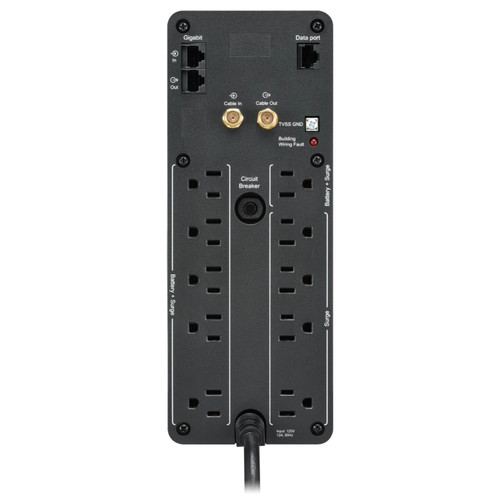
The BN1350M2-CA provides 10 physical outlets: 6 NEMA 5-15R on battery + surge protection and 4 NEMA 5-15R on surge-only protection. It also includes 2 USB charging ports (Type not further specified in provided specs), coaxial cable protection for CATV/SATV/modem/audio-video, and full-time multi-pole noise filtering. The cable length is 1.8 m.
The BR1350MS specs confirm surge protection with coax and network (data line) protection, plus EMI/RFI noise filtering and an audible alarm. However, the BR1350MS spec set does not state the total outlet count, individual outlet types, USB port count, or cable length — those values are absent from the provided specifications and cannot be inferred.
On documented outlet configuration, the BN1350M2-CA is the only model with a confirmed count and layout. Both confirm coax protection; the BR1350MS additionally lists network (Ethernet) line protection, which is not explicitly listed for the BN1350M2-CA in the provided specs.
What are the operating environment ratings, certifications, and physical footprint of each unit?
The BN1350M2-CA carries documented environmental ratings: operating temperature 0–40 °C, operating relative humidity 0–95% non-condensing, operating altitude up to 10,000 ft (0–3,048 m storage altitude), and an acoustic noise level of 45 dBA. Physical dimensions are 26 cm H × 10 cm W × 36.8 cm D at 10.4 kg. Battery type is lead-acid with a 3–5 year rated life, 16-hour recharge time, and 10 W charger power. Certifications include ENERGY STAR V2.0 (USA), NOM, and TUV C-US. Warranty is 3 years repair or replace.
The BR1350MS specs confirm a 45 dB noise level and an audible alarm but do not provide operating temperature range, humidity range, altitude rating, physical dimensions, weight, battery specifications, recharge time, battery life, certifications, or warranty terms in the provided data. All of those values are absent and must be verified with the manufacturer.
Which should you choose: the BN1350M2-CA or the BR1350MS?
Our take: The BR1350MS is the stronger choice when the connected load includes active PFC power supplies or other sine-sensitive equipment, because it delivers a true sinewave output versus the BN1350M2-CA's stepped-approximation sinewave — a fundamental compatibility difference at the same 1350 VA / 810 W rating and identical 8 ms / 10 ms transfer time. The BR1350MS also explicitly lists network (Ethernet) line protection alongside coax, extending data-port coverage not confirmed in the BN1350M2-CA specs. Conversely, the BN1350M2-CA is the only model with a fully documented outlet layout (10 outlets, 6 battery-backed + 4 surge-only), confirmed USB charging ports, complete environmental ratings (0–40 °C, 0–95% RH, 10,000 ft), a stated 3–5 year battery life with 16-hour recharge, ENERGY STAR V2.0 / TUV C-US certifications, and an explicit 3-year warranty. Buyers prioritizing verified specs and legacy or non-PFC loads should favor the BN1350M2-CA; those running PFC-equipped workstations or servers should prioritize the BR1350MS's true sinewave, subject to confirming its outlet count and certifications directly with APC.
Side-by-Side Comparison
Spec-for-spec, from manufacturer data.
| Specification | APC by Schneider Electric BN1350M2-CA | APC by Schneider Electric BR1350MS |
|---|---|---|
| UPS Type | Line-interactive | Line-interactive |
| Rated Power (VA) | 1350 VA | 1350 VA |
| Rated Power (W) | 810 W | 810 W |
| Output Waveform | Stepped approximation to sinewave | Sine wave |
| Input Voltage Range | 88–139 V | 88–147 V |
| Input Frequency | 60 Hz ±3 Hz | 60 Hz |
| Transfer Time | 8 ms typical / 10 ms maximum | 8 ms min / 10 ms max |
| Maximum Input Current | 12 A | 12 A |
| Surge Energy Rating | 1080 J | 1080 J |
| Total Outlet Count | 10 (6 battery+surge, 4 surge-only) | — |
| Outlet Type | NEMA 5-15R | — |
| USB Charging Ports | 2 | — |
| Data Line Protection | Coaxial (CATV/SATV/modem/AV) | Coax and Network |
| EMI/RFI Noise Filtering | Full-time multi-pole | Yes |
| Noise Level | 45 dBA | 45 dB |
| Battery Type | Lead-acid | — |
| Battery Life | 3–5 years | — |
| Battery Recharge Time | 16 h | — |
| Operating Temperature | 0–40 °C | — |
| Operating Humidity | 0–95% non-condensing | — |
| Operating Altitude | 0–10,000 ft | — |
| Net Weight | 10.4 kg | — |
| Dimensions (H × W × D) | 26 × 10 × 36.8 cm | — |
| Certifications | ENERGY STAR V2.0, NOM, TUV C-US | — |
| Warranty | 3 years repair or replace | — |
Frequently Asked Questions
Which should you choose: the BN1350M2-CA or the BR1350MS?
The BR1350MS is the stronger choice when the connected load includes active PFC power supplies or other sine-sensitive equipment, because it delivers a true sinewave output versus the BN1350M2-CA's stepped-approximation sinewave — a fundamental compatibility difference at the same 1350 VA / 810 W rating and identical 8 ms / 10 ms transfer time. The BR1350MS also explicitly lists network (Ethernet) line protection alongside coax, extending data-port coverage not confirmed in the BN1350M2-CA specs. Conversely, the BN1350M2-CA is the only model with a fully documented outlet layout (10 outlets, 6 battery-backed + 4 surge-only), confirmed USB charging ports, complete environmental ratings (0–40 °C, 0–95% RH, 10,000 ft), a stated 3–5 year battery life with 16-hour recharge, ENERGY STAR V2.0 / TUV C-US certifications, and an explicit 3-year warranty. Buyers prioritizing verified specs and legacy or non-PFC loads should favor the BN1350M2-CA; those running PFC-equipped workstations or servers should prioritize the BR1350MS's true sinewave, subject to confirming its outlet count and certifications directly with APC.
Which UPS is safer to use with a modern desktop PC or server that has an active PFC power supply?
The BR1350MS is the safer choice for active PFC power supplies because it produces a true sinewave output. The BN1350M2-CA outputs a stepped approximation to a sinewave, which can cause instability or nuisance tripping with PFC supplies during a battery event.
Does either the BN1350M2-CA or the BR1350MS protect my network cable or coax line?
Both models provide coaxial line protection per the provided specs. The BR1350MS additionally lists network (Ethernet data line) protection. The BN1350M2-CA's provided specs do not explicitly list Ethernet data line protection — verify with APC if that is a requirement.
How many outlets does the BR1350MS have compared to the BN1350M2-CA?
The BN1350M2-CA has 10 confirmed outlets: 6 NEMA 5-15R on battery plus surge backup and 4 NEMA 5-15R on surge-only. The BR1350MS outlet count and type are not stated in the provided specifications; that figure must be confirmed directly with APC or from the manufacturer's datasheet before purchase.
More UPS Comparisons
- APC by Schneider Electric BN1350M2-CA vs CyberPower CP1350PFCLCD
- APC by Schneider Electric BN1350M2-CA vs Vertiv PSA6-1350LVT
- APC by Schneider Electric BN1350M2-CA vs APC by Schneider Electric BN1350M2
- CyberPower CP1350PFCLCD vs APC by Schneider Electric BN1350M2
- CyberPower CP1350PFCLCD vs APC by Schneider Electric BR1350MS
- CyberPower CP1350PFCLCD vs APC by Schneider Electric BX1350M
UPS Buying Guides
Get a Second Opinion on Your Camera Choice
Share your site layout, coverage goals, and budget. Our team will validate the camera selection, flag anything we would change, and recommend products that match the use case.