
Comnet CWG26F4T22MP vs Comnet CWG26F4T22M: Specification Comparison
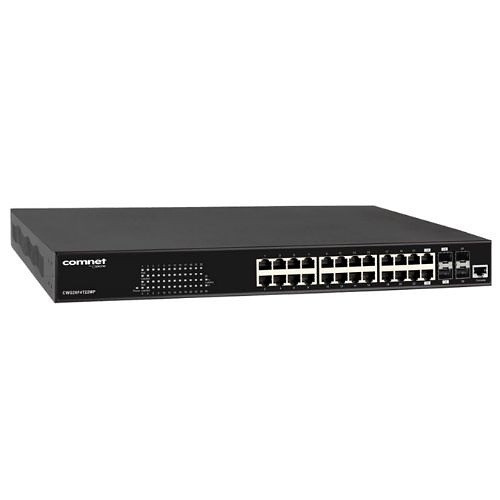
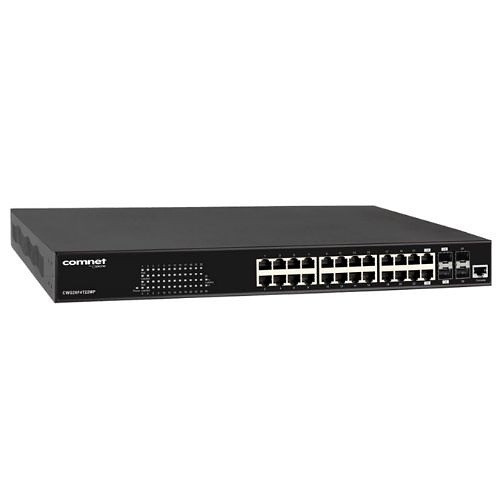
Both the CWG26F4T22MP and CWG26F4T22M are Comnet Commercial Grade 26-port Gigabit managed switches sharing the same chassis dimensions, switching fabric, and core L2 switching specifications. The critical differentiator is that the CWG26F4T22MP adds IEEE 802.3af/at Power over Ethernet across 24 PSE ports with a 420 W PoE budget, while the CWG26F4T22M is a non-PoE variant with TAA compliance explicitly stated. Buyers choosing between them are primarily deciding whether powered endpoints — IP cameras, access control readers, VoIP handsets — need inline power from the switch.
In This Guide
- Which switch can power IP cameras and other PoE devices directly?
- Are the core switching performance and port configurations equivalent between the two models?
- Do both switches meet the same environmental, regulatory, and build standards?
- Which should you choose: the CWG26F4T22MP or the CWG26F4T22M?
- Side-by-Side Specs
- FAQ
Which switch can power IP cameras and other PoE devices directly?
The CWG26F4T22MP provides PoE/PoE+ on 24 of its ports, delivering up to 15.4 W per port (802.3af) or up to 30 W per port (802.3at), using Mode A pinout (pairs 1/2 positive, 3/6 negative). Its total PoE power budget is 420 W, and maximum system power consumption rises to 450 W to support that load. With 24 PSE-capable ports and a 420 W budget, it can simultaneously power a mixed deployment of standard PoE cameras and PoE+ devices provided per-port and aggregate wattage limits are respected.
The CWG26F4T22M has no PoE capability stated anywhere in its specifications — no PSE port count, no PoE budget, no PoE type, and a maximum power consumption of only 25 W, which is consistent with a purely non-PoE data switch. All powered endpoints connected to the CWG26F4T22M would require local power supplies or external PoE injectors. For installations where every device already has its own power source, the lower draw of the CWG26F4T22M (25 W vs. 450 W peak) reduces rack power and heat load substantially.
Are the core switching performance and port configurations equivalent between the two models?
Both switches share identical core switching metrics: 52 Gbps switching bandwidth, 7 µs latency, and a forwarding rate of 38.688 Mpps. Both support up to 4,000 VLANs, an 8,000-entry MAC table, 8 priority queues per port, and jumbo frames up to 9.6 KB. These figures indicate the same underlying switching ASIC.
Port layout diverges in specificity. The CWG26F4T22M explicitly documents its physical port types: 22 × RJ-45, 2 × Combo RJ-45/SFP, and 2 × dedicated SFP, totaling 26 ports as named. The CWG26F4T22MP spec lists 22 TX ports and 24 PSE ports but does not separately enumerate combo or dedicated SFP port counts in the provided specification set. The CWG26F4T22M also explicitly lists redundancy protocols (RSTP/STP/MSTP), LACP and static trunk aggregation, and L3 static routing support — none of these are called out in the CWG26F4T22MP spec as provided, though the CWG26F4T22MP does specify 13 aggregation groups with up to 8 ports per group and 1,024 IGMP groups.
Do both switches meet the same environmental, regulatory, and build standards?
The two models share identical physical and environmental specifications: the same 13.46 × 16.97 × 1.73 in 1-RU 19-inch rack-mount chassis, identical net weight of 13.1 lbs (5.9 kg), the same 0 °C to +50 °C operating range, −20 °C to +80 °C storage range, and 10–90% non-condensing relative humidity. Both carry the same EMI certification (FCC Part 15, CISPR/EN55022 Class A) and identical EMS standards (EN61000-4-2 through -4-11 series). Mechanical durability testing to IEC 60068-2-27 (shock), IEC 60068-2-32 (free fall), and IEC 60068-2-6 (vibration) is identical on both units.
One meaningful compliance difference: the CWG26F4T22M explicitly carries TAA (Trade Agreements Act) compliance, which is a mandatory procurement requirement for U.S. federal, state, and many municipal government contracts. The CWG26F4T22MP specification does not state TAA compliance. The CWG26F4T22MP also provides an MTBF figure (>100,000 hours) not listed in the CWG26F4T22M spec. Buyers relying on MTBF for maintenance planning should note this data gap on the non-PoE model.
Which should you choose: the CWG26F4T22MP or the CWG26F4T22M?
Our take: The CWG26F4T22MP is the stronger choice when the installation requires inline power for IP cameras, access control panels, VoIP phones, or other PoE/PoE+ endpoints, while the CWG26F4T22M is preferable for government or federally funded projects that mandate TAA compliance or for data-only deployments where rack power and heat budgets are constrained. Key spec deltas: the CWG26F4T22MP delivers up to 420 W total PoE budget across 24 PSE ports at up to 30 W per port, versus zero PoE capability on the CWG26F4T22M; peak system power draw is 450 W on the PoE model versus 25 W on the non-PoE model — an 18× difference relevant to UPS sizing and rack power planning. The CWG26F4T22M additionally carries confirmed TAA compliance and explicit documentation of RSTP/STP/MSTP and L3 static routing, features absent from the provided CWG26F4T22MP spec sheet. Both models are functionally equivalent for pure L2 Gigabit switching in commercial physical-security backbones.
Side-by-Side Comparison
Spec-for-spec, from manufacturer data.
| Specification | Comnet CWG26F4T22MP | Comnet CWG26F4T22M |
|---|---|---|
| Switching Bandwidth | 52 Gbps | 52 Gbps |
| Switching Latency | 7 µs | 7 µs |
| Forwarding Rate | 38.688 Mpps | 38.688 Mpps |
| PoE Support | Yes — 802.3af/at (Mode A) | None |
| PSE Ports | 24 | — |
| Total PoE Budget | 420 W | — |
| PoE Per Port (Max) | 15.4 W / 30 W | — |
| Max Power Consumption | 450 W | 25 W |
| Max VLANs | 4,000 | 4,000 |
| MAC Table Size | 8,000 | 8,000 |
| Priority Queues | 8 per port | 8 per port |
| Jumbo Frame | Up to 9.6 KB | Up to 9.6 KB |
| IGMP Groups | 1,024 | — |
| Aggregation Groups / Ports per Group | 13 groups / 8 ports | — |
| Redundancy Protocols | — | RSTP / STP / MSTP |
| L3 Static Routing | — | Yes |
| MTBF | >100,000 hours | — |
| TAA Compliance | — | Yes |
| Chassis / Form Factor | 1-RU 19-in rack-mount | 1-RU 19-in rack-mount |
| Dimensions (L × W × H) | 13.46 × 16.97 × 1.73 in | 13.46 × 16.97 × 1.73 in |
| Net Weight | 13.1 lbs / 5.9 kg | 13.1 lbs / 5.9 kg |
| Operating Temperature | 0 °C to +50 °C | 0 °C to +50 °C |
| EMI Certification | FCC Part 15, CISPR (EN55022) Class A | FCC Part 15, CISPR Class A |
Frequently Asked Questions
Which should you choose: the CWG26F4T22MP or the CWG26F4T22M?
The CWG26F4T22MP is the stronger choice when the installation requires inline power for IP cameras, access control panels, VoIP phones, or other PoE/PoE+ endpoints, while the CWG26F4T22M is preferable for government or federally funded projects that mandate TAA compliance or for data-only deployments where rack power and heat budgets are constrained. Key spec deltas: the CWG26F4T22MP delivers up to 420 W total PoE budget across 24 PSE ports at up to 30 W per port, versus zero PoE capability on the CWG26F4T22M; peak system power draw is 450 W on the PoE model versus 25 W on the non-PoE model — an 18× difference relevant to UPS sizing and rack power planning. The CWG26F4T22M additionally carries confirmed TAA compliance and explicit documentation of RSTP/STP/MSTP and L3 static routing, features absent from the provided CWG26F4T22MP spec sheet. Both models are functionally equivalent for pure L2 Gigabit switching in commercial physical-security backbones.
Can the CWG26F4T22MP power 24 PoE cameras simultaneously at full wattage?
The CWG26F4T22MP has a total PoE budget of 420 W across its 24 PSE ports. At maximum 802.3af draw (15.4 W per port), 24 ports would require approximately 370 W — within budget. At full 802.3at (30 W per port), 24 simultaneous devices would demand 720 W, which exceeds the 420 W PoE budget. Installers must calculate actual per-device draw and ensure the aggregate stays at or below 420 W.
Is the CWG26F4T22M suitable for a U.S. federal government network procurement?
The CWG26F4T22M spec explicitly states TAA compliance, which is required for products purchased under U.S. federal contracts governed by the Trade Agreements Act. The CWG26F4T22MP specification does not list TAA compliance. Buyers with federal procurement requirements should verify TAA status directly with Comnet before specifying either model, but the CWG26F4T22M is the only one of the two with that claim documented in the provided specs.
Do both models support SFP uplinks for fiber backbone connections?
The CWG26F4T22M specification explicitly identifies 2 × Combo RJ-45/SFP ports and 2 × dedicated SFP ports, confirming four fiber-capable uplink slots. The CWG26F4T22MP specification does not enumerate SFP port counts in the provided spec data, though both units share the same 26-port product class and chassis. Confirm SFP port availability on the CWG26F4T22MP directly with Comnet or via its full datasheet before designing a fiber uplink topology around it.
More Network Switch Comparisons
- TP-Link SX6632YF vs Comnet CWG26F4T22M
- TP-Link SX6632YF vs Comnet CWGE26FX2TX24MSPOE
- TP-Link SX6632YF vs Comnet CNGE26FX2TX24MSPOE2
- Comnet CWG26F4T22MP vs Comnet CWGE26FX2TX24MSPOE
- Comnet CWG26F4T22M vs Comnet CWGE26FX2TX24MSPOE
- Comnet CNGE26FX2TX24MSPOE2 vs Comnet CWG26F4T22MP
Network Switch Buying Guides
Get a Second Opinion on Your Camera Choice
Share your site layout, coverage goals, and budget. Our team will validate the camera selection, flag anything we would change, and recommend products that match the use case.