
TP-Link SX6632YF vs Comnet CWGE26FX2TX24MSPOE: Specification Comparison
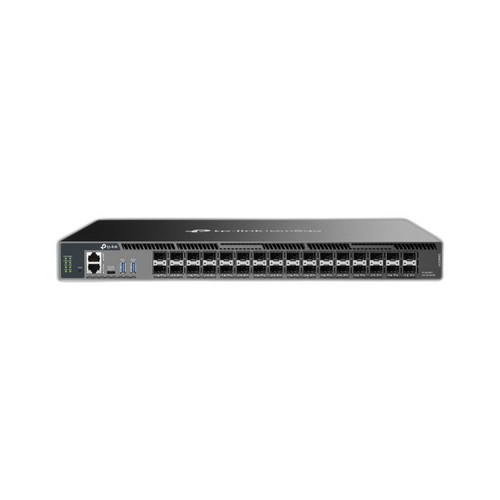
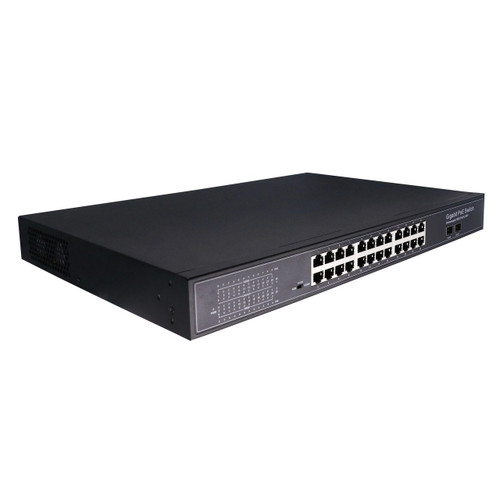
Both products are 26-port managed Gigabit/multi-gigabit switches positioned for commercial and light-industrial LAN deployments, and both support IEEE 802.3at PoE+. However, they diverge sharply in performance tier: the TP-Link SX6632YF is a 10G/25G all-fiber aggregation switch with 820 Gbps switching capacity, while the Comnet CWGE26FX2TX24MSPOE is a copper-dominant Gigabit edge switch with 52 Gbps switching bandwidth and 320 W PoE budget. A buyer choosing between them is weighing high-speed fiber backbone performance against a purpose-built PoE edge switch with environmental and redundancy credentials for physical-security infrastructure.
In This Guide
- Which switch delivers the port density and throughput your network backbone requires?
- Which switch better supports PoE-powered devices and demanding physical deployment environments?
- Which switch offers the management framework and network redundancy protocols your security or IT infrastructure demands?
- Which should you choose: the SX6632YF or the CWGE26FX2TX24MSPOE?
- Side-by-Side Specs
- FAQ
Which switch delivers the port density and throughput your network backbone requires?
The TP-Link SX6632YF provides 26×10G SFP+ ports and 6×25G SFP28 uplink ports — all fiber — with a non-blocking switching capacity of 820 Gbps. It supports stacking of up to 9 units, enabling a scalable high-density aggregation layer. Port speed is 10G on access ports and 25G on uplinks; no copper RJ45 access ports are specified in the provided data.
The Comnet CWGE26FX2TX24MSPOE offers 22×10/100/1000BASE-T copper ports, 2×Gigabit Combo ports, and 2×100/1000BASE-Fx SFP fiber ports — all at Gigabit speeds. Its switching bandwidth is 52 Gbps with a MAC table of 8,000 entries and jumbo frame support up to 9.6 KB. Stacking capability is not specified in the provided data.
The throughput gap is substantial: 820 Gbps vs. 52 Gbps, a roughly 15× difference. For high-density camera or IP device edge connections at Gigabit speeds with PoE, the Comnet is purpose-fitted. For aggregation of 10G uplinks or high-throughput inter-switch links, the TP-Link is in a different performance class entirely.
Which switch better supports PoE-powered devices and demanding physical deployment environments?
The Comnet CWGE26FX2TX24MSPOE delivers a stated total PoE budget of 320 W across its PoE-capable ports at up to 30 W per port (IEEE 802.3at). Typical power consumption is listed at 36 W, with maximum at 356 W. It is rated for operation from -10°C to +60°C and storage from -40°C to +85°C, with 5–95% non-condensing humidity tolerance. MTBF is stated as greater than 100,000 hours.
The TP-Link SX6632YF lists PoE+ (802.3at) support, but the provided specification data does not state a total PoE power budget, per-port PoE wattage, or PoE port count. Its operating temperature range is not provided in the supplied specs (the field shows '&', indicating a data gap). No MTBF figure is provided.
For PoE device deployments — IP cameras, access control readers, intercoms — the Comnet provides the concrete 320 W budget and per-port 30 W ceiling needed for capacity planning. The Comnet also has explicit environmental ratings relevant to IDF closets or light-industrial security head-end rooms. The TP-Link's PoE parameters and environmental envelope cannot be confirmed from the supplied data.
Which switch offers the management framework and network redundancy protocols your security or IT infrastructure demands?
The TP-Link SX6632YF operates under the Omada SDN Controller platform and supports CLI, SNMP v1/v2c/v3, and RMON. Layer 3 routing features include OSPF, RIPv2, VRRP, ECMP, PIM-SM/DM, Policy-Based Routing (PBR), and Static Routing. Redundancy protocols include ERPS and stacking (up to 9 units). It uses a Quad-Core ARM processor at 1.2 GHz with 8 GB eMMC storage.
The Comnet CWGE26FX2TX24MSPOE supports 802.1Q VLANs (up to 256), and redundancy protocols including C-Ring (Comnet's proprietary fast-ring), ERPS (G.8032), RSTP, STP, and MSTP. Regulatory approvals are provided: FCC Part 15, CISPR/EN55022 Class A, and EN61000-4-x. The management interface type and SNMP version support are not specified in the provided data.
The TP-Link offers a richer L3 routing feature set and a centralized SDN management plane via Omada, suitable for multi-site enterprise IT deployments. The Comnet's inclusion of C-Ring alongside ERPS and MSTP is relevant for physical-security ring topologies common in surveillance LAN designs, and its regulatory certifications (EN61000-4-x) address electromagnetic immunity — a meaningful credential for industrial or security-hardened environments. Neither product's cybersecurity certifications are stated in the provided data.
Which should you choose: the SX6632YF or the CWGE26FX2TX24MSPOE?
Our take: The SX6632YF is the stronger choice when building a 10G/25G aggregation or spine layer where throughput, L3 routing depth, and SDN management scalability are the primary requirements. Its 820 Gbps switching capacity dwarfs the Comnet's 52 Gbps, and its L3 feature set (OSPF, VRRP, PBR, 25G uplinks, 9-unit stacking) targets enterprise IT backbone deployments. However, the SX6632YF's PoE budget, per-port PoE wattage, and operating temperature range are absent from the supplied specifications, making PoE capacity planning impossible from this data. The Comnet CWGE26FX2TX24MSPOE is purpose-built for physical-security edge layers: its 320 W PoE budget, 30 W per-port ceiling, -10°C to +60°C operating range, 100,000-hour MTBF, and EN61000-4-x EMI immunity certifications address the concrete requirements of surveillance and access-control edge closets. Buyers deploying IP cameras and access readers with defined PoE budgets in hardened environments should favour the Comnet; buyers building high-throughput aggregation layers on a unified SDN platform should favour the TP-Link.
Side-by-Side Comparison
Spec-for-spec, from manufacturer data.
| Specification | TP-Link SX6632YF | Comnet CWGE26FX2TX24MSPOE |
|---|---|---|
| Product Type | Stackable L3 Managed Aggregation Switch | Managed PoE Edge Switch |
| Total Ports | 32 (26×10G SFP+ + 6×25G SFP28) | 26 (22×RJ45 + 2×Combo + 2×SFP) |
| Copper Access Ports | — | 22×10/100/1000BASE-T |
| Fiber/SFP Ports | 26×10G SFP+ + 6×25G SFP28 | 2×100/1000BASE-Fx SFP |
| Max Port Speed | 25G (SFP28 uplinks) | 1G |
| Switching Capacity / Bandwidth | 820 Gbps | 52 Gbps |
| PoE Standard | IEEE 802.3at (PoE+) | IEEE 802.3at (PoE+) |
| Total PoE Budget | — | 320 W |
| Max PoE Per Port | — | 30 W |
| Max Power Consumption | — | 356 W |
| Stacking | Up to 9 units | — |
| Layer 3 Routing | OSPF, RIPv2, VRRP, ECMP, PBR, PIM-SM/DM, Static | — |
| Redundancy Protocols | ERPS | C-Ring, ERPS (G.8032), RSTP/STP/MSTP |
| Operating Temperature | — | -10°C to +60°C |
| MTBF | — | >100,000 hours |
| Management Platform | Omada SDN Controller; CLI; SNMP v1/v2c/v3; RMON | — |
| Regulatory Approvals | — | FCC Part 15; CISPR EN55022 Class A; EN61000-4-x |
| Dimensions (in) | 17.3 × 15.0 × 1.7 | 13.46 × 16.97 × 1.73 |
| Power Supply | 100–240 V AC, 50/60 Hz | 100–240 VAC, 50–60 Hz |
Frequently Asked Questions
Which should you choose: the SX6632YF or the CWGE26FX2TX24MSPOE?
The SX6632YF is the stronger choice when building a 10G/25G aggregation or spine layer where throughput, L3 routing depth, and SDN management scalability are the primary requirements. Its 820 Gbps switching capacity dwarfs the Comnet's 52 Gbps, and its L3 feature set (OSPF, VRRP, PBR, 25G uplinks, 9-unit stacking) targets enterprise IT backbone deployments. However, the SX6632YF's PoE budget, per-port PoE wattage, and operating temperature range are absent from the supplied specifications, making PoE capacity planning impossible from this data. The Comnet CWGE26FX2TX24MSPOE is purpose-built for physical-security edge layers: its 320 W PoE budget, 30 W per-port ceiling, -10°C to +60°C operating range, 100,000-hour MTBF, and EN61000-4-x EMI immunity certifications address the concrete requirements of surveillance and access-control edge closets. Buyers deploying IP cameras and access readers with defined PoE budgets in hardened environments should favour the Comnet; buyers building high-throughput aggregation layers on a unified SDN platform should favour the TP-Link.
Is the SX6632YF or CWGE26FX2TX24MSPOE better for connecting a large number of IP security cameras with PoE?
The Comnet CWGE26FX2TX24MSPOE is better suited for direct PoE camera connections: it specifies a 320 W total PoE budget and 30 W per port (IEEE 802.3at) across its 22 copper ports, giving you concrete numbers for capacity planning. The TP-Link SX6632YF lists PoE+ (802.3at) support but does not provide a total PoE budget or per-port wattage in the supplied specifications, so you cannot reliably plan PoE loading from the available data. The TP-Link is also an all-fiber switch, whereas the Comnet provides 22 copper RJ45 ports for direct camera connections without SFP transceivers.
Can either switch be used as the core aggregation switch in a multi-building physical security network?
The TP-Link SX6632YF is more suitable for aggregation roles: it offers 26×10G SFP+ and 6×25G SFP28 fiber ports, 820 Gbps switching capacity, Layer 3 routing (OSPF, VRRP, ECMP, PBR), and stacking of up to 9 units — all characteristics of an aggregation or spine switch. The Comnet CWGE26FX2TX24MSPOE operates at Gigabit speeds with 52 Gbps switching bandwidth and is designed as an edge or distribution switch; stacking is not specified in its provided data. For aggregating multiple Gigabit edge switches across buildings, the TP-Link's 10G uplinks and L3 routing are the relevant capabilities.
Which switch has better environmental and reliability credentials for a demanding security deployment?
The Comnet CWGE26FX2TX24MSPOE provides explicit environmental and reliability data: operating range -10°C to +60°C, storage to -40°C to +85°C, 5–95% humidity (non-condensing), MTBF greater than 100,000 hours, and EN61000-4-x electromagnetic immunity certifications. The TP-Link SX6632YF's operating temperature range is not available in the supplied specifications, and no MTBF or EMI immunity certification is listed. For deployments where environmental tolerance and certified EMI resilience are procurement requirements — such as industrial-adjacent security head-end rooms — the Comnet's stated credentials are verifiable from the provided data; the TP-Link's are not.
More Network Switch Comparisons
- TP-Link SX6632YF vs Comnet CWG26F4T22M
- TP-Link SX6632YF vs Comnet CNGE26FX2TX24MSPOE2
- Comnet CWG26F4T22MP vs Comnet CWG26F4T22M
- Comnet CWG26F4T22MP vs Comnet CWGE26FX2TX24MSPOE
- Comnet CWG26F4T22M vs Comnet CWGE26FX2TX24MSPOE
- Comnet CNGE26FX2TX24MSPOE2 vs Comnet CWG26F4T22MP
Network Switch Buying Guides
Get a Second Opinion on Your Camera Choice
Share your site layout, coverage goals, and budget. Our team will validate the camera selection, flag anything we would change, and recommend products that match the use case.