
Comnet CNGE26FX2TX24MSPOE2 vs Comnet CWG26F4T22MP: Specification Comparison
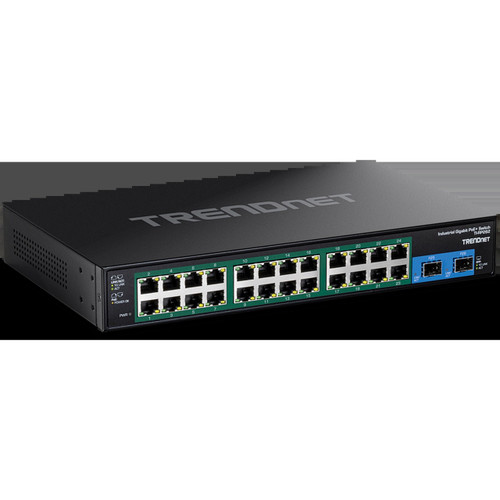
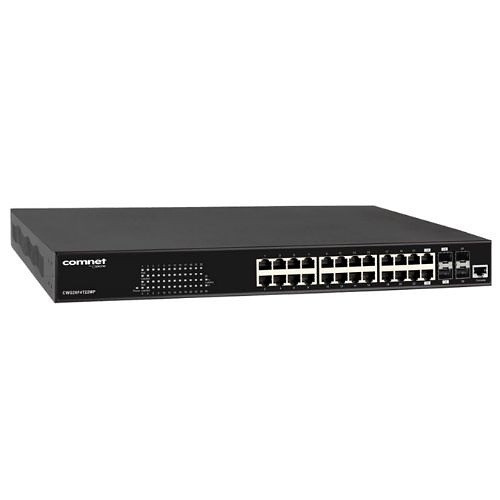
Both the Comnet CNGE26FX2TX24MSPOE2 and CWG26F4T22MP are 26-port Gigabit managed PoE switches in identical 1-RU 19-inch rack enclosures, sharing the same switching bandwidth, latency, MAC table size, and jumbo frame ceiling. A buyer deploying IP cameras, access control, or other PoE edge devices would legitimately cross-shop these two models. Key differentiators sit in PoE budget and grade, operating environment tolerance, power input type, and regulatory/management depth—each of which materially affects fit for a given installation.
In This Guide
- Which switch delivers more PoE power, and how does per-port output compare?
- Which switch is better suited to harsh or outdoor-adjacent environments, and what power infrastructure does each require?
- Which switch offers deeper management, more VLAN capacity, and stronger network redundancy for multi-segment deployments?
- Which should you choose: the CNGE26FX2TX24MSPOE2 or the CWG26F4T22MP?
- Side-by-Side Specs
- FAQ
Which switch delivers more PoE power, and how does per-port output compare?
The CNGE26FX2TX24MSPOE2 provides a total PoE budget of 720 W across its PoE-capable ports, with a maximum of 30 W per port under IEEE 802.3at (PoE+). This makes it capable of powering high-draw devices such as pan-tilt-zoom cameras, dual-band Wi-Fi 6 APs, or multi-door access controllers without requiring local injectors.
The CWG26F4T22MP specifies a maximum PoE budget of 420 W across 24 PSE ports, with per-port output of up to 30 W (Mode A pinout: pairs 1/2 and 3/6). Its maximum total power consumption including PoE load is listed at 450 W. The 720 W versus 420 W budget gap is 71% more headroom on the CNGE26FX2TX24MSPOE2—a direct constraint when aggregating many high-watt devices on a single switch. The CWG26F4T22MP's PoE standard is not explicitly named in the provided specs, though the 30 W per-port ceiling is consistent with 802.3at.
Which switch is better suited to harsh or outdoor-adjacent environments, and what power infrastructure does each require?
The CNGE26FX2TX24MSPOE2 is explicitly designated 'Hardened Industrial' and operates from -20 °C to +60 °C, with storage rated to -40 °C. It is powered by 50–57 VDC, which is consistent with a DC-bus or battery-backed industrial power plant—common in transportation, utilities, and ruggedized surveillance enclosures. It also carries a broader EMC envelope: ESD, radiated susceptibility, EFT, surge, conducted susceptibility, and AC immunity per EN61000-4-x, plus mechanical shock, vibration, and free-fall per IEC 60068.
The CWG26F4T22MP is designated 'Commercial Grade' and operates from 0 °C to +50 °C, with storage to -20 °C. It accepts 100–240 VAC at 50–60 Hz, meaning it plugs into a standard UPS-backed AC circuit—simpler to power but ineligible where only DC infrastructure exists. Its EMC coverage (EN61000-4-2 through -11) is solid for a commercial product but narrower than the industrial unit. The 20 °C lower-end difference is material for unheated IDF closets, parking garages, or northern outdoor enclosures.
Which switch offers deeper management, more VLAN capacity, and stronger network redundancy for multi-segment deployments?
The CWG26F4T22MP leads on VLAN scale: 4,000 maximum VLANs versus 256 on the CNGE26FX2TX24MSPOE2. For a multi-tenant facility, a campus with hundreds of isolated segments, or a network using dot1q trunking heavily, the 4,000-VLAN ceiling is a meaningful architectural advantage. The CWG26F4T22MP also specifies 8 priority queues per port, 13 aggregation groups with 8 ports each, and 1,024 IGMP groups—specs not provided for the CNGE26FX2TX24MSPOE2.
The CNGE26FX2TX24MSPOE2 counters with explicit redundancy protocol support: C-Ring (Comnet proprietary sub-20 ms recovery), ERPS (ITU-T G.8032), and RSTP/STP/MSTP. It also lists security features by name—802.1x port authentication, ACLs, Device Binding, HTTPS, and SSH—and management via SNMP v1/v2c/v3, RMON, Web, Telnet, and CLI. The CWG26F4T22MP's redundancy protocols and security feature set are not specified in the provided data. For a ring-topology or mission-critical uptime requirement, the CNGE26FX2TX24MSPOE2's stated redundancy options are directly verifiable; the CWG26F4T22MP's are not.
Which should you choose: the CNGE26FX2TX24MSPOE2 or the CWG26F4T22MP?
Our take: The CNGE26FX2TX24MSPOE2 is the stronger choice when the installation demands ruggedized environmental tolerance, a high aggregate PoE budget, and verifiable network redundancy. Three concrete spec deltas drive this: (1) PoE budget is 720 W versus 420 W—a 300 W advantage that supports roughly 10 additional 30 W devices at full draw; (2) operating temperature floor is -20 °C versus 0 °C, covering unheated or outdoor-adjacent locations the CWG26F4T22MP cannot; (3) ring redundancy protocols (C-Ring, ERPS) are explicitly listed on the CNGE26FX2TX24MSPOE2 but absent from the CWG26F4T22MP's provided specs. The CWG26F4T22MP is the appropriate choice for climate-controlled commercial wiring closets on AC power where VLAN scale (4,000 vs. 256) and AC input simplicity matter more than environmental hardening or PoE headroom.
Side-by-Side Comparison
Spec-for-spec, from manufacturer data.
| Specification | Comnet CNGE26FX2TX24MSPOE2 | Comnet CWG26F4T22MP |
|---|---|---|
| Total Port Count | 26 | 26 |
| Copper RJ45 Ports | 22 x 10/100/1000BASE-T(x) | 22 x 10/100/1000 Mbps TX (implied from model name) |
| SFP / Fiber Ports | 2 x Gigabit Combo + 2 x 100/1000BASE-Fx SFP | Not specified in provided specs |
| Switching Bandwidth | 52 Gbps | 52 Gbps |
| Switching Latency | 7 µs | 7 µs |
| Forwarding Rate | — | 38.688 Mpps |
| MAC Table Size | 8,000 | 8,000 |
| VLANs Supported | 256 | 4,000 |
| Priority Queues Per Port | — | 8 |
| Jumbo Frame Support | Up to 9.6 KB | Up to 9.6 KB |
| PoE Standard | IEEE 802.3at | Not specified (30 W per port max) |
| PoE Power Per Port (Max) | 30 W | 15.4 W / 30 W |
| Total PoE Budget | 720 W | 420 W |
| Number of PSE Ports | Not specified individually | 24 |
| Operating Temperature | -20 °C to +60 °C | 0 °C to +50 °C |
| Storage Temperature | -40 °C to +85 °C | -20 °C to +80 °C |
| Humidity (Operating) | 5% to 95% non-condensing | 10% to 90% non-condensing |
| Power Input | 50–57 VDC | 100–240 VAC, 50–60 Hz |
| Power Consumption (no PoE) | 36 W | 30 W (typical) |
| Max Power Consumption (with PoE) | — | 450 W |
| Enclosure | 1-RU, 19-inch rack-mountable | 1-RU, 19-inch rack-mountable |
| Dimensions | 13.46 x 16.97 x 1.73 in | 13.46 x 16.97 x 1.73 in |
| Shipping Weight | < 13 lbs / 6 kg | 13.2 lbs / 6 kg |
| MTBF | > 100,000 hours | > 100,000 hours |
| Redundancy Protocols | C-Ring, ERPS (G.8032), RSTP/STP/MSTP | Not specified in provided specs |
| Management Protocols | SNMP v1/v2c/v3, RMON, Web, Telnet, CLI | Not specified in provided specs |
| Security Features | 802.1x, ACL, Device Binding, HTTPS, SSH | Not specified in provided specs |
| IGMP Groups | — | 1,024 |
| Link Aggregation Groups | — | 13 groups / 8 ports per group |
| Product Grade | Hardened Industrial | Commercial Grade |
Frequently Asked Questions
Which should you choose: the CNGE26FX2TX24MSPOE2 or the CWG26F4T22MP?
The CNGE26FX2TX24MSPOE2 is the stronger choice when the installation demands ruggedized environmental tolerance, a high aggregate PoE budget, and verifiable network redundancy. Three concrete spec deltas drive this: (1) PoE budget is 720 W versus 420 W—a 300 W advantage that supports roughly 10 additional 30 W devices at full draw; (2) operating temperature floor is -20 °C versus 0 °C, covering unheated or outdoor-adjacent locations the CWG26F4T22MP cannot; (3) ring redundancy protocols (C-Ring, ERPS) are explicitly listed on the CNGE26FX2TX24MSPOE2 but absent from the CWG26F4T22MP's provided specs. The CWG26F4T22MP is the appropriate choice for climate-controlled commercial wiring closets on AC power where VLAN scale (4,000 vs. 256) and AC input simplicity matter more than environmental hardening or PoE headroom.
Can either switch power high-watt PTZ cameras or Wi-Fi 6 APs across all 24 ports simultaneously?
The CNGE26FX2TX24MSPOE2's 720 W budget supports an average of 30 W per PoE port across 24 ports—enough for full-load 802.3at devices on every port simultaneously. The CWG26F4T22MP's 420 W budget across 24 PSE ports averages 17.5 W per port at full simultaneous load; pairing it with multiple 30 W devices will require careful power budgeting to avoid hitting the 420 W ceiling.
Is the CNGE26FX2TX24MSPOE2 or CWG26F4T22MP better for deployments with hundreds of VLANs?
The CWG26F4T22MP supports up to 4,000 VLANs; the CNGE26FX2TX24MSPOE2 is specified at 256. For multi-tenant buildings, large campuses, or any design requiring more than 256 isolated segments, the CWG26F4T22MP has a clear capacity advantage on this single dimension.
Which switch is suitable for installation in an unheated outdoor enclosure or a location that drops below freezing?
Only the CNGE26FX2TX24MSPOE2 is rated for sub-zero operation: its operating range begins at -20 °C. The CWG26F4T22MP's operating range starts at 0 °C, so it is not specified for use in environments that reach freezing temperatures. Additionally, the CNGE26FX2TX24MSPOE2 accepts 50–57 VDC input, which aligns with outdoor and industrial DC power plants; the CWG26F4T22MP requires 100–240 VAC.
More Network Switch Comparisons
- TP-Link SX6632YF vs Comnet CWG26F4T22M
- TP-Link SX6632YF vs Comnet CWGE26FX2TX24MSPOE
- TP-Link SX6632YF vs Comnet CNGE26FX2TX24MSPOE2
- Comnet CWG26F4T22MP vs Comnet CWG26F4T22M
- Comnet CWG26F4T22MP vs Comnet CWGE26FX2TX24MSPOE
- Comnet CWG26F4T22M vs Comnet CWGE26FX2TX24MSPOE
Network Switch Buying Guides
Get a Second Opinion on Your Camera Choice
Share your site layout, coverage goals, and budget. Our team will validate the camera selection, flag anything we would change, and recommend products that match the use case.