
Comnet CWG26F4T22MP vs Comnet CWGE26FX2TX24MSPOE: Specification Comparison
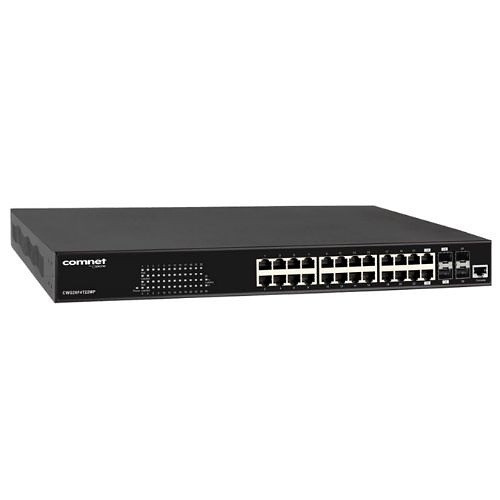
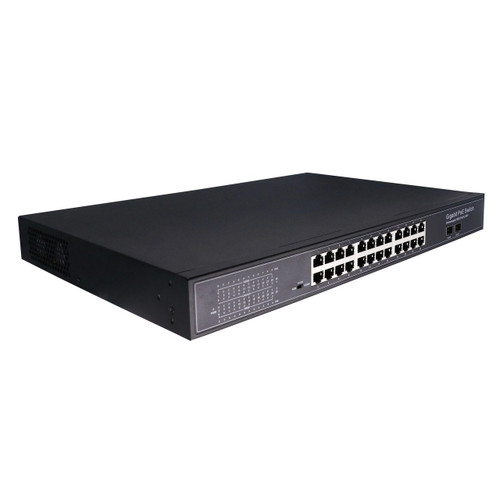
Both the Comnet CWG26F4T22MP and the CWGE26FX2TX24MSPOE are 26-port, 1U rack-mount Gigabit managed PoE switches aimed at commercial IP security and building-automation installers. Each delivers 52 Gbps switching bandwidth and an 8,000-entry MAC table in an identical chassis footprint, making them genuine cross-shop candidates. The comparison turns on PoE budget and port architecture, VLAN and redundancy feature depth, and environmental operating range — the three axes that drive switch selection in surveillance and access-control deployments.
In This Guide
- Which switch delivers more PoE power and how are the uplink ports structured?
- Which switch offers deeper VLAN segmentation and network redundancy protocols?
- Which switch handles a wider operating environment and what are the real power draw differences?
- Which should you choose: the CWG26F4T22MP or the CWGE26FX2TX24MSPOE?
- Side-by-Side Specs
- FAQ
Which switch delivers more PoE power and how are the uplink ports structured?
The CWG26F4T22MP provides 24 PSE ports with a maximum PoE budget of 420 W. Per-port output is listed as up to 15.4 W (802.3af) or 30 W (802.3at), and the spec sheet explicitly documents Mode A pinout (1/2+, 3/6−). The uplink complement is 4 fiber/SFP ports alongside 22 copper TX ports, giving the unit a strong fiber uplink ratio for connecting to a head-end or IDF across long runs.
The CWGE26FX2TX24MSPOE offers 24 PoE-capable copper ports as well, but its total PoE budget is 320 W — 100 W less than the CWG26F4T22MP. Per-port maximum is 30 W (IEEE 802.3at). Its uplink architecture differs: 2 dedicated 100/1000BASE-Fx SFP ports plus 2 Gigabit combo ports (copper or SFP), yielding up to 4 fiber-capable uplinks but with only 22 copper access ports documented.
For power-hungry edge devices — multi-sensor cameras, pan-tilt units, or 802.3at access controllers — the CWG26F4T22MP's 420 W budget provides roughly 31% more headroom than the CWGE26FX2TX24MSPOE's 320 W ceiling before load-shedding occurs.
Which switch offers deeper VLAN segmentation and network redundancy protocols?
The CWG26F4T22MP supports up to 4,000 VLANs, an 8-queues-per-port QoS architecture, 1,024 IGMP snooping groups, 13 aggregation groups with up to 8 ports each, and a forwarding rate of 38.688 Mbps. Its VLAN and multicast depth make it suited to large, segmented deployments where camera streams, access-control traffic, and management planes must be isolated across many logical networks. Redundancy protocols supported are not explicitly listed in the provided spec sheet.
The CWGE26FX2TX24MSPOE caps VLAN support at 256 (802.1Q), which is adequate for mid-size sites but falls far short of the CWG26F4T22MP's 4,000-VLAN ceiling. Where the CWGE26FX2TX24MSPOE pulls ahead is in documented redundancy protocols: C-Ring, ERPS (G.8032), RSTP/STP/MSTP are all explicitly listed, providing ring-topology resilience critical in industrial or campus ring deployments. Aggregation group count and IGMP group capacity are not specified for this model.
Buyers who need ring redundancy with documented protocol support should note that only the CWGE26FX2TX24MSPOE names those protocols in its spec sheet. Buyers who need fine-grained VLAN segmentation at scale will find the CWG26F4T22MP's 4,000-VLAN limit a substantial advantage.
Which switch handles a wider operating environment and what are the real power draw differences?
The CWG26F4T22MP is rated for 0 °C to +50 °C operation and −20 °C to +80 °C storage, with relative humidity of 10 %–90 % (non-condensing). Typical power consumption is listed as 30 W (non-PoE system draw); maximum system power including full PoE load is 450 W. EMC testing covers FCC Part 15 / CISPR Class A plus a full EN61000-4 suite (−2, −3, −4, −5, −6, −8, −11), and mechanical resilience is documented via IEC 60068-2-27 (shock), IEC 60068-2-32 (free fall), and IEC 60068-2-6 (vibration).
The CWGE26FX2TX24MSPOE operates across a wider range: −10 °C to +60 °C, a 10-degree advantage on both ends, and storage from −40 °C to +85 °C. Humidity tolerance is 5 %–95 % non-condensing — a broader band than the CWG26F4T22MP. Typical system power draw is 36 W (non-PoE), and maximum system power is 356 W, reflecting the lower PoE budget. Regulatory compliance is noted as FCC Part 15, CISPR Class A, EN61000-4-x, but individual sub-clauses tested are not enumerated in the provided spec.
For deployments in unconditioned IDF closets, outdoor-adjacent enclosures, or sites with humidity swings, the CWGE26FX2TX24MSPOE's broader thermal and humidity envelope is a concrete advantage. The CWG26F4T22MP's individually itemized IEC shock/vibration certifications may matter in high-vibration environments where documentation is required for warranty or compliance purposes.
Which should you choose: the CWG26F4T22MP or the CWGE26FX2TX24MSPOE?
Our take: The CWG26F4T22MP is the stronger choice when PoE budget and VLAN scale are the primary constraints. Its 420 W PoE ceiling exceeds the CWGE26FX2TX24MSPOE's 320 W by 100 W, its VLAN capacity of 4,000 dwarfs the competing model's 256, and its IGMP snooping supports 1,024 groups versus a figure not published for the CWGE26FX2TX24MSPOE — all critical in large camera-dense or multi-tenant deployments. Conversely, the CWGE26FX2TX24MSPOE operates from −10 °C to +60 °C versus the CWG26F4T22MP's 0 °C to +50 °C, and it explicitly documents C-Ring, ERPS, and MSTP redundancy protocols that are absent from the CWG26F4T22MP's spec sheet. Choose the CWG26F4T22MP for high-density PoE surveillance or access-control LAN cores that require deep VLAN segmentation; choose the CWGE26FX2TX24MSPOE for ring-topology or temperature-stressed installations where documented redundancy and wider thermal range matter more than raw PoE headroom.
Side-by-Side Comparison
Spec-for-spec, from manufacturer data.
| Specification | Comnet CWG26F4T22MP | Comnet CWGE26FX2TX24MSPOE |
|---|---|---|
| Switching Bandwidth | 52 Gbps | 52 Gbps |
| Switching Latency | 7 µs | 7 µs |
| Forwarding Rate | 38.688 Mbps | — |
| Total PoE Budget | 420 W | 320 W |
| PoE Standard / Max Per Port | 802.3af/at; 15.4 W / 30 W | IEEE 802.3at; 30 W |
| Number of PSE Ports | 24 | 24 |
| Copper TX Ports | 22 x 10/100/1000 | 22 x 10/100/1000BASE-T(x) |
| Fiber / SFP Uplink Ports | 4 SFP | 2 x 100/1000BASE-Fx SFP + 2 x Combo |
| Max VLANs | 4,000 | 256 (802.1Q) |
| MAC Table Size | 8,000 | 8,000 |
| Jumbo Frame Support | Up to 9.6 KB | Up to 9.6 KB |
| IGMP Snooping Groups | 1,024 | — |
| Redundancy Protocols | — | C-Ring, ERPS (G.8032), RSTP/STP/MSTP |
| Operating Temperature | 0 °C to +50 °C | −10 °C to +60 °C |
| Max System Power Consumption | 450 W | 356 W |
| Enclosure / Form Factor | 1U, 19-in rack; 13.46 × 16.97 × 1.73 in | 1U, 19-in rack; 13.46 × 16.97 × 1.73 in |
Frequently Asked Questions
Which should you choose: the CWG26F4T22MP or the CWGE26FX2TX24MSPOE?
The CWG26F4T22MP is the stronger choice when PoE budget and VLAN scale are the primary constraints. Its 420 W PoE ceiling exceeds the CWGE26FX2TX24MSPOE's 320 W by 100 W, its VLAN capacity of 4,000 dwarfs the competing model's 256, and its IGMP snooping supports 1,024 groups versus a figure not published for the CWGE26FX2TX24MSPOE — all critical in large camera-dense or multi-tenant deployments. Conversely, the CWGE26FX2TX24MSPOE operates from −10 °C to +60 °C versus the CWG26F4T22MP's 0 °C to +50 °C, and it explicitly documents C-Ring, ERPS, and MSTP redundancy protocols that are absent from the CWG26F4T22MP's spec sheet. Choose the CWG26F4T22MP for high-density PoE surveillance or access-control LAN cores that require deep VLAN segmentation; choose the CWGE26FX2TX24MSPOE for ring-topology or temperature-stressed installations where documented redundancy and wider thermal range matter more than raw PoE headroom.
Which switch can power more high-wattage cameras or access-control panels simultaneously?
The CWG26F4T22MP has a 420 W total PoE budget across 24 PSE ports, compared to 320 W for the CWGE26FX2TX24MSPOE. At maximum 30 W per port (802.3at), the CWG26F4T22MP can sustain roughly 14 fully loaded 30 W ports before hitting its ceiling, versus approximately 10 on the CWGE26FX2TX24MSPOE — a meaningful difference in multi-sensor or PTZ-heavy deployments.
Is either switch suitable for a ring-topology or redundant network layout?
Only the CWGE26FX2TX24MSPOE explicitly lists ring and redundancy protocols in its provided specifications: C-Ring, ERPS (G.8032), RSTP/STP/MSTP. The CWG26F4T22MP's spec sheet does not document these protocols. If ring redundancy with named protocol support is a project requirement, the CWGE26FX2TX24MSPOE is the only model with confirmed spec-level documentation for it.
Can either switch be deployed in an unconditioned space or wiring closet that gets cold in winter?
The CWGE26FX2TX24MSPOE is rated down to −10 °C operating and −40 °C storage, making it more suitable for spaces that drop below freezing. The CWG26F4T22MP's operating floor is 0 °C, so it is not rated for sub-freezing conditions. For humidity tolerance, the CWGE26FX2TX24MSPOE also covers a wider range (5 %–95 %) versus the CWG26F4T22MP's 10 %–90 %.
More Network Switch Comparisons
- TP-Link SX6632YF vs Comnet CWG26F4T22M
- TP-Link SX6632YF vs Comnet CWGE26FX2TX24MSPOE
- TP-Link SX6632YF vs Comnet CNGE26FX2TX24MSPOE2
- Comnet CWG26F4T22MP vs Comnet CWG26F4T22M
- Comnet CWG26F4T22M vs Comnet CWGE26FX2TX24MSPOE
- Comnet CNGE26FX2TX24MSPOE2 vs Comnet CWG26F4T22MP
Network Switch Buying Guides
Get a Second Opinion on Your Camera Choice
Share your site layout, coverage goals, and budget. Our team will validate the camera selection, flag anything we would change, and recommend products that match the use case.