
TP-Link SX6632YF vs Comnet CNGE26FX2TX24MSPOE2: Specification Comparison
Both the TP-Link SX6632YF and the Comnet CNGE26FX2TX24MSPOE2 are 26-port managed Ethernet switches targeting enterprise and industrial network infrastructure, but they occupy meaningfully different market tiers and use-case profiles. The SX6632YF is a high-throughput, all-fiber 10G/25G aggregation switch built for data-center-adjacent or high-density campus backbones. The CNGE26FX2TX24MSPOE2 is a hardened, PoE-capable gigabit switch engineered for harsh industrial and physical-security deployments. This comparison evaluates their port architecture and throughput, power and environmental ruggedness, and management and redundancy capabilities.
In This Guide
- Which switch delivers more bandwidth and what does the port mix look like?
- Which switch is better suited to harsh or outdoor-adjacent operating environments, and what are the PoE power budgets?
- How do the two switches compare on network management interfaces, redundancy protocols, and security features?
- Which should you choose: the SX6632YF or the CNGE26FX2TX24MSPOE2?
- Side-by-Side Specs
- FAQ
Which switch delivers more bandwidth and what does the port mix look like?
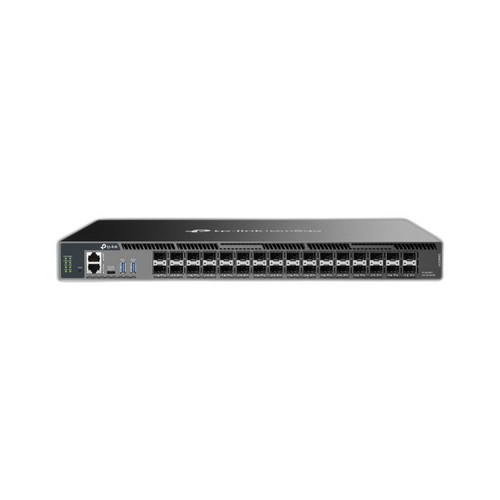
The TP-Link SX6632YF provides 26×10G SFP+ ports plus 6×25G SFP28 uplinks, all fiber-based (single-mode up to 64 m DDM), with a non-blocking switching fabric of 820 Gbps. This architecture is purpose-built for high-density aggregation, inter-switch stacking (up to 9 units), and backbone roles where multi-gigabit throughput per port is required.
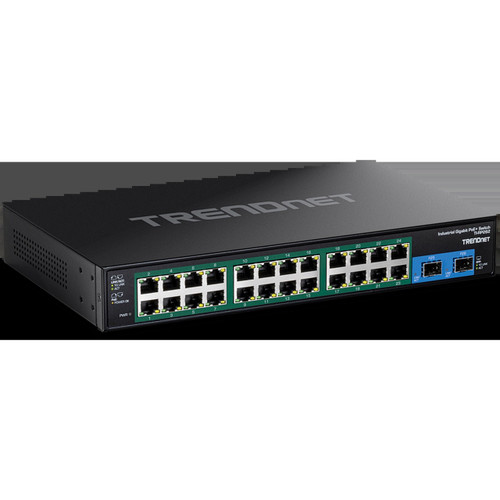
The Comnet CNGE26FX2TX24MSPOE2 delivers a mixed copper-fiber port set: 22×10/100/1000BASE-T(X) RJ45 ports, 2×Gigabit Combo ports, and 2×100/1000BASE-FX SFP slots, for a switching bandwidth of 52 Gbps and a switching latency of 7 μs. Its design prioritizes direct copper connectivity to IP cameras, access control panels, and other PoE edge devices rather than high-speed aggregation.
The throughput gap is substantial: 820 Gbps vs. 52 Gbps. Buyers needing 10G or 25G uplink density should note the SX6632YF has no RJ45 copper ports at all, while the Comnet has no 10G ports of any kind.
Which switch is better suited to harsh or outdoor-adjacent operating environments, and what are the PoE power budgets?
The Comnet CNGE26FX2TX24MSPOE2 is explicitly rated as a hardened industrial switch. Its operating temperature range is −20 °C to +60 °C and its storage temperature range extends to −40 °C to +85 °C. It carries regulatory certifications including FCC Part 15, CISPR (EN55022) Class A, and IEC EN61000-4-x ESD/RS/EFT/Surge/CS/AC plus IEC60068-2-27/32/6 for shock and vibration. Its MTBF is rated at greater than 100,000 hours. Operating voltage is 50–57 VDC. Total PoE budget is 720 W across IEEE 802.3at (PoE+) ports, delivering up to 30 W per port.
The TP-Link SX6632YF specifies an AC power supply (100–240 V, 50/60 Hz). Its operating temperature field in the provided specifications is listed as '&', which is an incomplete or corrupt value — no valid operating temperature range can be stated from the provided data. No MTBF figure, no shock/vibration rating, and no industrial certifications are listed in the provided specifications.
For any deployment subject to temperature extremes, power fluctuations, or vibration — such as transportation hubs, manufacturing floors, or outdoor cabinets — the Comnet's documented industrial ratings are directly spec-supported. The SX6632YF's environmental envelope cannot be confirmed from the data provided.
How do the two switches compare on network management interfaces, redundancy protocols, and security features?
The TP-Link SX6632YF supports CLI, SNMP v1/v2c/v3, and RMON. It integrates with TP-Link's Omada SDN Controller platform and supports Layer 3 routing protocols including OSPF, RIPv2, VRRP, ECMP, PIM-SM/DM, and PBR. It supports ERPS ring redundancy and stacking of up to 9 units via its stacking architecture. Its quad-core ARM processor runs at 1.2 GHz, with 2×4 MB NOR flash and 8 GB eMMC storage. A dedicated management port (1×RJ45) is provided.
The Comnet CNGE26FX2TX24MSPOE2 supports SNMP v1/v2c/v3, RMON, Web GUI, Telnet, and CLI management. Redundancy protocols include C-Ring (Comnet proprietary), ERPS (G.8032), RSTP, STP, and MSTP. Security features include 802.1x, ACL, Device Binding, HTTPS, and SSH. It supports 256 VLANs and an 8,000-entry MAC table with jumbo frames up to 9.6K bytes. No SDN controller integration is listed in the provided specifications.
The SX6632YF's Layer 3 routing suite (OSPF, VRRP, PIM multicast) is more extensive for enterprise routed-network designs. The Comnet's C-Ring plus ERPS redundancy is well-suited to ring topologies common in industrial and physical-security infrastructure. Neither platform is directly compatible with the other's management ecosystem based on the provided specifications.
Which should you choose: the SX6632YF or the CNGE26FX2TX24MSPOE2?
Our take: The SX6632YF is the stronger choice when the deployment requires high-throughput fiber aggregation, advanced Layer 3 routing, or SDN-controlled campus backbone infrastructure. It delivers 820 Gbps switching fabric versus the Comnet's 52 Gbps — a 15× difference — and adds 25G SFP28 uplink capability the Comnet does not offer. Conversely, the CNGE26FX2TX24MSPOE2 is the correct selection for hardened industrial or physical-security edge deployments: it provides 22 copper PoE+ ports with a 720 W total budget, a documented operating range of −20 °C to +60 °C with IEC60068 shock/vibration and EN61000-4 surge certifications, and an MTBF of greater than 100,000 hours — none of which are spec-confirmed for the SX6632YF from available data. Buyers running IP cameras, access control, or industrial I/O in environmentally stressful locations should select the Comnet; buyers building high-speed aggregation or routed core layers in controlled environments should select the SX6632YF.
Side-by-Side Comparison
Spec-for-spec, from manufacturer data.
| Specification | TP-Link SX6632YF | Comnet CNGE26FX2TX24MSPOE2 |
|---|---|---|
| Product Type | Stackable L3 Managed Aggregation Switch | Hardened Industrial Managed Switch |
| Total Ports | 32 (26×10G SFP+ + 6×25G SFP28) | 26 (22×RJ45 + 2×Combo + 2×SFP) |
| Port Speed (Copper) | None (all fiber) | 10/100/1000 Mbps (RJ45) |
| Port Speed (Fiber/Uplink) | 10G SFP+ / 25G SFP28 | 100/1000 Mbps SFP |
| Switching Capacity | 820 Gbps | 52 Gbps |
| Switching Latency | — | 7 μs |
| PoE Standard | 802.3at (PoE+) | IEEE 802.3at (PoE+) |
| PoE Per Port | — | Up to 30 W |
| Total PoE Budget | — | 720 W |
| Operating Temperature | Not confirmed (spec field corrupt) | −20 °C to +60 °C |
| Storage Temperature | — | −40 °C to +85 °C |
| MTBF | — | >100,000 hours |
| Redundancy Protocols | ERPS, Stacking (up to 9 units) | C-Ring, ERPS (G.8032), RSTP/STP/MSTP |
| Layer 3 Routing | OSPF, RIPv2, VRRP, ECMP, PIM-SM/DM, PBR | — |
| Management Interfaces | CLI, SNMP v1/v2c/v3, RMON, Omada SDN | CLI, SNMP v1/v2c/v3, RMON, Web, Telnet |
| Security Features | — | 802.1x, ACL, Device Binding, HTTPS/SSH |
| MAC Table Size | — | 8,000 entries |
| VLANs Supported | — | 256 |
| Power Input | 100–240 V AC, 50/60 Hz | 50–57 VDC |
| Dimensions (in) | 17.3 × 15.0 × 1.7 | 13.46 × 16.97 × 1.73 |
| Industrial Certifications | — | FCC, CISPR EN55022, EN61000-4-x, IEC60068 |
Frequently Asked Questions
Which should you choose: the SX6632YF or the CNGE26FX2TX24MSPOE2?
The SX6632YF is the stronger choice when the deployment requires high-throughput fiber aggregation, advanced Layer 3 routing, or SDN-controlled campus backbone infrastructure. It delivers 820 Gbps switching fabric versus the Comnet's 52 Gbps — a 15× difference — and adds 25G SFP28 uplink capability the Comnet does not offer. Conversely, the CNGE26FX2TX24MSPOE2 is the correct selection for hardened industrial or physical-security edge deployments: it provides 22 copper PoE+ ports with a 720 W total budget, a documented operating range of −20 °C to +60 °C with IEC60068 shock/vibration and EN61000-4 surge certifications, and an MTBF of greater than 100,000 hours — none of which are spec-confirmed for the SX6632YF from available data. Buyers running IP cameras, access control, or industrial I/O in environmentally stressful locations should select the Comnet; buyers building high-speed aggregation or routed core layers in controlled environments should select the SX6632YF.
Is the SX6632YF or CNGE26FX2TX24MSPOE2 better for powering IP cameras over PoE?
The Comnet CNGE26FX2TX24MSPOE2 is the purpose-built choice for PoE camera deployments. It provides 22 copper PoE+ (802.3at, up to 30 W per port) ports with a 720 W total PoE budget, copper RJ45 connectivity directly to cameras, and hardened environmental ratings suited to surveillance closets and outdoor cabinets. The TP-Link SX6632YF has no copper ports — it is an all-fiber SFP+ switch — so it cannot directly deliver PoE to cameras without intermediate switches. No PoE budget figure is listed for the SX6632YF in the provided specifications.
Can either switch operate in outdoor or industrial enclosures subject to temperature swings?
The Comnet CNGE26FX2TX24MSPOE2 is documented for operation from −20 °C to +60 °C with storage to −40 °C/+85 °C and carries IEC60068 shock/vibration and EN61000-4 ESD/surge certifications, making it spec-confirmed for industrial and harsh environments. The TP-Link SX6632YF's operating temperature field is incomplete in the provided specifications ('&' is listed), so no valid operating temperature range can be confirmed from available data. Buyers requiring documented thermal and EMC ratings for industrial deployments should rely on the Comnet's published spec sheet.
Which switch supports more advanced routing and is better for a routed core or aggregation layer?
The TP-Link SX6632YF is the stronger fit for routed aggregation. It supports Layer 3 protocols including OSPF, RIPv2, VRRP, ECMP, PIM-SM/DM, PBR, and ERPS, integrates with the Omada SDN Controller, and can stack up to 9 units. Its 820 Gbps non-blocking fabric and 26×10G SFP+ plus 6×25G SFP28 ports are sized for high-density inter-switch and uplink traffic. The Comnet CNGE26FX2TX24MSPOE2 focuses on Layer 2 redundancy (C-Ring, ERPS, RSTP/MSTP) and provides 52 Gbps switching bandwidth; no advanced Layer 3 routing protocols are listed in its provided specifications.
More Network Switch Comparisons
- TP-Link SX6632YF vs Comnet CWG26F4T22M
- TP-Link SX6632YF vs Comnet CWGE26FX2TX24MSPOE
- Comnet CWG26F4T22MP vs Comnet CWG26F4T22M
- Comnet CWG26F4T22MP vs Comnet CWGE26FX2TX24MSPOE
- Comnet CWG26F4T22M vs Comnet CWGE26FX2TX24MSPOE
- Comnet CNGE26FX2TX24MSPOE2 vs Comnet CWG26F4T22MP
Network Switch Buying Guides
Get a Second Opinion on Your Camera Choice
Share your site layout, coverage goals, and budget. Our team will validate the camera selection, flag anything we would change, and recommend products that match the use case.