
Comnet CWG26F4T22M vs Comnet CWGE26FX2TX24MSPOE: Specification Comparison
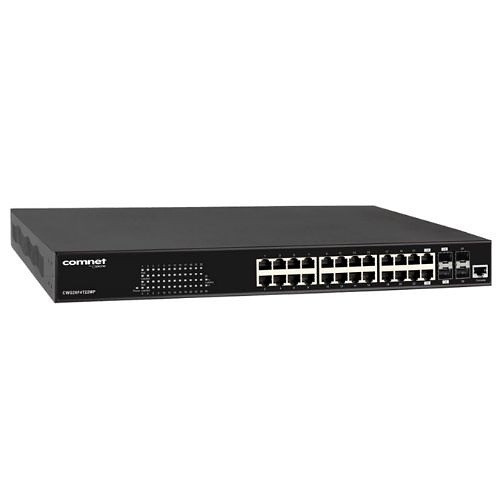
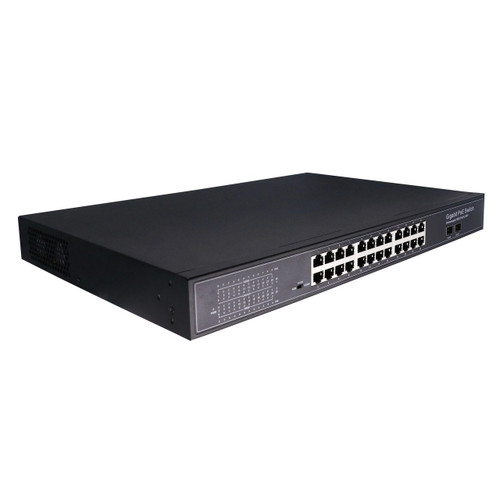
Both the Comnet CWG26F4T22M and the CWGE26FX2TX24MSPOE are 26-port, 1U rack-mountable Gigabit managed switches sharing identical port architecture—22 copper RJ-45 ports, 2 combo RJ-45/SFP ports, and 2 dedicated SFP uplinks. The fundamental differentiator is PoE capability: the CWGE26FX2TX24MSPOE delivers IEEE 802.3at PoE with a 320 W power budget, while the CWG26F4T22M is a non-PoE switch. Buyers cross-shopping these models are weighing whether powering IP cameras, access control readers, or other PoE endpoints from the switch itself justifies the trade-offs in VLAN scale, temperature range, and standby power draw.
In This Guide
- How do port density, PoE delivery, and switching throughput compare?
- Which switch offers broader management, VLAN scale, and network redundancy options?
- How do operating environment, power consumption, and certifications compare?
- Which should you choose: the CWG26F4T22M or the CWGE26FX2TX24MSPOE?
- Side-by-Side Specs
- FAQ
How do port density, PoE delivery, and switching throughput compare?
Both switches share identical port topology: 22 x RJ-45 10/100/1000 Mbps copper ports, 2 x Combo RJ-45/SFP ports, and 2 x dedicated SFP slots—26 ports total. Switching bandwidth is identical at 52 Gbps, and switching latency is identical at 7 µs on both models. The CWG26F4T22M specifies a forwarding rate of 38.688 Mbps (Mpps implied by spec label); the CWGE26FX2TX24MSPOE does not publish a forwarding rate figure.
The decisive port-level difference is PoE. The CWGE26FX2TX24MSPOE supports IEEE 802.3at (PoE+) at up to 30 W per port with a total PoE power budget of 320 W, enabling it to power IP cameras, VoIP handsets, or access readers directly. The CWG26F4T22M carries no PoE spec whatsoever; endpoints must be powered by separate injectors or PoE-capable midspans. For a deployment budgeting switch-fed power to 10+ cameras, the 320 W aggregate budget on the CWGE26FX2TX24MSPOE is a primary selection driver.
Which switch offers broader management, VLAN scale, and network redundancy options?
VLAN capacity differs substantially. The CWG26F4T22M supports up to 4,000 VLANs, making it suitable for large segmented deployments—multi-tenant facilities, enterprise campus distributions, or installations requiring granular traffic isolation per camera group or access zone. The CWGE26FX2TX24MSPOE caps at 256 VLANs via 802.1Q and does not specify a max-VLAN count beyond that figure.
Redundancy protocols also diverge. The CWG26F4T22M supports RSTP, STP, and MSTP. The CWGE26FX2TX24MSPOE adds Comnet's proprietary C-Ring and the standardized ERPS (G.8032) ring-protection protocol on top of RSTP/STP/MSTP—providing faster ring-recovery convergence relevant to surveillance ring topologies. Both switches support LACP and static link aggregation; this is stated explicitly for the CWG26F4T22M and implied by the CWGE26FX2TX24MSPOE's combo-port architecture, though aggregation is not listed in the CWGE26FX2TX24MSPOE spec sheet provided. The CWG26F4T22M also lists static Layer 3 routing support; L3 capability is not specified for the CWGE26FX2TX24MSPOE.
How do operating environment, power consumption, and certifications compare?
Operating temperature range favors the CWGE26FX2TX24MSPOE: -10°C to +60°C versus the CWG26F4T22M's 0°C to +50°C. The wider range on the CWGE26FX2TX24MSPOE suits installations in unheated closets, outdoor enclosures with climate control, or edge locations subject to temperature excursions. Storage temperature also favors the CWGE26FX2TX24MSPOE (-40°C to +85°C vs. -20°C to +80°C). Humidity tolerance similarly differs: 5%–95% non-condensing on the CWGE26FX2TX24MSPOE versus 10%–90% on the CWG26F4T22M.
Power draw diverges sharply due to PoE. The CWG26F4T22M draws a maximum of 25 W for switch electronics alone. The CWGE26FX2TX24MSPOE draws 36 W typical at switch level but up to 356 W maximum (switch + full PoE load), reflecting the 320 W PoE budget. The CWGE26FX2TX24MSPOE publishes an MTBF figure of >100,000 hours; no MTBF is specified for the CWG26F4T22M. The CWG26F4T22M lists TAA compliance and detailed IEC mechanical certifications (shock, free fall, vibration); the CWGE26FX2TX24MSPOE does not list TAA compliance or IEC mechanical test standards in the provided spec sheet.
Which should you choose: the CWG26F4T22M or the CWGE26FX2TX24MSPOE?
Our take: The CWG26F4T22M is the stronger choice when the deployment requires TAA compliance, large-scale VLAN segmentation (up to 4,000 VLANs), Layer 3 static routing, and a low-power non-PoE distribution switch for environments with a controlled 0°C–50°C operating range. Conversely, the CWGE26FX2TX24MSPOE is purpose-built for PoE-dependent physical security deployments: it delivers 320 W of IEEE 802.3at budget at up to 30 W per port—specs entirely absent from the CWG26F4T22M—and adds C-Ring and ERPS ring redundancy for faster failover in surveillance ring topologies. Its operating range (-10°C to +60°C) and storage range (-40°C to +85°C) also exceed the CWG26F4T22M on both ends. Choose the CWG26F4T22M for TAA-required, high-VLAN-count, non-PoE distribution; choose the CWGE26FX2TX24MSPOE for PoE camera/access-control edge switching where ring redundancy and wider temperature tolerance matter more than VLAN depth.
Side-by-Side Comparison
Spec-for-spec, from manufacturer data.
| Specification | Comnet CWG26F4T22M | Comnet CWGE26FX2TX24MSPOE |
|---|---|---|
| Total Port Count | 26 | 26 |
| Copper RJ-45 Ports | 22 x 10/100/1000 Mbps | 22 x 10/100/1000BASE-T(x) |
| Combo RJ-45/SFP Ports | 2 | 2 |
| Dedicated SFP Ports | 2 | 2 x 100/1000BASE-Fx SFP |
| PoE Standard | — | IEEE 802.3at |
| PoE Power Per Port | — | 30 W |
| Total PoE Power Budget | — | 320 W |
| Switching Bandwidth | 52 Gbps | 52 Gbps |
| Switching Latency | 7 µs | 7 µs |
| Forwarding Rate | 38.688 Mpps | — |
| MAC Table Size | 8,000 | 8,000 |
| Max VLANs | 4,000 | 256 |
| Redundancy Protocols | RSTP, STP, MSTP | C-Ring, ERPS (G.8032), RSTP, STP, MSTP |
| L3 Support | Static Route | — |
| Operating Temperature | 0°C to +50°C | -10°C to +60°C |
| Storage Temperature | -20°C to +80°C | -40°C to +85°C |
| Humidity | 10%–90% non-condensing | 5%–95% non-condensing |
| Max Power Consumption | 25 W | 356 W (switch + full PoE load) |
| Typical Switch Power | — | 36 W |
| Enclosure | 1-RU, 19-inch rack-mount | 1-RU, 19-inch rack-mount |
| Dimensions | 13.46 x 16.97 x 1.73 in | 13.46 x 16.97 x 1.73 in |
| Weight | 13.1 lbs / 5.9 kg | <13 lbs / 6 kg |
| MTBF | — | >100,000 hours |
| TAA Compliance | Yes | — |
| Jumbo Frame | Up to 9.6K bytes | Up to 9.6K bytes |
| EMI Certification | FCC Part 15, CISPR Class A | FCC Part 15, CISPR (EN55022) Class A |
| Mechanical Certifications | IEC60068-2-27, IEC60068-2-32, IEC60068-2-6 | — |
Frequently Asked Questions
Which should you choose: the CWG26F4T22M or the CWGE26FX2TX24MSPOE?
The CWG26F4T22M is the stronger choice when the deployment requires TAA compliance, large-scale VLAN segmentation (up to 4,000 VLANs), Layer 3 static routing, and a low-power non-PoE distribution switch for environments with a controlled 0°C–50°C operating range. Conversely, the CWGE26FX2TX24MSPOE is purpose-built for PoE-dependent physical security deployments: it delivers 320 W of IEEE 802.3at budget at up to 30 W per port—specs entirely absent from the CWG26F4T22M—and adds C-Ring and ERPS ring redundancy for faster failover in surveillance ring topologies. Its operating range (-10°C to +60°C) and storage range (-40°C to +85°C) also exceed the CWG26F4T22M on both ends. Choose the CWG26F4T22M for TAA-required, high-VLAN-count, non-PoE distribution; choose the CWGE26FX2TX24MSPOE for PoE camera/access-control edge switching where ring redundancy and wider temperature tolerance matter more than VLAN depth.
Can either switch power IP cameras directly without a separate PoE injector?
Only the CWGE26FX2TX24MSPOE supports PoE. It delivers IEEE 802.3at (PoE+) at up to 30 W per port with a 320 W total power budget, sufficient to power multiple IP cameras or access control devices directly. The CWG26F4T22M has no PoE capability specified; cameras or other powered devices connected to it would require separate PoE injectors or a midspan power solution.
Which switch is better suited for a government or federal project requiring TAA compliance?
The CWG26F4T22M is listed as TAA Compliant in its specifications. The CWGE26FX2TX24MSPOE does not include a TAA compliance statement in the provided spec sheet. For federal, state, or government projects where TAA compliance is a procurement requirement, the CWG26F4T22M is the only option of the two that satisfies this criterion based on the available data.
Is the CWG26F4T22M or CWGE26FX2TX24MSPOE better for larger deployments requiring extensive VLAN segmentation?
The CWG26F4T22M supports up to 4,000 VLANs, making it substantially more capable for large or multi-tenant deployments that require fine-grained traffic segmentation—such as isolating camera groups, access control networks, and corporate data traffic across a single switch. The CWGE26FX2TX24MSPOE is specified at a maximum of 256 VLANs. For high-VLAN-count architectures, the CWG26F4T22M has a clear advantage based on the published specifications.
More Network Switch Comparisons
- TP-Link SX6632YF vs Comnet CWG26F4T22M
- TP-Link SX6632YF vs Comnet CWGE26FX2TX24MSPOE
- TP-Link SX6632YF vs Comnet CNGE26FX2TX24MSPOE2
- Comnet CWG26F4T22MP vs Comnet CWG26F4T22M
- Comnet CWG26F4T22MP vs Comnet CWGE26FX2TX24MSPOE
- Comnet CNGE26FX2TX24MSPOE2 vs Comnet CWG26F4T22MP
Network Switch Buying Guides
Get a Second Opinion on Your Camera Choice
Share your site layout, coverage goals, and budget. Our team will validate the camera selection, flag anything we would change, and recommend products that match the use case.