
APC by Schneider Electric SMT1500J vs CyberPower PR1500LCD: Specification Comparison
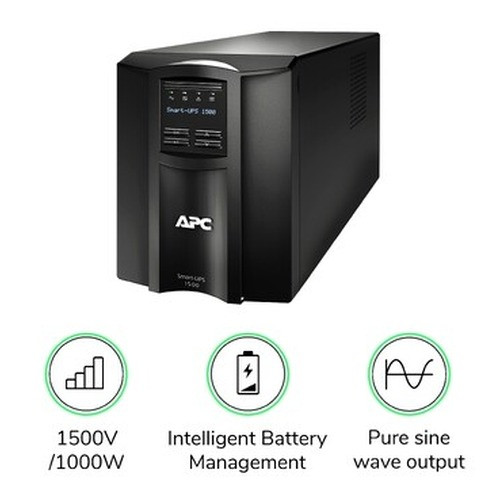
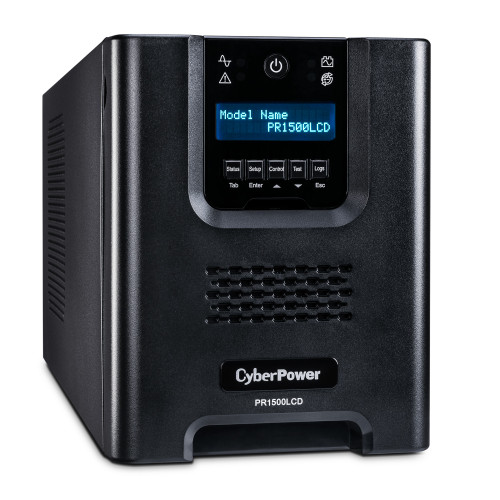
Both the APC SMT1500J and CyberPower PR1500LCD are 1500 VA line-interactive UPS systems built around sealed lead-acid batteries, true sine-wave output, and eight NEMA 5-15R output receptacles. This comparison examines the three dimensions most relevant to UPS purchasing decisions: power capacity and runtime, battery and power management capabilities, and connectivity plus management features. The SMT1500J is rated at 980 W / 1500 VA; the PR1500LCD is rated at 1500 W / 1500 VA — a meaningful watt-rating difference that affects usable load headroom.
In This Guide
- Which UPS delivers more usable wattage and longer runtime under real load conditions?
- How do the two units compare on battery technology, replaceability, surge protection, and AVR input range?
- What remote monitoring, management interfaces, and expansion options does each UPS support?
- Which should you choose: the SMT1500J or the PR1500LCD?
- Side-by-Side Specs
- FAQ
Which UPS delivers more usable wattage and longer runtime under real load conditions?
The APC SMT1500J carries a power rating of 980 W at 1500 VA, yielding a power factor of approximately 0.65. The CyberPower PR1500LCD is rated at 1500 W at 1500 VA — a power factor of 1.0 — meaning the CyberPower can support significantly heavier watt loads before reaching its rated ceiling. For a load drawing 980 W, the SMT1500J is at full rated capacity while the PR1500LCD still has 520 W of headroom.
At full load the SMT1500J provides 7 minutes of runtime; the PR1500LCD provides 4.7 minutes at its (higher) 1500 W full load. At half load the SMT1500J provides 24 minutes versus 15.1 minutes for the PR1500LCD at 750 W. Because the PR1500LCD's half-load baseline (750 W) is substantially higher than the SMT1500J's half-load baseline (490 W), the runtimes are not directly comparable without normalising to the same watt load — buyers should apply their actual load wattage against each unit's battery capacity to determine real-world runtime.
How do the two units compare on battery technology, replaceability, surge protection, and AVR input range?
Both units use sealed lead-acid (SLA) batteries. The CyberPower PR1500LCD specifies hot-swappable batteries (2 × 12 V / 17 Ah), allowing battery replacement without powering down connected equipment. The APC SMT1500J does not list hot-swap capability in the provided specifications.
The APC SMT1500J specifies a recharge time of 4 hours. No recharge time is stated in the CyberPower PR1500LCD specs provided. The SMT1500J carries a surge energy rating of 459 Joules and uses a circuit breaker for protection. No surge joule rating is listed for the PR1500LCD in the provided specs, though it does specify EMI/RFI filtration. On input voltage range, the SMT1500J operates from AC 80–123 V (adjustable 70–125 V) at 100 V nominal; the PR1500LCD accepts 78–149 VAC at 120 V nominal — a wider operating window on the high side, reflecting its North American 120 V design. The PR1500LCD also lists Active PFC compatibility and GreenPower UPS Bypass; neither feature appears in the SMT1500J spec sheet provided.
What remote monitoring, management interfaces, and expansion options does each UPS support?
The APC SMT1500J provides RS-232 (serial) and USB (4-pin Type B) management ports plus one SmartSlot expansion bay for optional network management cards. SmartSlot is APC's proprietary expansion ecosystem, supporting network management cards (SNMP/web), environmental sensors, and relay I/O cards — all sold separately. The provided specs list a serial cable as an included accessory.
The CyberPower PR1500LCD lists USB, Serial, and SNMP connectivity. SNMP connectivity is listed directly in the spec sheet, suggesting a built-in or included SNMP interface rather than an optional card, though the spec does not explicitly confirm whether a network card is included or optional. Both units include an LCD display for local status monitoring. The PR1500LCD additionally specifies an 'Extendable Multifunction LCD Panel.' No SNMP expansion slot or equivalent is described in the PR1500LCD specs beyond the listed connectivity fields.
Which should you choose: the SMT1500J or the PR1500LCD?
Our take: The PR1500LCD is the stronger choice when protecting high-watt, Active-PFC-sensitive loads on a North American 120 V circuit, particularly where battery serviceability matters. Its 1500 W capacity rating exceeds the SMT1500J's 980 W ceiling by 520 W — a 53% advantage in usable wattage — and its hot-swappable battery design eliminates downtime during battery replacement, a spec absent from the SMT1500J's provided data. Its 3-year warranty also extends one year beyond the SMT1500J's 2-year coverage. Conversely, the SMT1500J is the correct choice for 100 V Japanese electrical environments — it is explicitly rated for AC 100 V input — while the PR1500LCD is a 120 V North American unit. Buyers in APC-standardised environments may also prefer the SMT1500J's SmartSlot expansion bay for SNMP/relay accessories within an existing APC management infrastructure. Confirm actual load wattage against each unit's power rating before specifying either.
Side-by-Side Comparison
Spec-for-spec, from manufacturer data.
| Specification | APC by Schneider Electric SMT1500J | CyberPower PR1500LCD |
|---|---|---|
| Capacity (VA / W) | 1500 VA / 980 W | 1500 VA / 1500 W |
| Power Factor | 0.65 (calc.) | 1.0 (calc.) |
| UPS Topology | Line Interactive | Line Interactive |
| Output Waveform | Sine Wave | True Sine Wave |
| Nominal Input Voltage | AC 100 V | 120 VAC |
| Input Voltage Range | AC 80–123 V (adj. 70–125 V) | 78–149 VAC |
| Output Voltage | AC 100 V ± 5% | 120 VAC ± 5% |
| Output Receptacles | 8 × NEMA 5-15R | 8 × NEMA 5-15R |
| Runtime at Full Load | 7 min at 980 W | 4.7 min at 1500 W |
| Runtime at Half Load | 24 min at ~490 W | 15.1 min at 750 W |
| Battery Type | Sealed Lead-Acid | Sealed Lead-Acid (2 × 12V/17Ah) |
| Hot-Swappable Battery | — | Yes |
| Recharge Time | 4 hours | — |
| Surge Energy Rating | 459 Joules | — |
| Management Interfaces | RS-232, USB (Type B), SmartSlot ×1 | USB, Serial, SNMP |
| Warranty | 2 years limited | 3 years limited |
| Certifications | UL 1449, UL 1778, VCCI Class A, RoHS, REACH | UL1778, cUL 107.3, FCC DOC Class A, Energy Star, RoHS |
| Weight | 61.95 lb | 54 lb |
| Sound Emission | 45 dBA | — |
Frequently Asked Questions
Which should you choose: the SMT1500J or the PR1500LCD?
The PR1500LCD is the stronger choice when protecting high-watt, Active-PFC-sensitive loads on a North American 120 V circuit, particularly where battery serviceability matters. Its 1500 W capacity rating exceeds the SMT1500J's 980 W ceiling by 520 W — a 53% advantage in usable wattage — and its hot-swappable battery design eliminates downtime during battery replacement, a spec absent from the SMT1500J's provided data. Its 3-year warranty also extends one year beyond the SMT1500J's 2-year coverage. Conversely, the SMT1500J is the correct choice for 100 V Japanese electrical environments — it is explicitly rated for AC 100 V input — while the PR1500LCD is a 120 V North American unit. Buyers in APC-standardised environments may also prefer the SMT1500J's SmartSlot expansion bay for SNMP/relay accessories within an existing APC management infrastructure. Confirm actual load wattage against each unit's power rating before specifying either.
Can I replace the battery myself without shutting down my equipment?
The CyberPower PR1500LCD explicitly specifies hot-swappable batteries (2 × 12V/17Ah), meaning the battery can be replaced while the UPS remains operational and connected equipment stays powered. The APC SMT1500J specification provided does not list hot-swap capability, so battery replacement procedures should be confirmed with APC documentation before assuming in-service replacement is supported.
Which unit supports a wider range of input voltage fluctuations?
The two units are designed for different nominal voltages and are not directly substitutable on that axis. The SMT1500J is designed for 100 V nominal (AC 80–123 V operating range, adjustable to 70–125 V) for the Japanese market. The PR1500LCD is designed for 120 V nominal with a 78–149 VAC operating range — the widest specified window, covering significant sag and swell on a North American grid. Neither unit should be used outside its rated nominal voltage environment.
Which UPS is better suited for an existing APC-managed network infrastructure?
The APC SMT1500J includes one SmartSlot expansion bay, which accepts APC's proprietary network management, environmental monitoring, and relay I/O cards — integrating directly into APC PowerChute and third-party SNMP management platforms already deployed in APC environments. The CyberPower PR1500LCD lists SNMP connectivity in its specs but does not reference SmartSlot or equivalent APC-compatible expansion. If your site standardises on APC network management cards and PowerChute software, the SMT1500J is the compatible choice.
More UPS Comparisons
- APC by Schneider Electric SMX1500RMI2U vs CyberPower PRL1500RT2UC
- APC by Schneider Electric SMX1500RMI2U vs CyberPower BRG1500AVRLCD2
- APC by Schneider Electric SMX1500RMI2U vs CyberPower PR1500LCD
- APC by Schneider Electric SMX1500RMI2U vs APC by Schneider Electric BR1500MS2
- APC by Schneider Electric SMX1500RMI2U vs APC by Schneider Electric SMTL1500RM3UCUS
- CyberPower PRL1500RT2UC vs APC by Schneider Electric BR1500MS2
UPS Buying Guides
Get a Second Opinion on Your Camera Choice
Share your site layout, coverage goals, and budget. Our team will validate the camera selection, flag anything we would change, and recommend products that match the use case.