
APC by Schneider Electric SMT1500J vs APC by Schneider Electric BR1500MS2: Specification Comparison
Both the SMT1500J and BR1500MS2 are 1500 VA line-interactive UPS units with sine-wave output, lead-acid batteries, and LCD displays — the same device class a buyer would consider for protecting workstations, servers, or AV equipment. The SMT1500J is APC's Smart-UPS line rated for 100 V Japanese markets, while the BR1500MS2 is APC's Back-UPS Pro line for 120 V North American markets. The comparison covers runtime and recharge, surge protection and filtering, and management interface depth.
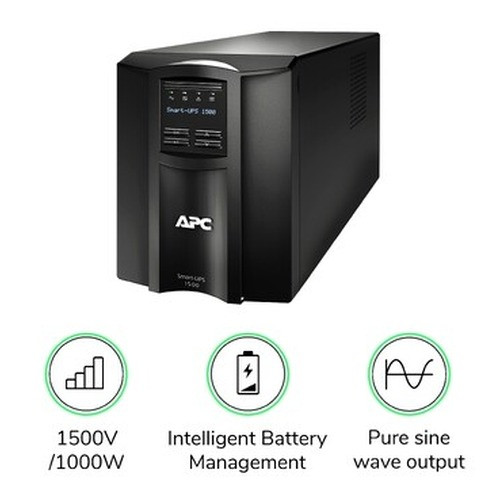
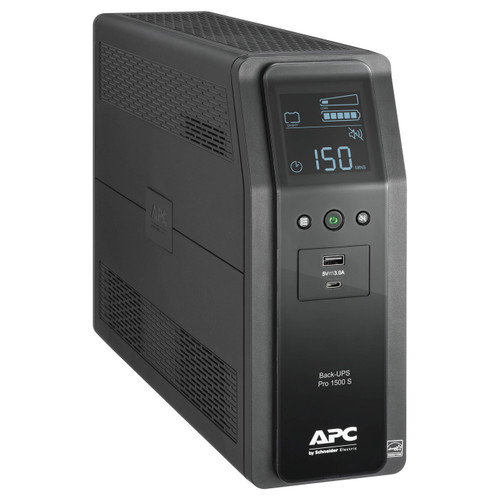
In This Guide
- Which unit delivers more usable runtime and how quickly does it recover charge?
- How do the two units compare on surge protection energy rating and power conditioning?
- Which UPS offers more management interface options and expansion capability?
- Which should you choose: the SMT1500J or the BR1500MS2?
- Side-by-Side Specs
- FAQ
Which unit delivers more usable runtime and how quickly does it recover charge?
The SMT1500J is rated for 7 minutes at full load (980 W) and 24 minutes at half load, with a recharge time of 4 hours. These figures are drawn directly from APC's published specifications for the unit.
The BR1500MS2 provides no manufacturer-stated runtime figures in the supplied specifications. Its recharge time is listed at 16 hours — four times longer than the SMT1500J's 4-hour recharge. The BR1500MS2 carries a battery design life of 3–5 years; the SMT1500J spec does not state a design-life figure.
For deployments where fast return-to-full-charge matters — such as environments with recurring short outages — the SMT1500J's 4-hour recharge is a material advantage. Buyers requiring the BR1500MS2 should plan for an extended recovery window after a deep discharge.
How do the two units compare on surge protection energy rating and power conditioning?
The BR1500MS2 carries a surge energy rating of 1,080 joules and specifies full-time multi-pole noise filtering with 5% of IEEE surge let-through and zero clamping response time. It also includes coaxial cable (CATV/SATV/modem/audio-video) data-line protection.
The SMT1500J is rated at 459 joules — less than half the BR1500MS2's rating. Its spec lists circuit-breaker protection and Automatic Voltage Regulation (AVR), but does not state a noise-filtering specification or data-line protection.
On raw surge energy absorption, the BR1500MS2 holds a significant advantage at 1,080 J versus 459 J. For installations with sensitive AV or cable equipment, the BR1500MS2's coaxial data-line protection adds a layer not present in the SMT1500J spec.
Which UPS offers more management interface options and expansion capability?
The SMT1500J provides both RS-232 (serial) and USB (4-pin Type B) management interfaces, plus one SmartSlot expansion bay (total 1, free 1) for optional network management cards. A serial cable is included. The SmartSlot enables future addition of network management adapters without replacing the unit.
The BR1500MS2 includes a USB cable and a multi-function LCD status and control console. The supplied specifications do not reference an RS-232 port, a network management slot, or any expansion capability beyond the included USB interface.
For IT environments requiring SNMP monitoring, rack integration, or remote shutdown software beyond basic USB connectivity, the SMT1500J's SmartSlot and RS-232 interface provide a meaningful integration advantage. The BR1500MS2's management depth, per available specs, is limited to USB and the onboard LCD.
Which should you choose: the SMT1500J or the BR1500MS2?
Our take: The SMT1500J is the stronger choice when management depth and fast recharge are priorities, but the BR1500MS2 is the stronger choice when surge protection energy and data-line filtering matter most. Key spec deltas: surge energy is 1,080 J (BR1500MS2) versus 459 J (SMT1500J), a 2.35× gap; recharge time is 4 hours (SMT1500J) versus 16 hours (BR1500MS2), a 4× difference; and the SMT1500J adds an RS-232 port plus a SmartSlot expansion bay absent from the BR1500MS2 spec. The SMT1500J is rated for 100 V / 50–60 Hz Japanese markets; the BR1500MS2 is rated for 120 V / 60 Hz North American markets — these units are not interchangeable by voltage region. Buyers in North America seeking AV or cable-plant surge protection should favor the BR1500MS2; IT buyers needing network card expansion and faster battery recovery should favor the SMT1500J, provided the 100 V supply voltage is appropriate.
Side-by-Side Comparison
Spec-for-spec, from manufacturer data.
| Specification | APC by Schneider Electric SMT1500J | APC by Schneider Electric BR1500MS2 |
|---|---|---|
| UPS Technology | Line Interactive | Line Interactive |
| Output Waveform | Sine wave | Sine wave |
| VA Rating | 1500 VA | 1500 VA |
| Watt Rating | 980 W | 900 W |
| Input Voltage | AC 100 V (range 80–123 V) | 120 V (range 88–147 V) |
| Input Frequency | 50/60 Hz | 60 Hz ± 3 Hz |
| Output Connectors | 8 x NEMA 5-15 | 6 NEMA 5-15R (battery) + 4 NEMA 5-15R (surge only) |
| Surge Energy Rating | 459 J | 1,080 J |
| Battery Type | Lead acid | Lead-Acid |
| Recharge Time | 4 hours | 16 hours |
| Runtime at Full Load | 7 min | — |
| Runtime at Half Load | 24 min | — |
| Battery Design Life | — | 3–5 years |
| Management Interfaces | RS-232 + USB Type B | USB |
| Expansion Slot | 1 x SmartSlot | — |
| Warranty | 2 years limited | — |
| Weight | 61.95 lb | 27.6 lb |
| Sound Emission | 45 dBA | 45 dBA |
| Operating Humidity | 0–95% | 0–95% non-condensing |
| Data Line Protection | — | Coaxial (CATV/SATV/modem/AV) |
Frequently Asked Questions
Which should you choose: the SMT1500J or the BR1500MS2?
The SMT1500J is the stronger choice when management depth and fast recharge are priorities, but the BR1500MS2 is the stronger choice when surge protection energy and data-line filtering matter most. Key spec deltas: surge energy is 1,080 J (BR1500MS2) versus 459 J (SMT1500J), a 2.35× gap; recharge time is 4 hours (SMT1500J) versus 16 hours (BR1500MS2), a 4× difference; and the SMT1500J adds an RS-232 port plus a SmartSlot expansion bay absent from the BR1500MS2 spec. The SMT1500J is rated for 100 V / 50–60 Hz Japanese markets; the BR1500MS2 is rated for 120 V / 60 Hz North American markets — these units are not interchangeable by voltage region. Buyers in North America seeking AV or cable-plant surge protection should favor the BR1500MS2; IT buyers needing network card expansion and faster battery recovery should favor the SMT1500J, provided the 100 V supply voltage is appropriate.
Is the SMT1500J or BR1500MS2 better for a server room with a network management card?
The SMT1500J includes one SmartSlot expansion bay and an RS-232 management interface in addition to USB, making it compatible with APC network management cards for SNMP monitoring and remote shutdown. The BR1500MS2 spec does not list a SmartSlot or RS-232 port, so network card expansion is not documented as an option for that model.
Which unit bounces back faster after a power outage drains the battery?
The SMT1500J is specified at a 4-hour recharge time. The BR1500MS2 is specified at 16 hours. If your site experiences frequent or recurring outages, the SMT1500J's recharge time is substantially shorter based on published specs.
Can I use either of these UPS units in the United States?
The BR1500MS2 is rated for 120 V / 60 Hz input, which matches standard North American utility supply. The SMT1500J is rated for 100 V / 50–60 Hz input with a range of 80–123 V AC, which corresponds to Japanese utility standards. Using the SMT1500J on a standard 120 V North American circuit is outside its specified input voltage design point and is not supported by the available specifications.
More UPS Comparisons
- APC by Schneider Electric SMX1500RMI2U vs CyberPower PRL1500RT2UC
- APC by Schneider Electric SMX1500RMI2U vs CyberPower BRG1500AVRLCD2
- APC by Schneider Electric SMX1500RMI2U vs CyberPower PR1500LCD
- APC by Schneider Electric SMX1500RMI2U vs APC by Schneider Electric BR1500MS2
- APC by Schneider Electric SMX1500RMI2U vs APC by Schneider Electric SMTL1500RM3UCUS
- CyberPower PRL1500RT2UC vs APC by Schneider Electric BR1500MS2
UPS Buying Guides
Get a Second Opinion on Your Camera Choice
Share your site layout, coverage goals, and budget. Our team will validate the camera selection, flag anything we would change, and recommend products that match the use case.