
Altronix NETWAY4EBTB vs Axis T8504-E: Specification Comparison
Both the Altronix NETWAY4EBTB and the Axis T8504-E are 4-port Gigabit PoE switches with a single SFP fiber uplink, positioning them as edge-layer distribution nodes in IP surveillance or building-automation networks. The comparison turns on three practical axes: raw PoE power budget and per-port delivery, operating environment and physical hardening, and network management depth. Neither unit is a simple unmanaged commodity; both target installers who need fiber backbone connectivity alongside copper PoE drops.
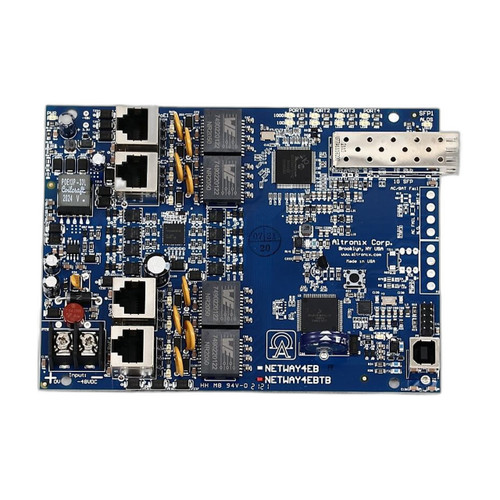

In This Guide
- Which switch delivers more PoE power, and how is that power distributed across ports?
- Which switch is rated and built for harsh outdoor or industrial environments?
- Which switch offers deeper network management and integration capabilities?
- Which should you choose: the NETWAY4EBTB or the T8504-E?
- Side-by-Side Specs
- FAQ
Which switch delivers more PoE power, and how is that power distributed across ports?
The Altronix NETWAY4EBTB is rated at 240 W total with up to 90 W per port, conforming to 802.3bt (PoE++, Type 3/4). All four ports share the 240 W pool equally at that maximum, meaning two 90 W devices could draw 180 W simultaneously while leaving 60 W for the remaining two ports. This makes the NETWAY4EBTB capable of powering high-draw endpoints such as pan-tilt-zoom cameras with integrated heaters or multi-radio access points.
The Axis T8504-E carries a 150 W total budget and uses asymmetric allocation: ports 1–2 deliver up to 60 W each; ports 3–4 deliver up to 30 W each. Its standard is IEEE 802.3at (PoE+, Type 2, Class 4), which tops out at 30 W per port under the standard, with the 60 W on ports 1–2 appearing to be a vendor extension beyond the 802.3at envelope. The 90 W difference in total budget (240 W vs. 150 W) is significant when powering four simultaneous high-draw devices.
Which switch is rated and built for harsh outdoor or industrial environments?
The Axis T8504-E carries an explicit outdoor environmental rating. Its aluminum casing is listed as NEMA Type 4X (250 V), it operates from -40 °C to 60 °C (per spec field) or -40 °C to 50 °C (per the tilde-prefixed field), and it includes 6 kV surge protection on all network ports and AC input lines. AC input is 100–240 V, 50/60 Hz, eliminating the need for an external DC supply in most installations. The unit is pole-mountable and carries approvals including UL/IEC 60950-1, IEC 62368-1, FCC, EMC, ICES, VCCI, RCM, and EAC.
The Altronix NETWAY4EBTB provides a storage temperature range of -30 °C to 85 °C, but no operating temperature range is specified in the provided data. No outdoor or NEMA environmental rating is listed; the form factor is described as a switch board with rack-mount capability, suggesting enclosure or cabinet integration rather than stand-alone outdoor deployment. No surge protection rating is specified. Input is 48–56 V DC, requiring an upstream DC power source. Installers deploying in direct outdoor or extreme-temperature environments should note the absence of these ratings for the NETWAY4EBTB.
Which switch offers deeper network management and integration capabilities?
The Axis T8504-E is a managed switch with documented support for IPv4, IPv6, HTTP, HTTPS, SSH, SNMP, DNS, TCP, UDP, and VLAN. It integrates with AXIS Device Manager for centralized configuration. Security features include password protection, HTTPS encryption, and VLAN segmentation. The switching capacity is 10 Gbps with 7.44 Mpps throughput and an 8 k MAC address table. Jumbo frames up to 10 KB are supported. The tilde-prefixed fields also reference SNMP v1/v2c/v3 and RADIUS/TACACS, though these appear in the marketing fields rather than the vendor spec fields.
The Altronix NETWAY4EBTB lists LINQ compatibility for supervision, which is Altronix's proprietary network management and alarm-reporting platform. No Layer 2 or Layer 3 management protocols (SNMP, VLAN, SSH, HTTPS) are listed in the provided specifications. No throughput or MAC table size is specified. LINQ supervision provides power-event visibility within Altronix ecosystems but does not substitute for the standards-based network management available on the T8504-E in mixed-vendor environments.
Which should you choose: the NETWAY4EBTB or the T8504-E?
Our take: The NETWAY4EBTB is the stronger choice when maximum per-port PoE power and 802.3bt compatibility are the primary requirements and the switch will be housed inside a controlled enclosure fed by a DC bus. It delivers 240 W total versus the T8504-E's 150 W, and its 90 W-per-port 802.3bt ceiling exceeds the T8504-E's 60 W maximum on any single port. Conversely, the T8504-E is the stronger choice for outdoor or harsh-environment installations: it carries an explicit outdoor/NEMA 4X rating, a verified -40 °C operating range, 6 kV surge protection on all ports and AC lines, and standards-based management (VLAN, SNMP, HTTPS, AXIS Device Manager) versus the NETWAY4EBTB's proprietary LINQ supervision. The T8504-E also accepts universal AC input directly, reducing infrastructure complexity outdoors. Choose the NETWAY4EBTB for high-wattage indoor/cabinet deployments on Altronix DC power architectures; choose the T8504-E for outdoor Axis-ecosystem or multi-vendor managed networks requiring environmental hardening.
Side-by-Side Comparison
Spec-for-spec, from manufacturer data.
| Specification | Altronix NETWAY4EBTB | Axis T8504-E |
|---|---|---|
| Product Type | PoE Switch (Switch Board) | PoE Switch (Managed, Outdoor) |
| PoE Standard | 802.3bt (PoE++) | 802.3at (PoE+) |
| Total PoE Budget | 240 W | 150 W |
| Max Per-Port PoE | 90 W (all 4 ports) | 60 W (ports 1–2), 30 W (ports 3–4) |
| Number of PoE Ports | 4 | 4 |
| Uplink | Single-mode fiber SFP | 1× SFP fiber uplink |
| Input Voltage | 48–56 V DC | 100–240 V AC, 50/60 Hz |
| Switching Capacity | — | 10 Gbps |
| Throughput | — | 7.44 Mpps |
| MAC Table | — | 8,000 entries |
| Operating Temperature | Not specified | -40 °C to 60 °C |
| Storage Temperature | -30 °C to 85 °C | -40 °C to 85 °C |
| Outdoor / NEMA Rating | Not specified | Outdoor, NEMA Type 4X |
| Surge Protection | Not specified | 6 kV (all network ports and AC) |
| Management / Supervision | LINQ compatible (Altronix proprietary) | VLAN, SNMP, SSH, HTTPS, AXIS Device Manager |
| Warranty | Lifetime | 5 years |
Frequently Asked Questions
Which should you choose: the NETWAY4EBTB or the T8504-E?
The NETWAY4EBTB is the stronger choice when maximum per-port PoE power and 802.3bt compatibility are the primary requirements and the switch will be housed inside a controlled enclosure fed by a DC bus. It delivers 240 W total versus the T8504-E's 150 W, and its 90 W-per-port 802.3bt ceiling exceeds the T8504-E's 60 W maximum on any single port. Conversely, the T8504-E is the stronger choice for outdoor or harsh-environment installations: it carries an explicit outdoor/NEMA 4X rating, a verified -40 °C operating range, 6 kV surge protection on all ports and AC lines, and standards-based management (VLAN, SNMP, HTTPS, AXIS Device Manager) versus the NETWAY4EBTB's proprietary LINQ supervision. The T8504-E also accepts universal AC input directly, reducing infrastructure complexity outdoors. Choose the NETWAY4EBTB for high-wattage indoor/cabinet deployments on Altronix DC power architectures; choose the T8504-E for outdoor Axis-ecosystem or multi-vendor managed networks requiring environmental hardening.
Can the NETWAY4EBTB power 802.3bt devices that the T8504-E cannot?
Yes, based on the provided specifications. The NETWAY4EBTB is rated for 802.3bt (PoE++), which supports up to 90 W per port. The T8504-E is rated for 802.3at (PoE+), with a maximum of 60 W on ports 1–2 and 30 W on ports 3–4. Devices requiring more than 60 W per port—such as certain high-power PTZ cameras with integrated heating or multi-radio wireless APs—would require the NETWAY4EBTB. The T8504-E does not claim 802.3bt compliance in its provided specifications.
Is the T8504-E suitable for deployment in a parking-garage or rooftop cabinet where temperatures swing from freezing to high heat?
Based on the provided specifications, yes. The T8504-E carries an outdoor environmental rating and a NEMA Type 4X designation, with an operating temperature range listed as -40 °C to 60 °C (one spec field) or -40 °C to 50 °C (a secondary field). It also includes 6 kV surge protection on all network ports and AC input lines. The NETWAY4EBTB does not specify an operating temperature range or any outdoor/NEMA rating in the provided data, so it cannot be evaluated for the same conditions.
Which switch integrates more easily into an existing managed network with VLANs and SNMP monitoring?
The T8504-E, based on the provided specifications. It lists explicit support for VLAN, SNMP, SSH, HTTPS, and integrates with AXIS Device Manager for centralized monitoring. The NETWAY4EBTB lists LINQ compatibility for supervision, which is Altronix's proprietary platform; no standard network-management protocols (SNMP, VLAN, SSH) are listed in its provided specifications. For multi-vendor managed networks relying on standard protocols, the T8504-E is the documented choice.
More Network Switch Comparisons
- Vivotek GET-083A-120 vs TP-Link SG1005P
- Vivotek GET-083A-120 vs Axis T8504-E
- Vivotek GET-083A-120 vs Axis D8004
- Vivotek GET-083A-120 vs Ubiquiti N-SW
- TP-Link SG1005P vs Axis T8504-E
- TP-Link SG1005P vs Axis D8004
Network Switch Buying Guides
Get a Second Opinion on Your Camera Choice
Share your site layout, coverage goals, and budget. Our team will validate the camera selection, flag anything we would change, and recommend products that match the use case.