
Vivotek IHT-1000 vs Allied Telesis AT-x530L-10GHXm-10: Specification Comparison
Both the Vivotek AW-IHT-1000 and the Allied Telesis AT-x530L-10GHXm-10 are 8-port PoE-capable managed switches designed for IP surveillance and network infrastructure deployments. The AW-IHT-1000 is a compact, DIN-rail-style industrial switch with hardened environmental ratings, while the AT-x530L-10GHXm-10 is a 1U rack-mount switch offering multi-gigabit copper ports and a substantially higher PoE power budget. Both serve edge-switching roles in physical-security networks but target different installation environments and performance tiers.
In This Guide
Which switch delivers more PoE power and higher per-port bandwidth?
The AT-x530L-10GHXm-10 provides a 500 W total PoE budget across its 8 ports, with per-port flexibility up to 90 W (PoE++, IEEE 802.3bt) on 5 ports and 60 W on all 8. This makes it suitable for high-draw devices such as multi-sensor panoramic cameras, PTZ cameras with heaters, or Wi-Fi 6E access points. The AW-IHT-1000 is rated at 240 W total PoE budget with a maximum of 30 W per port (IEEE 802.3at, PoE+). It covers conventional IP cameras, single-radio WAPs, and access control readers but cannot power 60 W or 90 W devices.
Port speed also diverges significantly. The AT-x530L-10GHXm-10 copper ports are rated 100 M / 1 / 2.5 / 5 Gbps, supporting multi-gigabit endpoints such as Wi-Fi 6/6E APs or next-generation cameras. The AW-IHT-1000 copper ports are standard Gigabit Ethernet (10/100/1000BASE-T). Uplinks follow the same pattern: the Allied Telesis unit offers two 1/10 Gbps SFP+ ports, whereas the Vivotek unit provides two 1 Gbps SFP slots — a 10× difference in uplink headroom.
Forwarding capacity reflects this tier gap: 89.2 Mpps and 120 Gbps switching fabric for the AT-x530L-10GHXm-10 versus 14.88 Mpps (noted in specs as Mbps — likely a label error in the source data; accepted as provided) and 20 Gbps for the AW-IHT-1000. Latency at the AT-x530L-10GHXm-10 is 2.12 µs at 10 Gbps; the AW-IHT-1000 spec sheet does not publish a latency figure.
Which switch is better suited to harsh or outdoor edge deployments?
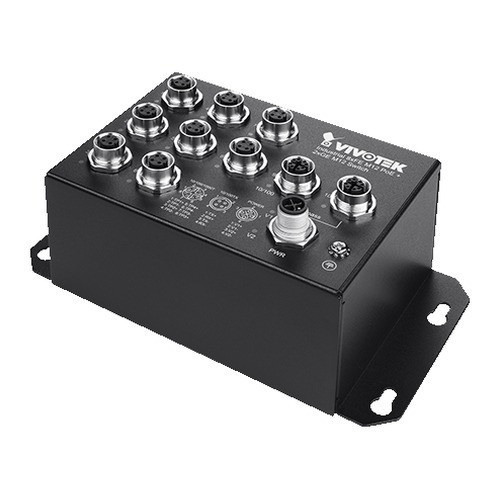
The AW-IHT-1000 is explicitly hardened for industrial field installations. Its operating temperature range is −40 °C to +75 °C (−40 °F to +167 °F), and it carries formal test certifications for vibration (IEC 60068-2-6), mechanical shock (IEC 60068-2-27), and freefall (IEC 60068-2-32). Per-port surge protection is rated at 12 kV, and EMS compliance covers EN61000-4-2/3/4/5/6/8. It supports dual redundant DC power inputs (PW1 and PW2, each 48–56 VDC), which is a reliability requirement in many industrial and transportation deployments.
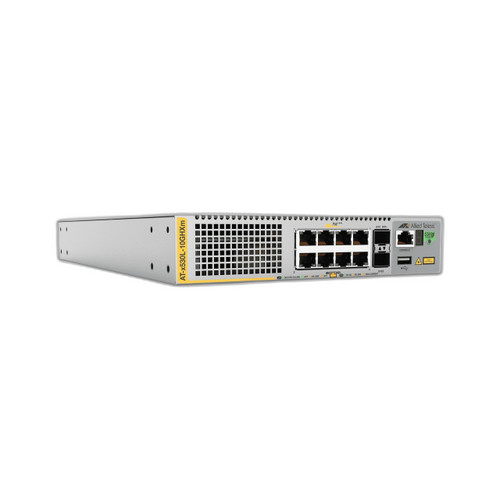
The AT-x530L-10GHXm-10 specifications provided do not state an operating temperature range, IP rating, surge protection level, or any IEC 60068 environmental test certifications. Its physical format is a 1U rack-mount chassis (210 × 362 × 42.5 mm, 3.5 kg), appropriate for climate-controlled IDF/MDF closets. Maximum power consumption reaches 605 W with a heat dissipation of 2,065 BTU/h and an acoustic noise level of 64 dBA — figures that presuppose an enclosed rack environment with active cooling, not an exposed edge or outdoor cabinet.
The AW-IHT-1000 is significantly lighter and more compact (172 × 132 × 39 mm, 0.8 kg), consistent with DIN-rail or wall-mount deployment inside junction boxes, traffic cabinets, or camera poles. The AT-x530L-10GHXm-10 specs do not indicate a DIN-rail mount option.
Which switch offers greater scalability and network management capability?
The AT-x530L-10GHXm-10 includes two dedicated stacking ports (marked with an asterisk in the provided spec), enabling multiple units to be logically combined into a single managed stack. This is a material advantage for growing surveillance or enterprise networks where port counts and bandwidth must scale without redesigning the core topology. The AW-IHT-1000 specifications do not reference stacking capability.
MAC address table size is 4 K entries on the AW-IHT-1000, with a 128 KB packet buffer. The AT-x530L-10GHXm-10 specifications provided do not disclose MAC table size or buffer memory, so a direct comparison on these dimensions cannot be made from the supplied data.
Both switches confirm IEEE 802.3x full-duplex flow control and store-and-forward transmission for the AW-IHT-1000; the AT-x530L-10GHXm-10 transmission method is not explicitly stated in the provided specs. Neither product's provided specification set details Layer 2/Layer 3 management features (VLANs, IGMP snooping, QoS queues, CLI/SNMP/web GUI), so management depth cannot be compared from these data alone. Buyers requiring specific management features should consult vendor datasheets directly.
Which should you choose: the IHT-1000 or the AT-x530L-10GHXm-10?
Our take: The AW-IHT-1000 is the stronger choice when the installation environment is harsh, space-constrained, or unpowered — its −40 °C to +75 °C operating range, 12 kV per-port surge protection, IEC 60068 shock/vibration certification, and redundant 48–56 VDC inputs make it purpose-built for outdoor cabinets, transportation infrastructure, and industrial edge sites where a rack-mount unit would fail or be impractical. The AT-x530L-10GHXm-10 is the stronger choice for controlled-environment rack installations demanding higher throughput and power density: its 500 W PoE budget (vs. 240 W), per-port PoE++ support up to 90 W (vs. 30 W maximum), 120 Gbps switching fabric (vs. 20 Gbps), 10 Gbps SFP+ uplinks (vs. 1 Gbps SFP), and stacking ports are decisive advantages for enterprise closets, large-camera-count NVR aggregation, or high-density Wi-Fi 6E deployments where device power and bandwidth demands exceed what the AW-IHT-1000 can supply.
Side-by-Side Comparison
Spec-for-spec, from manufacturer data.
| Specification | Vivotek IHT-1000 | Allied Telesis AT-x530L-10GHXm-10 |
|---|---|---|
| PoE Copper Ports | 8x GbE (10/100/1000BASE-T) | 8x Multi-Gig (100M/1/2.5/5G) |
| Uplink Ports | 2x SFP 1000BASE-X (1 Gbps) | 2x SFP+ (1/10 Gbps) |
| Stacking Ports | — | 2 (spec noted) |
| Switching Fabric | 20 Gbps | 120 Gbps |
| Forwarding Rate | 14.88 Mpps (as spec'd) | 89.2 Mpps |
| Total PoE Budget | 240 W | 500 W |
| Max PoE Per Port | 30 W (IEEE 802.3at) | 90 W (PoE++, 5 ports); 60 W (all 8) |
| PoE Standards | IEEE 802.3af / 802.3at | 802.3af (7.5W) / at (30W) / bt (60W / 90W) |
| Latency | Not specified | 2.12 µs @ 10G; 3.49 µs @ 5G |
| MAC Address Table | 4 K | — |
| Buffer Memory | 128 KB | — |
| Operating Temperature | -40 °C to +75 °C | Not specified |
| Surge Protection / Port | 12 kV | Not specified |
| Environmental Certs | IEC 60068-2-6/27/32; EN61000-4-2/3/4/5/6/8 | Not specified |
| Power Input | Dual DC 48–56 VDC (redundant) | AC (max 605 W consumption) |
| Dimensions (L×W×H mm) | 172 × 132 × 39 | 362 × 210 × 42.5 (1U rack) |
| Weight (unpackaged) | 0.8 kg | 3.5 kg |
| Form Factor | Compact / wall / DIN-rail | 1U rack-mount |
Frequently Asked Questions
Which should you choose: the IHT-1000 or the AT-x530L-10GHXm-10?
The AW-IHT-1000 is the stronger choice when the installation environment is harsh, space-constrained, or unpowered — its −40 °C to +75 °C operating range, 12 kV per-port surge protection, IEC 60068 shock/vibration certification, and redundant 48–56 VDC inputs make it purpose-built for outdoor cabinets, transportation infrastructure, and industrial edge sites where a rack-mount unit would fail or be impractical. The AT-x530L-10GHXm-10 is the stronger choice for controlled-environment rack installations demanding higher throughput and power density: its 500 W PoE budget (vs. 240 W), per-port PoE++ support up to 90 W (vs. 30 W maximum), 120 Gbps switching fabric (vs. 20 Gbps), 10 Gbps SFP+ uplinks (vs. 1 Gbps SFP), and stacking ports are decisive advantages for enterprise closets, large-camera-count NVR aggregation, or high-density Wi-Fi 6E deployments where device power and bandwidth demands exceed what the AW-IHT-1000 can supply.
Can the AW-IHT-1000 or the AT-x530L-10GHXm-10 power a PTZ camera with a built-in wiper and heater?
Many PTZ cameras with heaters and wipers draw 45–90 W. The AW-IHT-1000 is limited to 30 W per port (IEEE 802.3at), which is insufficient for those devices. The AT-x530L-10GHXm-10 supports up to 90 W per port (PoE++, IEEE 802.3bt) on 5 of its 8 ports and 60 W on all 8, making it the correct choice for high-draw PTZ units.
Is the AW-IHT-1000 or the AT-x530L-10GHXm-10 better for an outdoor traffic or perimeter installation?
The AW-IHT-1000 is explicitly rated for −40 °C to +75 °C operation and holds IEC 60068-2-6/27/32 certifications for vibration, shock, and freefall, plus 12 kV surge protection per port and redundant DC power inputs — all characteristics required in outdoor or roadside deployments. The AT-x530L-10GHXm-10 specifications provided do not state an operating temperature range, surge protection, or any IEC 60068 environmental certifications, and its 605 W / 2,065 BTU/h thermal profile requires a ventilated rack enclosure.
Which switch is a better fit if I need to expand port count in the future without a full redesign?
The AT-x530L-10GHXm-10 includes two stacking ports, allowing multiple units to operate as a single logical switch and scale port count incrementally. The AW-IHT-1000 specifications do not reference stacking capability, so expansion would require adding a separate upstream switch and managing it independently.
More Network Switch Comparisons
- Vivotek IHT-1271 vs TP-Link SG3210XHP-M2
- Vivotek IHT-1271 vs TP-Link S4500-8GP2F
- Vivotek IHT-1271 vs TP-Link SG1210P
- Vivotek IHT-1271 vs Allied Telesis AT-x530L-10GHXm-10
- Vivotek IHT-1271 vs Vivotek GEV-108A-130
- Vivotek IHT-1271 vs Vivotek IHT-1000
Network Switch Buying Guides
Get a Second Opinion on Your Camera Choice
Share your site layout, coverage goals, and budget. Our team will validate the camera selection, flag anything we would change, and recommend products that match the use case.