
Vivotek GEV-108A-130 vs Allied Telesis AT-x530L-10GHXm-10: Specification Comparison
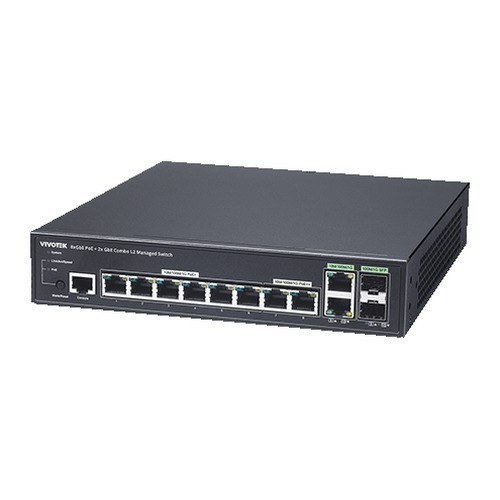
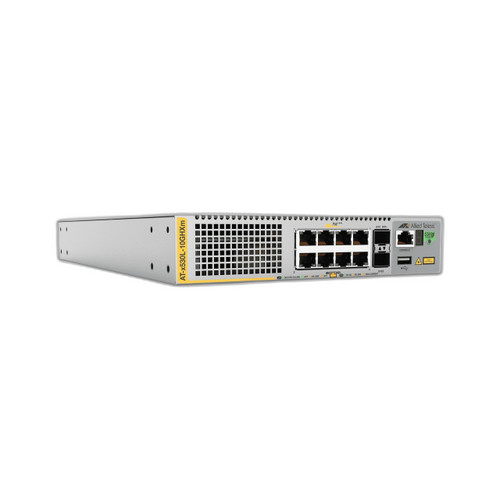
Both the Vivotek AW-GEV-108A-130 and the Allied Telesis AT-x530L-10GHXm-10 are 8-port PoE managed switches targeting surveillance and enterprise LAN deployments. Each delivers PoE power to eight downstream ports with dual uplinks, positioning them as direct cross-shop candidates for installers specifying edge switching for IP camera systems. They diverge significantly in port speed, PoE power budget, switching capacity, and management depth — the key axes explored below.
In This Guide
- How do the port speeds, PoE power budget, and switching throughput compare?
- What are the power requirements, physical dimensions, and environmental ratings?
- How do the management features, surveillance integration, and protocol support compare?
- Which should you choose: the GEV-108A-130 or the AT-x530L-10GHXm-10?
- Side-by-Side Specs
- FAQ
How do the port speeds, PoE power budget, and switching throughput compare?
The AW-GEV-108A-130 provides 8 × Gigabit PoE RJ-45 ports plus 2 × Gigabit SFP combo uplinks. Its switching bandwidth is 20 Gbps with a forwarding capacity of 14.88 Mpps. PoE is distributed across 6 ports at up to 30 W each (802.3af/at) and 2 ports at up to 90 W each (802.3bt), for a total PoE budget of 130 W. An extended PoE mode stretches reach to 250 m at 10 Mbps.
The AT-x530L-10GHXm-10 offers 8 × multi-rate copper ports (100 M / 1 / 2.5 / 5 Gbps) plus 2 × 10 Gbps SFP+ uplinks and 2 stacking ports. Its switching fabric is 120 Gbps with a forwarding rate of 89.2 Mpps — six times the throughput of the Vivotek unit. All 8 copper ports support PoE++: 8 ports at 30 W, 8 at 60 W, and 5 at 90 W, with a total PoE budget of 500 W. No extended-reach PoE mode is listed in the provided specs.
What are the power requirements, physical dimensions, and environmental ratings?
The AW-GEV-108A-130 accepts universal AC input (100–240 V, 50–60 Hz) and weighs 1.95 kg. Its dimensions are 220 × 44 × 242 mm. The operating temperature range is −10 °C to 50 °C with 10–90% RH humidity tolerance. Maximum power consumption is not stated in the provided specs. The unit carries UL, CE, UKCA, FCC, VCCI, LVD, and ICES certifications and ships with a power cord, rack mount kit, QIG, and CD manual.
The AT-x530L-10GHXm-10 draws up to 605 W maximum (dissipating up to 2,065 BTU/h) and generates 64 dBA of acoustic noise — metrics that reflect its 500 W PoE budget. It weighs 3.5 kg unpackaged and measures 210 × 362 × 42.5 mm in a 1U rack form factor. Operating temperature and humidity ranges are not specified in the provided specs. Certifications beyond what can be inferred from listed specs are not provided in the data supplied.
How do the management features, surveillance integration, and protocol support compare?
The AW-GEV-108A-130 includes a purpose-built surveillance management layer: auto-discovery of up to 256 Vivotek devices, topology/floor/Google Map views, per-device reboot and restore, configuration export/import, PoE scheduling, PoE alive-check, and a DHCP server function. It supports SNMP v1/v2c/v3, RMON groups 1/2/3/9, LLDP/LLDP-MED, RADIUS/TACACS+, SSL, 802.1Q VLAN (4,096 IDs), Q-in-Q, Voice VLAN, IGMP snooping v1/v2, MLD v1/v2, MSTP/RSTP/STP, LACP, IP Source Guard, DHCP snooping (up to 384 entries), storm control, private VLAN edge, and S-Flow. ACL matching covers source/destination MAC, VLAN ID, IP, protocol, TCP/UDP ports, DSCP, 802.1p, ICMP, Ethernet type, and TCP flags. Hardware queues: 8.
The AT-x530L-10GHXm-10 spec data provided does not enumerate management protocols, VLAN capabilities, QoS queues, ACL features, or software integration details beyond the physical and PoE power specifications. Stacking capability (2 stacking ports) is noted, which the Vivotek unit does not list. Latency is specified at five speed tiers: 8.24 µs at 100 Mbps, 7.89 µs at 1 Gbps, 5.63 µs at 2.5 Gbps, 3.49 µs at 5 Gbps, and 2.12 µs at 10 Gbps — no equivalent latency figures are provided for the Vivotek unit.
Which should you choose: the GEV-108A-130 or the AT-x530L-10GHXm-10?
Our take: The AW-GEV-108A-130 is the stronger choice when deploying an all-Vivotek surveillance edge with tight power budgets and a need for deep, camera-centric management in a lightweight desktop or shelf-mount form. Three concrete spec deltas define the trade-off: the AT-x530L-10GHXm-10 delivers 500 W of PoE budget versus 130 W, making it the only option when powering five or more 90 W devices or a dense mix of 60 W PTZ and access-control hardware; its switching fabric is 120 Gbps versus 20 Gbps; and its uplinks reach 10 Gbps SFP+ versus 1 Gbps combo. The Vivotek unit counters with a documented management stack — 4,096 VLAN IDs, ACL engine, SNMP v3, DHCP server, PoE scheduling, and Vivotek-native device discovery for up to 256 endpoints — none of which are confirmed in the supplied AT-x530L-10GHXm-10 specs. Choose the Allied Telesis unit for multi-vendor, high-density, or bandwidth-intensive environments; choose the Vivotek unit for smaller Vivotek-centric camera deployments requiring on-switch surveillance management.
Side-by-Side Comparison
Spec-for-spec, from manufacturer data.
| Specification | Vivotek GEV-108A-130 | Allied Telesis AT-x530L-10GHXm-10 |
|---|---|---|
| Product Class | 8-Port Gigabit PoE Managed Switch | 8-Port Multi-Rate PoE++ Managed Switch |
| Copper Port Speed | 1 Gbps (8 ports) | 100M / 1 / 2.5 / 5 Gbps (8 ports) |
| Uplink Ports | 2 × 1 Gbps SFP Combo | 2 × 10 Gbps SFP+ |
| Stacking Ports | — | 2 |
| Total PoE Budget | 130 W | 500 W |
| PoE per Port (max) | 90 W (2 ports, 802.3bt) | 90 W (5 ports, PoE++) |
| PoE Standards | 802.3af / at / bt | 7.5 W / 15.4 W / 30 W / 60 W / 90 W tiers (per spec) |
| Extended PoE Reach | 250 m at 10 Mbps | — |
| Switching Bandwidth | 20 Gbps | 120 Gbps |
| Forwarding Rate | 14.88 Mpps | 89.2 Mpps |
| MAC Address Table | 8 K | — |
| Max Power Consumption | — | 605 W |
| Dimensions (W × D × H) | 220 × 242 × 44 mm | 210 × 362 × 42.5 mm |
| Weight (unpackaged) | 1.95 kg | 3.5 kg |
| Operating Temperature | -10 °C to 50 °C | — |
| Warranty | 24 months | — |
Frequently Asked Questions
Which should you choose: the GEV-108A-130 or the AT-x530L-10GHXm-10?
The AW-GEV-108A-130 is the stronger choice when deploying an all-Vivotek surveillance edge with tight power budgets and a need for deep, camera-centric management in a lightweight desktop or shelf-mount form. Three concrete spec deltas define the trade-off: the AT-x530L-10GHXm-10 delivers 500 W of PoE budget versus 130 W, making it the only option when powering five or more 90 W devices or a dense mix of 60 W PTZ and access-control hardware; its switching fabric is 120 Gbps versus 20 Gbps; and its uplinks reach 10 Gbps SFP+ versus 1 Gbps combo. The Vivotek unit counters with a documented management stack — 4,096 VLAN IDs, ACL engine, SNMP v3, DHCP server, PoE scheduling, and Vivotek-native device discovery for up to 256 endpoints — none of which are confirmed in the supplied AT-x530L-10GHXm-10 specs. Choose the Allied Telesis unit for multi-vendor, high-density, or bandwidth-intensive environments; choose the Vivotek unit for smaller Vivotek-centric camera deployments requiring on-switch surveillance management.
Is the AW-GEV-108A-130 or the AT-x530L-10GHXm-10 better for powering high-wattage PTZ cameras?
The AT-x530L-10GHXm-10 is better suited for high-wattage PTZ cameras. Its spec lists 5 ports capable of delivering 90 W and all 8 ports capable of 60 W, backed by a 500 W total PoE budget. The AW-GEV-108A-130 provides only 2 ports at 90 W (802.3bt) and 6 ports at 30 W, with a 130 W total budget — sufficient for a compact, lower-power camera array but not for a deployment requiring multiple simultaneous 60–90 W devices.
Does the AW-GEV-108A-130 or the AT-x530L-10GHXm-10 offer better management features for a surveillance installer?
Based on the specs provided, the AW-GEV-108A-130 offers significantly more documented management capability relevant to surveillance installers: Vivotek device auto-discovery (up to 256 units), topology and floor-plan views, per-device PoE reboot and alive-checking, PoE scheduling, DHCP server, SNMP v1/v2c/v3, RMON, RADIUS/TACACS+, full ACL engine, and 4,096-ID VLAN support. The AT-x530L-10GHXm-10 specs supplied do not enumerate equivalent management protocols or surveillance-specific features, so a direct comparison cannot be made on those axes from the available data.
Which switch is better for a mixed-vendor or enterprise network where stacking and multi-gigabit speeds matter?
The AT-x530L-10GHXm-10 is the more capable choice for mixed-vendor or enterprise deployments. It provides 8 × multi-rate ports (up to 5 Gbps per port), dual 10 Gbps SFP+ uplinks, 2 stacking ports, a 120 Gbps switching fabric, and 89.2 Mpps forwarding rate. The AW-GEV-108A-130 is limited to 1 Gbps per port, 20 Gbps switching bandwidth, and 14.88 Mpps, with no stacking capability listed. For bandwidth-sensitive workloads or network tiers requiring stacking, the Allied Telesis unit is the only option of the two with those characteristics documented.
More Network Switch Comparisons
- Vivotek IHT-1271 vs TP-Link SG3210XHP-M2
- Vivotek IHT-1271 vs TP-Link S4500-8GP2F
- Vivotek IHT-1271 vs TP-Link SG1210P
- Vivotek IHT-1271 vs Allied Telesis AT-x530L-10GHXm-10
- Vivotek IHT-1271 vs Vivotek GEV-108A-130
- Vivotek IHT-1271 vs Vivotek IHT-1000
Network Switch Buying Guides
Get a Second Opinion on Your Camera Choice
Share your site layout, coverage goals, and budget. Our team will validate the camera selection, flag anything we would change, and recommend products that match the use case.