
Ubiquiti USW-PRO-MAX-48 vs Ubiquiti USW-PRO-48: Specification Comparison
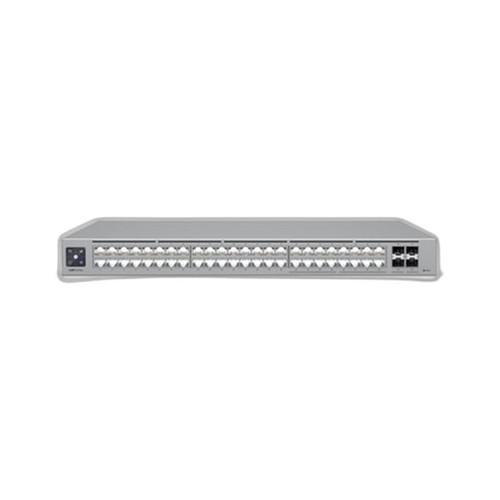
Both the USW-PRO-MAX-48 and USW-PRO-48 are Ubiquiti 48-port managed network switches in a 1U rackmount steel chassis, targeting enterprise and prosumer LAN deployments. The core comparison sits between a mixed-speed platform with 2.5G and 10G uplink capability versus a uniform gigabit platform — both NDAA-compliant, both sharing the same operating temperature range and vendor ecosystem. Buyers cross-shopping these two are weighing whether their infrastructure demands multi-speed tiers or whether clean gigabit-to-all-ports simplicity is sufficient.

In This Guide
- Which switch delivers the right port speeds and switching fabric for your network tier?
- How do the power requirements, physical footprint, and operating environment compare?
- What management features, certifications, and compliance credentials does each model carry?
- Which should you choose: the USW-PRO-MAX-48 or the USW-PRO-48?
- Side-by-Side Specs
- FAQ
Which switch delivers the right port speeds and switching fabric for your network tier?
The USW-PRO-MAX-48 provides a mixed-speed port configuration: 32 ports at 1G, 16 ports at 2.5G, and 4 × 10G SFP+ uplinks. Its switching fabric is rated at 224 Gbps with a forwarding rate of 167 Mpps and 112 Gbps of non-blocking throughput. This architecture suits environments with Wi-Fi 6/6E access points, multi-gig NAS, or servers that benefit from 2.5G links alongside standard 1G edge devices.
The USW-PRO-48 delivers 48 uniform 10/100/1000 Mbps gigabit ports. Its switching capacity is 176 Gbps with a forwarding rate of 131 Mpps. No 2.5G or 10G uplink specs are listed for this model. The uniform 1G architecture simplifies cabling and procurement in all-gigabit environments where no device currently benefits from multi-gig bandwidth.
The USW-PRO-MAX-48 carries a 48 Gbps advantage in switching capacity (224 vs. 176 Gbps) and a 36 Mpps advantage in forwarding rate (167 vs. 131 Mpps). VLAN support is specified at 1,000 for the USW-PRO-MAX-48; no VLAN count is listed in the provided specs for the USW-PRO-48.
How do the power requirements, physical footprint, and operating environment compare?
Both units share SGCC steel enclosures, 1U rack form factors, and the same operating temperature range of -5 to 40°C (23 to 104°F). Both accept universal AC input of 100–240V via an internal AC/DC power supply, eliminating any external brick requirement.
The USW-PRO-MAX-48 draws 100W typical power and weighs 4.8 kg (10.6 lb). Its chassis measures 442 × 325 × 44 mm, making it 40 mm deeper than the USW-PRO-48. The USW-PRO-48 draws 60W and weighs 4.0 kg (8.8 lb), with dimensions of 442 × 285 × 44 mm. The 40W power difference is meaningful in high-density rack environments where PDU capacity and heat load are constrained.
Neither model is listed as PoE-capable in the core port specs — note that the USW-PRO-MAX-48 spec sheet references 'PoE++ (802.3bt)' in one field, but no PoE budget or PoE port count is provided in the specifications supplied. Buyers requiring PoE should verify directly with the manufacturer datasheet before specifying either model in a PoE deployment.
What management features, certifications, and compliance credentials does each model carry?
Both switches are managed via Ethernet and carry NDAA compliance, making both eligible for federal and government-adjacent deployments that prohibit covered telecommunications equipment. Both carry CE, FCC, and IC certifications. Anatel certification numbers differ: USW-PRO-MAX-48 lists 06373-24-08356 and USW-PRO-48 lists 00469-21-08356, reflecting separate regulatory filings.
Both models are positioned within the Ubiquiti UniFi ecosystem and share the same management interface type per the provided specs. No differentiation in management software features or supported protocols is specified in the data provided — buyers requiring feature-level management comparison (e.g., RSTP, LACP, QoS granularity) should consult the respective datasheets at the paths noted.
Both models carry a manufacturer warranty; no warranty term duration is specified in the provided data for either unit. No third-party software integrations or API specifications are listed in the supplied specs for either model.
Which should you choose: the USW-PRO-MAX-48 or the USW-PRO-48?
Our take: The USW-PRO-MAX-48 is the stronger choice when the deployment includes multi-gig endpoints — Wi-Fi 6/6E APs, NAS devices, or servers requiring more than 1G — or when upstream 10G connectivity is required. Concrete spec deltas: switching fabric is 224 Gbps vs. 176 Gbps (+27%); forwarding rate is 167 Mpps vs. 131 Mpps (+28%); the USW-PRO-MAX-48 adds 16 × 2.5G ports and 4 × 10G SFP+ uplinks that the USW-PRO-48 does not list. The trade-off is 40W higher power draw (100W vs. 60W) and a chassis that is 40 mm deeper. The USW-PRO-48 is the rational choice for all-gigabit, power-constrained, or depth-limited rack environments where no current device benefits from multi-gig bandwidth and the lower power and cost envelope matters.
Side-by-Side Comparison
Spec-for-spec, from manufacturer data.
| Specification | Ubiquiti USW-PRO-MAX-48 | Ubiquiti USW-PRO-48 |
|---|---|---|
| Total Ports | 48 | 48 |
| 1G Port Count | 32 × 1G | 48 × 10/100/1000 Mbps |
| 2.5G Port Count | 16 × 2.5G | — |
| 10G SFP+ Uplinks | 4 × 10G SFP+ | — |
| Switching Capacity | 224 Gbps | 176 Gbps |
| Forwarding Rate | 167 Mpps | 131 Mpps |
| Non-Blocking Throughput | 112 Gbps | — |
| VLAN Support | 1,000 VLANs | — |
| Power Consumption | 100W | 60W |
| Power Supply | AC/DC internal, 100–240V | AC/DC internal, 100–240V |
| Form Factor | 1U Rack Mount | 1U Rack-mountable |
| Dimensions (mm) | 442 × 325 × 44 | 442 × 285 × 44 |
| Weight | 4.8 kg (10.6 lb) | 4.0 kg (8.8 lb) |
| Enclosure | SGCC steel | SGCC steel |
| Operating Temperature | -5 to 40°C (23 to 104°F) | -5 to 40°C (23 to 104°F) |
| NDAA Compliant | Yes | Yes |
Frequently Asked Questions
Which should you choose: the USW-PRO-MAX-48 or the USW-PRO-48?
The USW-PRO-MAX-48 is the stronger choice when the deployment includes multi-gig endpoints — Wi-Fi 6/6E APs, NAS devices, or servers requiring more than 1G — or when upstream 10G connectivity is required. Concrete spec deltas: switching fabric is 224 Gbps vs. 176 Gbps (+27%); forwarding rate is 167 Mpps vs. 131 Mpps (+28%); the USW-PRO-MAX-48 adds 16 × 2.5G ports and 4 × 10G SFP+ uplinks that the USW-PRO-48 does not list. The trade-off is 40W higher power draw (100W vs. 60W) and a chassis that is 40 mm deeper. The USW-PRO-48 is the rational choice for all-gigabit, power-constrained, or depth-limited rack environments where no current device benefits from multi-gig bandwidth and the lower power and cost envelope matters.
Is the USW-PRO-MAX-48 or USW-PRO-48 better for a deployment with Wi-Fi 6 access points?
The USW-PRO-MAX-48 is the better fit. Wi-Fi 6 access points frequently support 2.5G uplinks to take full advantage of their aggregate wireless throughput. The USW-PRO-MAX-48 provides 16 × 2.5G ports specifically for this use case, whereas the USW-PRO-48 is limited to 1G on all 48 ports per the provided specifications.
Does the extra power draw of the USW-PRO-MAX-48 matter in a dense rack?
It can. The USW-PRO-MAX-48 is rated at 100W typical versus 60W for the USW-PRO-48 — a 40W difference per switch. In a rack with multiple switches, that delta compounds against PDU circuit capacity and cooling load. Both run off a universal 100–240V internal supply, so input voltage is not a differentiator; the decision comes down to whether your PDU and cooling infrastructure can absorb the additional draw.
Are both switches NDAA-compliant and suitable for government or education deployments?
Yes. Both the USW-PRO-MAX-48 and USW-PRO-48 are listed as NDAA-compliant in the provided specifications, and both carry CE, FCC, and IC certifications. NDAA compliance means neither contains covered telecommunications equipment as defined under the relevant statute, making both eligible for federally-funded deployments subject to those restrictions.
More Network Switch Comparisons
- TP-Link SG6654XHP vs Ubiquiti USW-PRO-MAX-48
- TP-Link SG6654XHP vs Ubiquiti USW-PRO-48
- TP-Link SG6654XHP vs TP-Link SG3452XMPP
- TP-Link SG6654XHP vs TP-Link SG3452XP
- TP-Link SG3452XMPP vs Ubiquiti USW-48
- TP-Link SG3452XMPP vs Ubiquiti USW-PRO-MAX-48
Network Switch Buying Guides
Get a Second Opinion on Your Camera Choice
Share your site layout, coverage goals, and budget. Our team will validate the camera selection, flag anything we would change, and recommend products that match the use case.