
Ubiquiti USW-PRO-MAX-48-POE vs Ubiquiti USW-ENTERPRISE-48-POE: Specification Comparison
Both the USW-PRO-MAX-48-POE and USW-ENTERPRISE-48-POE are Ubiquiti 1U rack-mount managed PoE switches sharing a 48-port RJ-45 front panel, 720W PoE budget, 870W internal power supply, identical physical dimensions, and the same NDAA compliance status. A buyer evaluating either unit is choosing between two enterprise-class Layer 2/3 platforms differentiated primarily by port speed tier, PoE standard, switching architecture, and base power draw—making them genuine cross-shop candidates for high-density IP camera, Wi-Fi 6/6E AP, and access-control deployments.

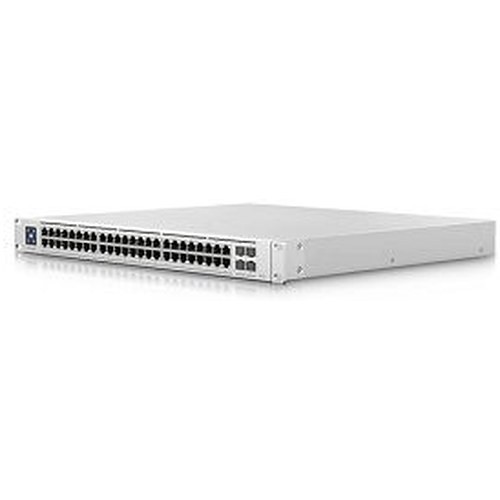
In This Guide
- How do the port speeds, PoE standard, and switching throughput compare between the two models?
- How do the power budgets, base consumption, physical build, and environmental ratings compare?
- Which deployment scenarios, device ecosystems, and management requirements does each model best serve?
- Which should you choose: the USW-PRO-MAX-48-POE or the USW-ENTERPRISE-48-POE?
- Side-by-Side Specs
- FAQ
How do the port speeds, PoE standard, and switching throughput compare between the two models?
The USW-PRO-MAX-48-POE offers a heterogeneous port configuration: 48 × 1G RJ-45 ports, 8 × 2.5G ports, and 2 × 10G SFP+ uplinks. Its switching capacity is 224 Gbps with 112 Gbps non-blocking throughput and a forwarding rate of 167 Mpps. PoE is delivered at the 802.3bt (PoE++) standard, which supports per-port power levels up to 90W, enabling high-draw devices such as PTZ cameras, Wi-Fi 6E APs, and video intercoms without supplemental injectors.
The USW-ENTERPRISE-48-POE standardizes all 48 RJ-45 ports at 2.5G, with 4 × 10G SFP+ uplinks. Its switching capacity equals 160 Gbps non-blocking, while its forwarding rate is notably higher at 238 Mpps. PoE is delivered at the 802.3at (PoE+) standard, capping per-port output at 30W—sufficient for standard IP cameras and 802.11ax APs but unable to power 802.3bt-only devices without supplemental hardware.
For installers: the PRO-MAX model's 224 Gbps fabric and PoE++ headroom address mixed high-power device loads; the ENTERPRISE model's uniform 2.5G access tier and higher forwarding rate favor dense, latency-sensitive environments where all endpoints can leverage 2.5G link speeds and per-port power demands stay within 30W.
How do the power budgets, base consumption, physical build, and environmental ratings compare?
Both switches share the same 870W internal AC power supply (100–240V, 50/60 Hz), identical 720W PoE output budget, and the same SGCC steel enclosure measuring 442 × 400 × 44 mm and weighing 6.2 kg without mounting brackets. Operating temperature range is identical: -5°C to 40°C (23°F to 104°F) for both units.
The key power distinction is base (non-PoE) consumption. The USW-PRO-MAX-48-POE draws 100W at base load, leaving a larger effective margin within the 870W supply for PoE allocation. The USW-ENTERPRISE-48-POE draws 150W at base load—50W more—which reduces the practical PoE headroom by the same amount even though the rated 720W PoE budget figure is identical for both.
The USW-ENTERPRISE-48-POE is specified with a 1.3-inch LCM color touchscreen display; no such display is listed in the USW-PRO-MAX-48-POE specifications. This on-unit display may be relevant for out-of-band status checks or local management without a connected laptop in IDF/MDF environments.
Which deployment scenarios, device ecosystems, and management requirements does each model best serve?
Both switches support up to 1,000 VLANs, are managed via Ethernet, and carry NDAA compliance alongside CE, FCC, IC, and Anatel certifications—making both eligible for U.S. federal and regulated-sector deployments. Both operate within the Ubiquiti UniFi ecosystem, assuming standard UniFi Network controller management applies to both (controller platform not explicitly re-stated in the provided specs beyond 'Management: Ethernet').
The USW-PRO-MAX-48-POE is the more appropriate choice when the installed device mix includes 802.3bt endpoints (high-power PTZ cameras, multi-radio Wi-Fi 6E APs, smart UPS devices) or when selective 2.5G and 10G SFP+ uplink capacity is required alongside a 1G access tier. Its 224 Gbps fabric provides headroom for future traffic growth.
The USW-ENTERPRISE-48-POE suits deployments where every access device already supports or benefits from a 2.5G link (e.g., Wi-Fi 6/6E APs with 2.5G uplink ports, NVRs with 2.5G NICs) and all PoE loads remain within 30W per port. Its four 10G SFP+ uplinks and 238 Mpps forwarding rate make it a capable aggregation layer switch in a multi-tier architecture. The LCM touchscreen adds a local management convenience not present on the PRO-MAX.
Which should you choose: the USW-PRO-MAX-48-POE or the USW-ENTERPRISE-48-POE?
Our take: The USW-PRO-MAX-48-POE is the stronger choice when the deployment includes high-draw 802.3bt devices or requires a mixed-speed access tier with room to grow. Three concrete spec deltas drive this: first, PoE standard—PoE++ (802.3bt, up to 90W/port) vs. PoE+ (802.3at, 30W/port cap)—determining whether PTZ cameras, multi-radio APs, or similar high-power endpoints can be powered at all without injectors; second, switching capacity—224 Gbps vs. 160 Gbps—a 40% fabric advantage; third, base power draw—100W vs. 150W—meaning 50W more of the shared 870W supply is available for PoE on the PRO-MAX despite both carrying the same 720W PoE budget spec. The USW-ENTERPRISE-48-POE is the better fit when all 48 access devices support 2.5G links and PoE+ suffices, or when the on-unit LCM display is operationally useful. Both are NDAA-compliant and identically housed.
Side-by-Side Comparison
Spec-for-spec, from manufacturer data.
| Specification | Ubiquiti USW-PRO-MAX-48-POE | Ubiquiti USW-ENTERPRISE-48-POE |
|---|---|---|
| SKU | USW-PRO-MAX-48-POE | USW-ENTERPRISE-48-POE |
| Form Factor | 1U Rack Mount | 1U Rack Mount |
| RJ-45 Access Ports | 48 × 1G | 48 × 2.5G |
| Additional Access Ports | 8 × 2.5G | — |
| SFP+ Uplinks | 2 × 10G | 4 × 10G |
| PoE Standard | 802.3bt (PoE++) | 802.3at (PoE+) |
| PoE Budget | 720W | 720W |
| Switching Capacity | 224 Gbps | 160 Gbps |
| Non-Blocking Throughput | 112 Gbps | 160 Gbps (non-blocking) |
| Forwarding Rate | 167 Mpps | 238 Mpps |
| Base Power Consumption (excl. PoE) | 100W | 150W |
| Internal Power Supply | 870W | 870W |
| VLAN Support | 1,000 | 1,000 |
| Local Display | — | 1.3" LCM color touchscreen |
| Dimensions (mm) | 442.4 × 400 × 44 | 442 × 400 × 44 |
| Weight (without brackets) | 6.2 kg (13.7 lb) | 6.2 kg (13.7 lb) |
| Operating Temperature | -5°C to 40°C | -5°C to 40°C |
| NDAA Compliant | Yes | Yes |
| Enclosure | SGCC steel | SGCC steel |
| Certifications | CE, FCC, IC, Anatel 06373-24-08356 | CE, FCC, IC, Anatel 05485-22-08356 |
Frequently Asked Questions
Which should you choose: the USW-PRO-MAX-48-POE or the USW-ENTERPRISE-48-POE?
The USW-PRO-MAX-48-POE is the stronger choice when the deployment includes high-draw 802.3bt devices or requires a mixed-speed access tier with room to grow. Three concrete spec deltas drive this: first, PoE standard—PoE++ (802.3bt, up to 90W/port) vs. PoE+ (802.3at, 30W/port cap)—determining whether PTZ cameras, multi-radio APs, or similar high-power endpoints can be powered at all without injectors; second, switching capacity—224 Gbps vs. 160 Gbps—a 40% fabric advantage; third, base power draw—100W vs. 150W—meaning 50W more of the shared 870W supply is available for PoE on the PRO-MAX despite both carrying the same 720W PoE budget spec. The USW-ENTERPRISE-48-POE is the better fit when all 48 access devices support 2.5G links and PoE+ suffices, or when the on-unit LCM display is operationally useful. Both are NDAA-compliant and identically housed.
Is the USW-PRO-MAX-48-POE or USW-ENTERPRISE-48-POE better for powering high-wattage PTZ cameras and Wi-Fi 6E access points?
The USW-PRO-MAX-48-POE is the appropriate choice for high-draw devices. It delivers PoE++ (802.3bt), which supports up to 90W per port, while the USW-ENTERPRISE-48-POE delivers PoE+ (802.3at), capped at 30W per port. If any device in the deployment requires more than 30W—common for PTZ cameras, multi-radio Wi-Fi 6E APs, or video door stations—the ENTERPRISE model cannot power those devices without external injectors. The PRO-MAX eliminates that constraint.
Both switches list a 720W PoE budget—does that mean they deliver the same real-world PoE capacity?
Not exactly. Both are rated for 720W of PoE output and share an 870W internal power supply, but base (non-PoE) power consumption differs: the USW-PRO-MAX-48-POE draws 100W at base load versus 150W for the USW-ENTERPRISE-48-POE. That 50W difference means the ENTERPRISE model consumes more of the shared 870W supply before a single PoE watt is delivered, reducing effective simultaneous PoE headroom compared to the PRO-MAX, despite the identical 720W rated budget.
Which switch has faster throughput—the USW-PRO-MAX-48-POE or the USW-ENTERPRISE-48-POE?
It depends on the metric. The USW-PRO-MAX-48-POE has the larger switching fabric: 224 Gbps switching capacity versus 160 Gbps for the ENTERPRISE. However, the USW-ENTERPRISE-48-POE has the higher packet forwarding rate: 238 Mpps versus 167 Mpps for the PRO-MAX. For raw bandwidth headroom and large-frame video traffic aggregation, the PRO-MAX fabric is larger. For small-packet forwarding density—relevant in high-session-count environments—the ENTERPRISE's forwarding rate is higher.
More Network Switch Comparisons
- NETGEAR GS748PP-100NAS vs Ubiquiti USW-48-POE
- NETGEAR GS748PP-100NAS vs Ubiquiti USW-PRO-MAX-48-POE
- NETGEAR GS748PP-100NAS vs Ubiquiti USW-ENTERPRISE-48-POE
- NETGEAR GS748PP-100NAS vs Ubiquiti ES-48-500W
- NETGEAR GS748PP-100NAS vs NETGEAR GS348PP-100NAS
- Ubiquiti USW-48-POE vs NETGEAR GS348PP-100NAS
Network Switch Buying Guides
Get a Second Opinion on Your Camera Choice
Share your site layout, coverage goals, and budget. Our team will validate the camera selection, flag anything we would change, and recommend products that match the use case.