
Ubiquiti USW-PRO-48-POE vs NETGEAR GS748PP-100NAS: Specification Comparison
Both the Ubiquiti USW-PRO-48-POE and the NETGEAR GS748PP-100NAS are 1U rackmount, 48-port Gigabit Ethernet PoE switches aimed at enterprise and commercial installations requiring powered endpoints such as IP cameras, access control readers, and wireless access points. They share the same port count and physical form factor, making them a legitimate cross-shop for integrators sizing a wiring-closet switch. The comparison turns on management depth, PoE power budget architecture, uplink capacity, and VLAN/routing capability—dimensions that separate a managed enterprise platform from a plug-and-play unmanaged unit.
In This Guide
- Which switch delivers more PoE headroom, and how is that power allocated across ports?
- Does either switch offer enough backhaul and internal fabric to prevent congestion under full port load?
- Which switch gives integrators the network management, VLAN segmentation, and monitoring tools needed for a converged security deployment?
- Which should you choose: the USW-PRO-48-POE or the GS748PP-100NAS?
- Side-by-Side Specs
- FAQ
Which switch delivers more PoE headroom, and how is that power allocated across ports?
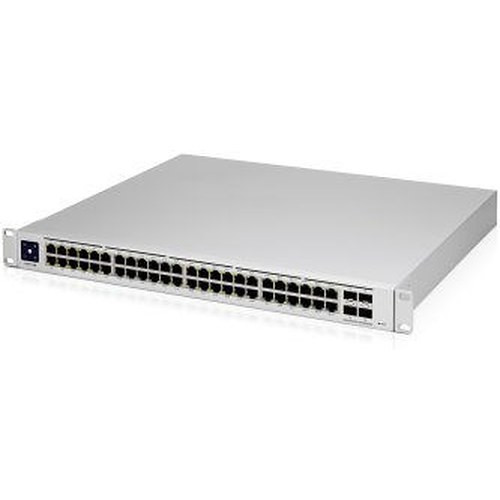
The USW-PRO-48-POE provides a 600 W aggregate PoE output budget (660 W total system draw including 60 W independent), structured as 40 ports at 32 W PoE+ (802.3af/at) and 8 ports at 64 W PoE++ (802.3bt). This tiered allocation allows high-draw devices—pan-tilt-zoom cameras, Wi-Fi 6E access points, or video intercoms requiring 60+ W—to be placed on the eight PoE++ ports without a separate injector.
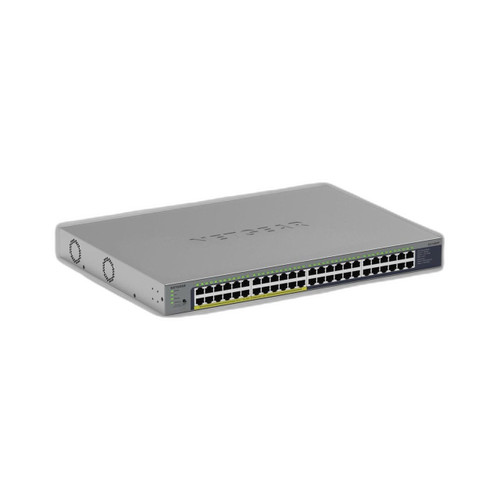
The NETGEAR GS748PP-100NAS is rated at 30 W per port with a PoE++ (802.3bt) designation; however, the spec sheet does not state a total aggregate PoE budget across all 48 ports. The 30 W per-port figure is the only power budget value present in the provided specifications. Buyers who need to calculate total worst-case draw should obtain the aggregate budget from NETGEAR's datasheet before deployment, as 48 × 30 W = 1,440 W theoretical maximum cannot be assumed to be switchable simultaneously without a confirmed total budget figure.
For camera-dense installations where PTZ or multi-sensor cameras draw 25–60 W each, the Ubiquiti's documented 600 W pool and explicit 64 W port tier give integrators a concrete, plannable number. The NETGEAR's aggregate is not specified in the provided data.
Does either switch offer enough backhaul and internal fabric to prevent congestion under full port load?
The USW-PRO-48-POE has a stated switching capacity of 176 Gbps aggregate (88 Gbps non-blocking) and a forwarding rate of 131 Mpps. It adds four 10G SFP+ uplink ports, meaning the backhaul to a core switch or router can sustain up to 40 Gbps (4 × 10 Gbps) simultaneously—well above the 48 Gbps of downlink traffic if all access ports are saturated at 1 Gbps full-duplex.
The NETGEAR GS748PP-100NAS is rated at 96 Gbps non-blocking switching fabric. The provided specifications do not list dedicated uplink ports beyond the 48 Gigabit ports, and no SFP or SFP+ uplink count is stated. If the unit ships without a higher-speed uplink, the backhaul path is limited to one or more of the 48 × 1 Gbps ports, which reduces effective downlink capacity.
For high-density video surveillance environments streaming multiple 4K or H.265 streams simultaneously, the Ubiquiti's 10G SFP+ uplinks and 176 Gbps fabric provide a measurable throughput advantage. The NETGEAR's 96 Gbps non-blocking fabric is sufficient for the access layer, but the absence of a specified high-speed uplink in the provided specs is a gap buyers must verify.
Which switch gives integrators the network management, VLAN segmentation, and monitoring tools needed for a converged security deployment?
The USW-PRO-48-POE is a fully managed Layer 2/3 switch supporting static routing, DHCP, and up to 1,000 VLANs. Management interfaces include a web UI, SSH, SNMP, REST API, and native integration with the UniFi Controller platform, enabling centralized configuration, firmware updates, port-level PoE scheduling, traffic analytics, and alerts from a single pane of glass across multiple sites.
The NETGEAR GS748PP-100NAS is specified as unmanaged. No VLAN support, SNMP, remote management interface, CLI, or controller integration is listed in the provided specifications. Configuration is limited to plug-and-play operation with no port-level control.
In a converged IP security deployment—cameras on one VLAN, VoIP on another, corporate data on a third—VLAN segmentation is typically a hard requirement enforced by IT security policy. The absence of any management capability on the NETGEAR eliminates it from architectures that mandate network segmentation, QoS prioritization, or centralized monitoring. The Ubiquiti satisfies all three through its documented feature set.
Which should you choose: the USW-PRO-48-POE or the GS748PP-100NAS?
Our take: The USW-PRO-48-POE is the stronger choice when the deployment requires network segmentation, centralized management, or high-power PoE++ endpoints. Key spec deltas: (1) PoE budget — Ubiquiti documents 600 W aggregate with 8 dedicated 64 W PoE++ ports versus NETGEAR's 30 W per-port figure with no stated aggregate; (2) uplinks — Ubiquiti adds four 10G SFP+ ports for 40 Gbps backhaul headroom versus no high-speed uplink specified for the NETGEAR; (3) management — Ubiquiti provides Layer 2/3 switching, 1,000 VLANs, SNMP, SSH, REST API, and UniFi Controller integration versus the NETGEAR's unmanaged, zero-configuration operation. The NETGEAR GS748PP-100NAS is appropriate only for flat, unmanaged edge deployments where simplicity and zero-configuration operation outweigh segmentation and monitoring requirements. Any installation subject to IT security policy requiring VLAN isolation must select the USW-PRO-48-POE or an equivalent managed platform.
Side-by-Side Comparison
Spec-for-spec, from manufacturer data.
| Specification | Ubiquiti USW-PRO-48-POE | NETGEAR GS748PP-100NAS |
|---|---|---|
| Port Count | 48 | 48 |
| Port Speed | 1G/100M/10M | 1G |
| PoE Standard | PoE++ (802.3bt) | PoE++ (802.3bt) |
| PoE per Port (max) | 64W (8 ports); 32W (40 ports) | 30W per port |
| Total PoE Budget | 600W aggregate (660W system max) | Not specified in provided specs |
| Uplink Ports | 4× 10G SFP+ | Not specified in provided specs |
| Switching Capacity | 176 Gbps aggregate / 88 Gbps non-blocking | 96 Gbps non-blocking |
| Forwarding Rate | 131 Mpps | Not specified in provided specs |
| Management | Managed Layer 2/3 | Unmanaged |
| VLAN Support | Up to 1,000 VLANs | — |
| Routing | Static routes, DHCP, VLAN routing | — |
| Management Interfaces | Web UI, SSH, SNMP, REST API, UniFi Controller | — |
| Form Factor | 1U Rackmount | Rackmount / Desktop |
| Weight | 16.3 lb | Not specified in provided specs |
| Country of Origin | CN | Not specified in provided specs |
| Warranty | Manufacturer Warranty | Not specified in provided specs |
Frequently Asked Questions
Which should you choose: the USW-PRO-48-POE or the GS748PP-100NAS?
The USW-PRO-48-POE is the stronger choice when the deployment requires network segmentation, centralized management, or high-power PoE++ endpoints. Key spec deltas: (1) PoE budget — Ubiquiti documents 600 W aggregate with 8 dedicated 64 W PoE++ ports versus NETGEAR's 30 W per-port figure with no stated aggregate; (2) uplinks — Ubiquiti adds four 10G SFP+ ports for 40 Gbps backhaul headroom versus no high-speed uplink specified for the NETGEAR; (3) management — Ubiquiti provides Layer 2/3 switching, 1,000 VLANs, SNMP, SSH, REST API, and UniFi Controller integration versus the NETGEAR's unmanaged, zero-configuration operation. The NETGEAR GS748PP-100NAS is appropriate only for flat, unmanaged edge deployments where simplicity and zero-configuration operation outweigh segmentation and monitoring requirements. Any installation subject to IT security policy requiring VLAN isolation must select the USW-PRO-48-POE or an equivalent managed platform.
Is the USW-PRO-48-POE or GS748PP-100NAS better for larger camera deployments with PTZ or multi-sensor cameras?
The USW-PRO-48-POE is better suited. It documents eight ports capable of delivering 64 W each (PoE++/802.3bt) and a total PoE budget of 600 W, giving integrators the headroom to power high-draw PTZ and multi-sensor cameras without external injectors. The GS748PP-100NAS specifies 30 W per port but does not state a total aggregate PoE budget in the provided specifications, making capacity planning for dense deployments less deterministic.
Can I use the GS748PP-100NAS in a network that requires camera VLANs separated from corporate traffic?
No—based on the provided specifications the GS748PP-100NAS is unmanaged, meaning it has no VLAN configuration capability. For any deployment requiring traffic segmentation between cameras, access control, VoIP, or corporate data, a managed switch such as the USW-PRO-48-POE, which supports up to 1,000 VLANs and Layer 2/3 routing, is required.
Do I need a UniFi Controller to manage the USW-PRO-48-POE, and what are my other management options?
The provided specifications list the UniFi Controller as one management option among several. The USW-PRO-48-POE also supports a web UI, SSH, SNMP, and REST API, so it can be configured and monitored without a UniFi Controller if your environment uses a different NMS. The UniFi Controller adds centralized multi-site management, PoE scheduling, and traffic analytics but is not the only access method documented in the specifications.
More Network Switch Comparisons
- NETGEAR GS748PP-100NAS vs Ubiquiti USW-48-POE
- NETGEAR GS748PP-100NAS vs Ubiquiti USW-PRO-MAX-48-POE
- NETGEAR GS748PP-100NAS vs Ubiquiti USW-ENTERPRISE-48-POE
- NETGEAR GS748PP-100NAS vs Ubiquiti ES-48-500W
- NETGEAR GS748PP-100NAS vs NETGEAR GS348PP-100NAS
- Ubiquiti USW-48-POE vs NETGEAR GS348PP-100NAS
Network Switch Buying Guides
Get a Second Opinion on Your Camera Choice
Share your site layout, coverage goals, and budget. Our team will validate the camera selection, flag anything we would change, and recommend products that match the use case.