
Ubiquiti USW-LITE-8-POE vs Vivotek IHT-1000: Specification Comparison
Both the Ubiquiti USW-LITE-8-POE and the Vivotek AW-IHT-1000 are managed 8-port gigabit PoE+ switches targeted at IP security and networked-device deployments. A buyer evaluating either unit is choosing how to power and segment cameras, access points, or IoT endpoints at the edge. While they share the same core port count and PoE+ standard, they diverge sharply on power budget, operating environment, physical ruggedness, and uplink options — dimensions that matter significantly to an installer selecting edge switching for a specific site profile.
In This Guide
- Which switch delivers more PoE power and switching headroom for demanding camera or AP deployments?
- Which switch is rated for harsh or outdoor-adjacent environments, and how do their physical builds compare?
- How do the two switches compare on power input design, redundancy, VLAN management, and platform integration?
- Which should you choose: the USW-LITE-8-POE or the IHT-1000?
- Side-by-Side Specs
- FAQ
Which switch delivers more PoE power and switching headroom for demanding camera or AP deployments?
The AW-IHT-1000 leads decisively on raw power budget: its specified total PoE output is 240 W across 8 ports, with a per-port maximum of 30 W (IEEE 802.3at). The USW-LITE-8-POE specifies a total PoE budget of 52 W across all 8 ports — less than one-quarter of the Vivotek's budget — which limits how many high-draw devices (PTZ cameras, 802.11ax APs, thermal imagers) can be simultaneously powered at full draw.
On switching capacity, the AW-IHT-1000 specifies 20 Gbps switching bandwidth and a forwarding capacity of 14.88 Mbps. The USW-LITE-8-POE specifies 16 Gbps switching capacity, 8 Gbps non-blocking throughput, and a forwarding rate of 12 Mpps. Both are adequate for 8-port line-rate gigabit forwarding, though the Vivotek's 20 Gbps figure and 2 additional SFP uplink ports provide greater aggregate headroom for backbone connectivity.
The AW-IHT-1000 also adds two 1000-BASE-X SFP fiber slots — not present on the USW-LITE-8-POE — enabling long-distance fiber uplinks to a core switch or NVR without a separate media converter. The Vivotek also specifies a 9,216-byte jumbo frame and 128 KB buffer; the Ubiquiti spec sheet does not list these values.
Which switch is rated for harsh or outdoor-adjacent environments, and how do their physical builds compare?
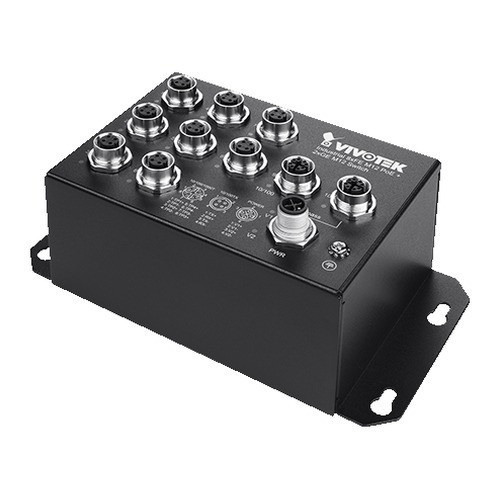
The AW-IHT-1000 is explicitly positioned as an industrial switch with an operating temperature range of -40 °C to +75 °C (-40 °F to +167 °F) and a storage temperature of -40 °C to +85 °C. It carries IEC 60068-2-6 vibration, IEC 60068-2-27 shock, and IEC 60068-2-32 freefall ratings, and its EMS compliance references EN 61000-4-2/3/4/5/6/8. Per-port surge protection is specified at 12 kV. These ratings make it suitable for transportation hubs, factory floors, parking structures, and similar non-conditioned spaces.
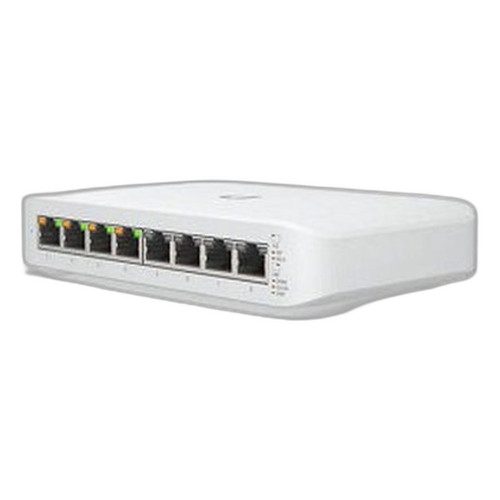
The USW-LITE-8-POE specifies an operating temperature of -15 °C to +40 °C (5 °F to 104 °F) and a polycarbonate enclosure. No vibration, shock, freefall, or surge-protection ratings are listed in the provided specifications. Its form factor is described as compact desktop/wall-mount, targeting conditioned indoor environments such as IT closets or retail back-of-house.
Weight and size also differ: the Vivotek is 172 × 132 × 39 mm at 0.8 kg; the Ubiquiti is 99.6 × 163.7 × 31.7 mm at 295 g (0.295 kg). The Vivotek is heavier and likely intended for DIN-rail or panel mounting in industrial enclosures, though the provided spec does not explicitly list DIN-rail as a mount type.
How do the two switches compare on power input design, redundancy, VLAN management, and platform integration?
The AW-IHT-1000 specifies dual DC power inputs (PW1 and PW2, each 48–56 VDC) with redundant power backup — a critical availability feature in unmanned or remote edge locations. The USW-LITE-8-POE accepts a single external 60 W AC/DC adapter (50–57 V DC output) with no redundant input specified.
On VLAN and management, the USW-LITE-8-POE specifies support for up to 1,000 VLANs and is managed via the Ubiquiti UniFi controller ecosystem (listed as Ethernet management). This is a meaningful differentiator for installers already running UniFi infrastructure, offering centralized provisioning, traffic monitoring, and firmware management from a single pane. The AW-IHT-1000 spec sheet as provided does not specify VLAN count or a named management platform.
Certifications differ in scope. The USW-LITE-8-POE carries NDAA Section 889 compliance, CE, FCC, IC, and Anatel listings. The AW-IHT-1000 lists FCC Part 15 Class A, CE, LVD, VCCI, and EMS per EN 61000-4 series. NDAA compliance is not stated for the AW-IHT-1000 in the provided specifications. For federally funded or government-adjacent projects requiring NDAA Section 889 compliance, this distinction is material.
Which should you choose: the USW-LITE-8-POE or the IHT-1000?
Our take: The USW-LITE-8-POE is the stronger choice when deploying in conditioned indoor environments within an existing UniFi ecosystem where NDAA Section 889 compliance is required and per-port power draw stays well under 6.5 W average. The AW-IHT-1000 is the stronger choice for installations in harsh or non-conditioned environments. Its 240 W total PoE budget is 4.6× larger than the Ubiquiti's 52 W, its operating temperature floor is 25 °C lower (-40 °C vs -15 °C), and its 12 kV per-port surge protection and dual redundant DC inputs address reliability requirements the USW-LITE-8-POE does not specify. The two SFP uplink slots on the Vivotek also enable fiber backbone connectivity absent from the Ubiquiti. Integrators powering PTZ cameras, thermal imagers, or multi-radio APs in transportation, industrial, or outdoor-adjacent sites should specify the AW-IHT-1000; those deploying standard IP cameras in office or retail spaces on a UniFi platform will find the USW-LITE-8-POE adequate and simpler to manage.
Side-by-Side Comparison
Spec-for-spec, from manufacturer data.
| Specification | Ubiquiti USW-LITE-8-POE | Vivotek IHT-1000 |
|---|---|---|
| Device Type | Managed PoE+ Switch | Industrial Managed PoE+ Switch |
| RJ45 PoE+ Ports | 8 × 1 Gbps (all PoE+) | 8 × 1 Gbps (all PoE+) |
| SFP Uplink Ports | — | 2 × 1000-BASE-X SFP |
| Total PoE Power Budget | 52 W | 240 W |
| Max PoE per Port | — | 30 W (802.3at) |
| PoE Standard | IEEE 802.3at (PoE+) | IEEE 802.3af / 802.3at |
| Switching Capacity | 16 Gbps (8 Gbps non-blocking) | 20 Gbps |
| Forwarding Rate | 12 Mpps | 14.88 Mbps |
| VLAN Support | 1,000 VLANs | — |
| Operating Temperature | -15 °C to +40 °C | -40 °C to +75 °C |
| Per-Port Surge Protection | — | 12 kV |
| Redundant Power Input | No (single AC/DC adapter) | Yes (dual 48–56 VDC inputs) |
| Vibration / Shock Rating | — | IEC 60068-2-6 / IEC 60068-2-27 |
| Enclosure Material | Polycarbonate | — |
| Weight | 295 g | 0.8 kg |
| NDAA Section 889 Compliant | Yes | — |
Frequently Asked Questions
Which should you choose: the USW-LITE-8-POE or the IHT-1000?
The USW-LITE-8-POE is the stronger choice when deploying in conditioned indoor environments within an existing UniFi ecosystem where NDAA Section 889 compliance is required and per-port power draw stays well under 6.5 W average. The AW-IHT-1000 is the stronger choice for installations in harsh or non-conditioned environments. Its 240 W total PoE budget is 4.6× larger than the Ubiquiti's 52 W, its operating temperature floor is 25 °C lower (-40 °C vs -15 °C), and its 12 kV per-port surge protection and dual redundant DC inputs address reliability requirements the USW-LITE-8-POE does not specify. The two SFP uplink slots on the Vivotek also enable fiber backbone connectivity absent from the Ubiquiti. Integrators powering PTZ cameras, thermal imagers, or multi-radio APs in transportation, industrial, or outdoor-adjacent sites should specify the AW-IHT-1000; those deploying standard IP cameras in office or retail spaces on a UniFi platform will find the USW-LITE-8-POE adequate and simpler to manage.
Can the USW-LITE-8-POE power eight high-draw PTZ cameras simultaneously?
Unlikely at full draw. The USW-LITE-8-POE specifies a total PoE budget of 52 W across all 8 ports, which averages 6.5 W per port. Many PTZ cameras and 802.11ax APs require 15–25 W each under IEEE 802.3at. The AW-IHT-1000, with its 240 W total budget and 30 W per-port maximum, is the appropriate choice for powering high-draw devices on all 8 ports simultaneously.
Is either switch suitable for an outdoor cabinet or an unconditioned plant floor?
The AW-IHT-1000 is rated for -40 °C to +75 °C operation and carries IEC 60068-2-6 vibration, IEC 60068-2-27 shock, IEC 60068-2-32 freefall ratings, and EN 61000-4 EMS compliance with 12 kV per-port surge protection — making it appropriate for harsh or non-conditioned locations. The USW-LITE-8-POE is rated only to -15 °C to +40 °C in a polycarbonate enclosure with no vibration, shock, or surge ratings listed, and is better suited to conditioned indoor spaces.
Which switch is easier to manage if I already run a UniFi network?
The USW-LITE-8-POE is designed for the Ubiquiti UniFi ecosystem and supports up to 1,000 VLANs, making it straightforward to provision and monitor from the UniFi controller alongside other UniFi devices. The AW-IHT-1000's provided specifications do not reference a named management platform or VLAN count, so integration effort into an existing UniFi environment cannot be confirmed from the available spec data.
More Network Switch Comparisons
- Vivotek IHT-1271 vs TP-Link SG3210XHP-M2
- Vivotek IHT-1271 vs TP-Link S4500-8GP2F
- Vivotek IHT-1271 vs TP-Link SG1210P
- Vivotek IHT-1271 vs Allied Telesis AT-x530L-10GHXm-10
- Vivotek IHT-1271 vs Vivotek GEV-108A-130
- Vivotek IHT-1271 vs Vivotek IHT-1000
Network Switch Buying Guides
Get a Second Opinion on Your Camera Choice
Share your site layout, coverage goals, and budget. Our team will validate the camera selection, flag anything we would change, and recommend products that match the use case.