
Ubiquiti USW-LITE-8-POE vs Vivotek GEV-108A-130: Specification Comparison
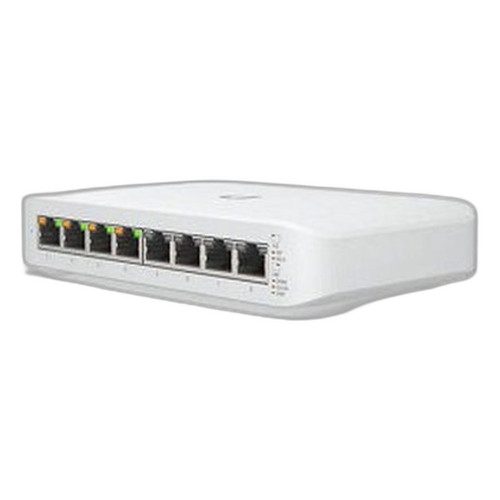
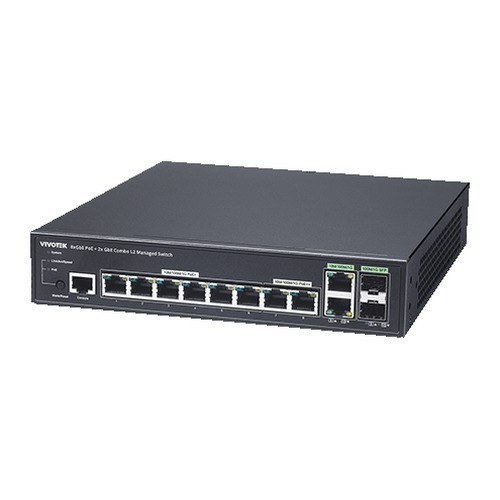
Both the Ubiquiti USW-LITE-8-POE and the Vivotek AW-GEV-108A-130 are 8-port gigabit PoE managed switches aimed at IP security and AV installations where cameras, access points, or access control devices need inline power without external injectors. The Ubiquiti targets compact, cost-sensitive edge deployments under a UniFi management ecosystem, while the Vivotek is a rack-capable unit with a higher PoE budget, dual SFP combo uplinks, and deep surveillance-device management tooling native to the Vivotek platform. This comparison covers PoE capacity and port architecture, physical form and operating environment, and management depth and protocol support.
In This Guide
- Which switch delivers more PoE power and how are watts distributed across ports?
- How do form factor, physical build, and operating environment compare?
- What management depth and protocol support does each switch provide?
- Which should you choose: the USW-LITE-8-POE or the GEV-108A-130?
- Side-by-Side Specs
- FAQ
Which switch delivers more PoE power and how are watts distributed across ports?
The AW-GEV-108A-130 holds a decisive advantage in raw PoE output. Its 130W total budget is split across 8 ports: ports 1–6 each deliver up to 30W (802.3af/at), while ports 7–8 support 802.3bt at up to 90W each — enabling high-draw PTZ cameras, multi-sensor units, or PoE-powered displays without a separate injector. An Extended PoE mode is also specified, pushing PoE reach to 250m at 10 Mbps, which matters on large campuses or parking structures where cable runs exceed the standard 100m limit.
The USW-LITE-8-POE provides a 52W total PoE+ budget across all 8 ports at 802.3at (30W per port maximum). With 52W shared, simultaneous full-load operation on all 8 ports is not possible at 30W each; installers must budget per-port draw carefully. The switch does not list 802.3bt support or extended-reach PoE in its specifications. For deployments using only standard 802.3at cameras or APs drawing well under 52W combined, this is sufficient; for high-power endpoints or longer cable pulls, it is not.
How do form factor, physical build, and operating environment compare?
The USW-LITE-8-POE is a compact desktop/wall-mount unit measuring 99.6 × 163.7 × 31.7 mm and weighing 295g (10.4 oz). Its enclosure and mount material are both listed as polycarbonate. It is powered by an included external 60W AC/DC adapter outputting 50–57V DC, and is rated for operation from −15°C to +40°C. No rack-mount form factor or rack kit is specified.
The AW-GEV-108A-130 is substantially larger at 220 × 44 × 242 mm and weighs 1.95 kg, consistent with a 1U rackmount profile — a rack mount kit is listed as an included accessory. It accepts universal AC input (100–240V, 50–60Hz) with an internal power supply, eliminating the external adapter. Its operating range is −10°C to +50°C with storage rated to 70°C, and operating humidity is specified at 10–90% RH. The Ubiquiti spec sheet does not list humidity tolerance. The Vivotek's wider upper temperature limit (+50°C vs +40°C) gives it 10°C more headroom in warm IDF closets or outdoor enclosures without active cooling.
What management depth and protocol support does each switch provide?
The AW-GEV-108A-130 offers an extensive management feature set documented in its spec sheet. VLAN support reaches 4,096 VLAN IDs with 802.1Q tag-based, port-based, private VLAN edge, Q-in-Q, MAC-based, IP subnet-based, Voice VLAN, and protocol-based modes. Layer 2 redundancy is covered by STP (802.1D), RSTP (802.1w), and MSTP (802.1s). QoS provides 8 hardware queues with WRR, DSCP, 802.1p, and per-port controls. Security includes RADIUS, TACACS+, SSL, DHCP snooping, IP source guard, storm control, and port security. SNMP v1/v2c/v3, RMON (groups 1, 2, 3, 9), LLDP-MED, sFlow, NTP, and port mirroring are all specified. Vivotek-specific surveillance tooling includes auto-discovery of up to 256 Vivotek devices, topology/floor/Google Map views, PoE scheduling, PoE alive checking with reboot, non-stop PoE, and per-device account/password and VLAN grouping — functions that require no separate NMS for small-to-mid Vivotek deployments.
The USW-LITE-8-POE is managed as part of the UniFi ecosystem (management listed as Ethernet). Its spec sheet as provided lists 1,000 VLAN support, 16 Gbps switching capacity, and 12 Mpps forwarding rate, but does not enumerate the specific VLAN types, spanning tree variants, QoS queues, security protocols, SNMP version support, or sFlow capability. Buyers who rely on UniFi Controller gain a unified dashboard across Ubiquiti devices, but protocol-level specs for standalone or third-party NMS integration are not present in the supplied data and cannot be assumed.
Which should you choose: the USW-LITE-8-POE or the GEV-108A-130?
Our take: The AW-GEV-108A-130 is the stronger choice when the deployment requires high-power PoE endpoints, rack installation, or deep surveillance-native management tooling. Its 130W budget is 2.5× the Ubiquiti's 52W, with two 90W 802.3bt ports for PTZ or multi-sensor cameras; its operating ceiling is +50°C versus +40°C; and its 4,096-VLAN-ID capacity versus 1,000 gives more headroom in segmented enterprise or multi-tenant sites. It also adds two SFP combo uplinks absent on the Ubiquiti. The USW-LITE-8-POE is the appropriate pick for compact, cost-sensitive edge nodes in all-Ubiquiti UniFi networks where total PoE draw stays well under 52W, desktop or wall placement is preferred, and weight (295g versus 1.95 kg) is a constraint. Vivotek-platform installers gain the most from the GEV-108A-130's native device discovery and PoE control; UniFi-centric integrators will find the USW-LITE-8-POE fits their existing management workflow more naturally.
Side-by-Side Comparison
Spec-for-spec, from manufacturer data.
| Specification | Ubiquiti USW-LITE-8-POE | Vivotek GEV-108A-130 |
|---|---|---|
| Total PoE Power Budget | 52W | 130W |
| Max PoE Per Port | 30W (802.3at) | 90W on ports 7–8 (802.3bt); 30W on ports 1–6 |
| PoE Standards | IEEE 802.3at (PoE+) | IEEE 802.3af / 802.3at / 802.3bt |
| Extended PoE Reach | — | Up to 250m at 10 Mbps |
| Gigabit RJ45 Ports (PoE) | 8 | 8 |
| Additional Uplink Ports | — | 2× Gigabit SFP Combo |
| Total Ports | 8 | 10 |
| Switching Capacity | 16 Gbps | 20 Gbps |
| Forwarding Rate | 12 Mpps | 14.88 Mpps |
| VLAN Support | 1,000 VLANs | 4,096 VLAN IDs (multiple VLAN types) |
| Form Factor | Compact desktop / wall-mount | 1U rackmount (kit included) |
| Dimensions (mm) | 99.6 × 163.7 × 31.7 | 220 × 44 × 242 |
| Weight | 295g (10.4 oz) | 1.95 kg |
| Power Input | External 60W AC/DC adapter (50–57V DC) | Internal; 100–240V AC, 50–60Hz |
| Operating Temperature | −15°C to +40°C | −10°C to +50°C |
| NDAA Section 889 Compliant | Yes | — |
| Certifications | CE, FCC, IC, Anatel | UL, CE, UKCA, FCC, VCCI, LVD, ICES |
| Warranty | Manufacturer warranty (duration not specified) | 24 months |
Frequently Asked Questions
Which should you choose: the USW-LITE-8-POE or the GEV-108A-130?
The AW-GEV-108A-130 is the stronger choice when the deployment requires high-power PoE endpoints, rack installation, or deep surveillance-native management tooling. Its 130W budget is 2.5× the Ubiquiti's 52W, with two 90W 802.3bt ports for PTZ or multi-sensor cameras; its operating ceiling is +50°C versus +40°C; and its 4,096-VLAN-ID capacity versus 1,000 gives more headroom in segmented enterprise or multi-tenant sites. It also adds two SFP combo uplinks absent on the Ubiquiti. The USW-LITE-8-POE is the appropriate pick for compact, cost-sensitive edge nodes in all-Ubiquiti UniFi networks where total PoE draw stays well under 52W, desktop or wall placement is preferred, and weight (295g versus 1.95 kg) is a constraint. Vivotek-platform installers gain the most from the GEV-108A-130's native device discovery and PoE control; UniFi-centric integrators will find the USW-LITE-8-POE fits their existing management workflow more naturally.
Can the USW-LITE-8-POE or GEV-108A-130 power a high-wattage PTZ camera on a single port?
Only the AW-GEV-108A-130 supports 802.3bt on ports 7 and 8, delivering up to 90W per port — sufficient for high-draw PTZ cameras or multi-sensor units that exceed the 802.3at 30W ceiling. The USW-LITE-8-POE is specified at 802.3at (PoE+, 30W per port max) with a 52W shared budget, so it cannot meet a single-port 90W demand and does not list 802.3bt support.
Which switch is better suited for a rack-mounted IDF closet installation?
The AW-GEV-108A-130 is the rack-suited option. Its dimensions (220 × 44 × 242 mm) match a 1U rack profile and a rack mount kit is included in the box. Its internal universal AC power supply (100–240V) avoids an external adapter in the rack. The USW-LITE-8-POE is a compact desktop/wall-mount unit with an external AC/DC adapter and no rack kit listed in its specifications.
Is the USW-LITE-8-POE or GEV-108A-130 better for a mixed Vivotek camera deployment where I want to reboot cameras remotely or set PoE schedules?
The AW-GEV-108A-130 is purpose-built for that use case. Its specifications include PoE on/off control, PoE alive checking with automatic PD reboot, PoE scheduling, and auto-discovery of up to 256 Vivotek devices with per-device account/password management — all accessible through its built-in web management interface without a separate NMS. The USW-LITE-8-POE's supplied specifications do not list per-port PoE scheduling or PD-reboot features.
More Network Switch Comparisons
- Vivotek IHT-1271 vs TP-Link SG3210XHP-M2
- Vivotek IHT-1271 vs TP-Link S4500-8GP2F
- Vivotek IHT-1271 vs TP-Link SG1210P
- Vivotek IHT-1271 vs Allied Telesis AT-x530L-10GHXm-10
- Vivotek IHT-1271 vs Vivotek GEV-108A-130
- Vivotek IHT-1271 vs Vivotek IHT-1000
Network Switch Buying Guides
Get a Second Opinion on Your Camera Choice
Share your site layout, coverage goals, and budget. Our team will validate the camera selection, flag anything we would change, and recommend products that match the use case.