
Ubiquiti USW-FLEX vs Ubiquiti USW-FLEX-MINI: Specification Comparison
Both the USW-FLEX and USW-FLEX-MINI are Ubiquiti UniFi 5-port managed gigabit switches aimed at compact, edge, or distributed deployments. They share identical switching capacity (10 Gbps), forwarding rate (7 Mpps), VLAN depth (1,000), and port count (5× GbE). The critical divergence is power: the USW-FLEX is a PoE++ sourcing switch powered by upstream PoE, while the USW-FLEX-MINI is a USB-C-powered device with no PoE output. Buyers cross-shopping these are weighing powered-device delivery and environmental ruggedness against extreme compactness and low-power simplicity.
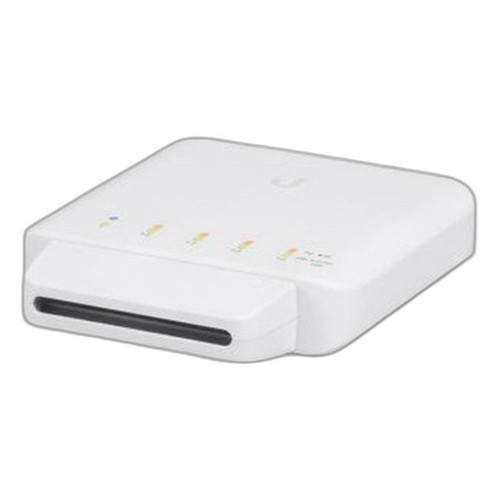
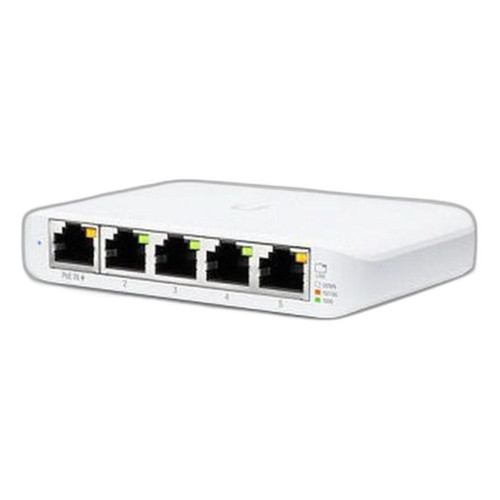
In This Guide
- Which switch can power downstream devices — and how much budget does it provide?
- Where can each switch be physically deployed — indoors only, or in harsh outdoor and industrial sites?
- Do the two switches deliver equivalent data-plane performance and management capability?
- Which should you choose: the USW-FLEX or the USW-FLEX-MINI?
- Side-by-Side Specs
- FAQ
Which switch can power downstream devices — and how much budget does it provide?
The USW-FLEX is a PoE++ (802.3bt) sourcing switch with a stated 60W total PoE output budget and a single-port maximum of 54V/1.11A (~60W). It accepts power from an upstream PoE+ source at either 46W or 20W input. This makes it capable of powering cameras, access points, VoIP phones, or other PoE-class devices directly from its downstream ports without a separate power injector or local AC outlet.
The USW-FLEX-MINI carries a PoE (802.3af) notation in its specs but its power budget is listed as 2.5W maximum total consumption, powered solely by a USB Type-C connection at 5V/1A (4.8–5.2V DC). No PoE output budget figure is provided in the supplied specifications. Buyers who need to power any downstream PoE device cannot rely on the USW-FLEX-MINI based on the available spec data; it functions as a pure traffic-switching edge device.
Where can each switch be physically deployed — indoors only, or in harsh outdoor and industrial sites?
The USW-FLEX is rated for an operating temperature of -40°C to 55°C (-40°F to 131°F) at its 46W PoE output mode, with storage down to -30°C and up to 70°C. It supports desktop, wall-mount, and pole-mount configurations at 122.5 × 107.1 × 28 mm and 230 g. ESD protection is rated at ±16kV air and ±16kV contact. This positions the USW-FLEX for outdoor enclosures, industrial sites, unheated buildings, and remote edge locations that experience temperature extremes.
The USW-FLEX-MINI is rated -5°C to 45°C (23°F to 113°F) — a strictly indoor, climate-controlled range. Its enclosure is polycarbonate, dimensions are 107 × 70 × 21 mm, and it weighs 150 g. It supports desktop placement only; no wall-mount or pole-mount configuration is listed in the provided specifications. No ESD rating is specified for the MINI. The narrower thermal window and desktop-only form factor limit it to controlled interior spaces such as AV racks, reception desks, or server-room edge closets.
Do the two switches deliver equivalent data-plane performance and management capability?
Both switches share identical core switching specifications: 10 Gbps switching capacity, 5 Gbps non-blocking throughput across all five ports, a 7 Mpps forwarding rate, and support for up to 1,000 VLANs. Both are managed via Ethernet and integrate into the UniFi ecosystem. Neither model lists differences in SNMP versions, Layer 3 features, spanning tree variants, or QoS queuing in the supplied specifications, so no differentiation can be drawn on those dimensions from the provided data.
Both carry NDAA-compliant status and identical certification sets (CE, FCC, IC, Anatel), differing only in Anatel registration numbers (14502-20-08356 for the FLEX vs. 14501-20-08356 for the MINI). From a pure data-plane and management perspective, the two switches are functionally equivalent at the spec level provided; the USW-FLEX is heavier (230 g vs. 150 g) and physically larger, which is the natural trade-off for its rugged enclosure and PoE sourcing electronics.
Which should you choose: the USW-FLEX or the USW-FLEX-MINI?
Our take: The USW-FLEX is the stronger choice when downstream devices need power or when the deployment environment falls outside a controlled interior. It delivers 60W of PoE++ output — versus no documented PoE output on the USW-FLEX-MINI — and operates across a -40°C to 55°C range versus the MINI's -5°C to 45°C window, a 95-degree wider thermal envelope. It also adds wall and pole mounting to the desktop option, while the MINI offers desktop-only. Both switches are identical on data-plane metrics: 10 Gbps switching capacity, 5 Gbps non-blocking throughput, 7 Mpps forwarding, and 1,000 VLANs. The USW-FLEX-MINI is appropriate where no PoE output is needed, the installation is in a temperature-stable interior, and an available USB-C 5V source eliminates the need for PoE infrastructure. Platform qualifier: both integrate into the UniFi management ecosystem and are NDAA-compliant.
Side-by-Side Comparison
Spec-for-spec, from manufacturer data.
| Specification | Ubiquiti USW-FLEX | Ubiquiti USW-FLEX-MINI |
|---|---|---|
| SKU | USW-FLEX | USW-FLEX-MINI |
| Ports | 5× Gigabit Ethernet | 5× Gigabit Ethernet |
| Switching Capacity | 10 Gbps | 10 Gbps |
| Non-Blocking Throughput | 5 Gbps | 5 Gbps |
| Forwarding Rate | 7 Mpps | 7 Mpps |
| VLAN Support | 1,000 VLANs | 1,000 VLANs |
| PoE Output | 60W PoE++ (802.3bt) | Not specified in provided specs |
| Power Input | PoE+ upstream (46W or 20W) | USB Type-C, 5V DC, 1A |
| Power Consumption (excl. PoE) | 5W | 2.5W |
| Operating Temperature | -40°C to 55°C | -5°C to 45°C |
| Storage Temperature | -30°C to 70°C | — |
| ESD Protection | ±16kV Air, ±16kV Contact | — |
| Dimensions | 122.5 × 107.1 × 28 mm | 107 × 70 × 21 mm |
| Weight | 230 g (8.1 oz) | 150 g (5.3 oz) |
| Mount Options | Desktop, wall, pole | Desktop only |
| NDAA Compliant | Yes | Yes |
Frequently Asked Questions
Which should you choose: the USW-FLEX or the USW-FLEX-MINI?
The USW-FLEX is the stronger choice when downstream devices need power or when the deployment environment falls outside a controlled interior. It delivers 60W of PoE++ output — versus no documented PoE output on the USW-FLEX-MINI — and operates across a -40°C to 55°C range versus the MINI's -5°C to 45°C window, a 95-degree wider thermal envelope. It also adds wall and pole mounting to the desktop option, while the MINI offers desktop-only. Both switches are identical on data-plane metrics: 10 Gbps switching capacity, 5 Gbps non-blocking throughput, 7 Mpps forwarding, and 1,000 VLANs. The USW-FLEX-MINI is appropriate where no PoE output is needed, the installation is in a temperature-stable interior, and an available USB-C 5V source eliminates the need for PoE infrastructure. Platform qualifier: both integrate into the UniFi management ecosystem and are NDAA-compliant.
Can the USW-FLEX-MINI power a PoE camera or access point?
The provided specifications list the USW-FLEX-MINI's total power consumption as 2.5W via USB-C at 5V. No PoE output power budget is specified. Based on available spec data, the USW-FLEX-MINI cannot be confirmed as a PoE power source for downstream devices. The USW-FLEX, by contrast, specifies 60W of PoE++ output and is designed to power downstream PoE loads.
Is the USW-FLEX or USW-FLEX-MINI suitable for an outdoor or unheated enclosure?
The USW-FLEX is rated for -40°C to 55°C and supports wall and pole mounting, making it appropriate for outdoor enclosures, industrial sites, and unheated spaces. The USW-FLEX-MINI is rated only for -5°C to 45°C with desktop placement only, restricting it to climate-controlled interior environments.
Do the two switches perform the same in terms of network throughput and VLAN capacity?
Yes, based on the provided specifications both switches share identical data-plane figures: 10 Gbps switching capacity, 5 Gbps non-blocking throughput, 7 Mpps forwarding rate, and support for up to 1,000 VLANs. They also share the same 5-port GbE port count and UniFi managed-Ethernet management. The differentiation lies in PoE output, operating temperature, and mounting options — not in switching or VLAN performance.
More Network Switch Comparisons
- TP-Link ES205GP vs Ubiquiti USW-FLEX
- TP-Link ES205GP vs Ubiquiti USW-FLEX-MINI
- TP-Link ES205GP vs Ubiquiti USW-FLEX-3
- TP-Link ES205GP vs Ubiquiti USW-FLEX-MINI-3
- TP-Link ES205GP vs TP-Link SG105PP-M2
- TP-Link SG105PP-M2 vs Ubiquiti USW-FLEX
Network Switch Buying Guides
Get a Second Opinion on Your Camera Choice
Share your site layout, coverage goals, and budget. Our team will validate the camera selection, flag anything we would change, and recommend products that match the use case.