
TP-Link ES205GP vs Ubiquiti USW-FLEX-MINI: Specification Comparison
Both products are 5-port Gigabit Ethernet switches in the sub-100-dollar desktop/wall-mount segment, making them direct cross-shop candidates for small deployments such as a single camera cluster, a conference room, or a remote IDF closet. The comparison turns on one fundamental divide: the ES205GP delivers managed PoE+ power to connected devices, while the USW-FLEX-MINI is itself powered by USB-C and provides no PoE output to downstream ports. Buyers must decide whether powered-device delivery or ultra-low-power, compact deployment is the priority.
In This Guide
- Which switch actually powers connected devices — and how much headroom does each provide?
- What management depth and VLAN capability does each switch expose to the installer?
- How do physical footprint, mounting options, and operating environment compare for field deployment?
- Which should you choose: the ES205GP or the USW-FLEX-MINI?
- Side-by-Side Specs
- FAQ
Which switch actually powers connected devices — and how much headroom does each provide?
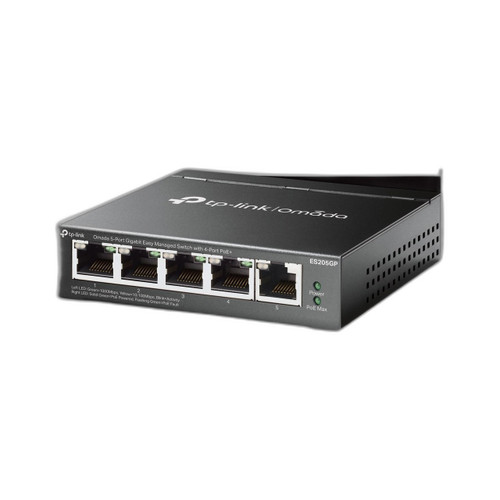
The ES205GP provides PoE+ (802.3af/at) on all four non-uplink ports with a 65 W total budget and a 30 W per-port maximum. That headroom supports simultaneous operation of high-draw devices — multi-sensor cameras, 802.11ax access points, or video intercoms — without load-shedding. Its power input is 53.5 VDC / 1.31 A from an external supply rated at 65 W max.
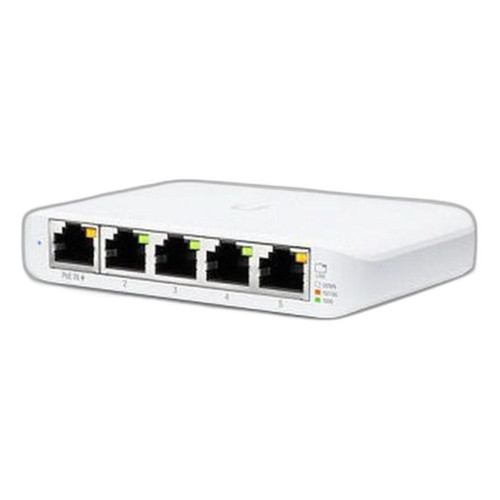
The USW-FLEX-MINI carries a 'PoE (802.3af)' entry in its spec sheet, but its power source is USB Type-C at 5 V / 2.5 W maximum total consumption. A 2.5 W envelope is physically incapable of sourcing 802.3af power (minimum 15.4 W per port) to downstream devices. No downstream PoE budget figure is listed because no PoE output is delivered. Buyers requiring powered endpoints must supply their own injectors or separate PoE switches for every device connected to the USW-FLEX-MINI.
What management depth and VLAN capability does each switch expose to the installer?
The ES205GP is described as 'Managed with Omada SDN' and lists DHCP Client as a management feature. It integrates with TP-Link's Omada Software Defined Networking controller, enabling centralized provisioning alongside Omada-family APs and routers. No explicit VLAN count is stated in the provided specs.
The USW-FLEX-MINI supports up to 1,000 VLANs per its spec sheet and is managed through Ubiquiti's UniFi controller ecosystem. Both switches therefore require vendor-specific controller software; neither is vendor-agnostic. Sites already standardized on Omada will favor the ES205GP, while UniFi-standardized sites will favor the USW-FLEX-MINI. NDAA compliance is confirmed only for the USW-FLEX-MINI; no NDAA statement is present for the ES205GP in the provided specs.
How do physical footprint, mounting options, and operating environment compare for field deployment?
The ES205GP measures 99.8 × 98 × 25 mm and supports both wall mount and rack mount via included bracket, making it suitable for IDF closets or surface-mounted camera-cluster applications. Its operating temperature range is 0 °C to 40 °C (32 °F to 104 °F).
The USW-FLEX-MINI measures 107 × 70 × 21 mm with a polycarbonate enclosure designed for compact desktop placement. No rack or wall-mount option is listed in the provided specs. Its operating temperature range extends slightly wider: -5 °C to 45 °C (23 °F to 113 °F), offering 5 °C additional cold tolerance and 5 °C additional heat tolerance versus the ES205GP. At 150 g, it is a lightweight unit suited to concealed or cable-tray deployment where power draw must be minimized.
Which should you choose: the ES205GP or the USW-FLEX-MINI?
Our take: The ES205GP is the stronger choice when connected devices require inline power, as it delivers 65 W of PoE+ across four ports with up to 30 W per port — versus the USW-FLEX-MINI's 2.5 W total draw and no confirmed downstream PoE output. For a typical small camera cluster of three or four PoE cameras, the ES205GP is operationally self-sufficient; the USW-FLEX-MINI would require separate power injection for every endpoint. The USW-FLEX-MINI holds advantages in operating temperature range (-5 to 45 °C versus 0 to 40 °C), confirmed NDAA compliance, and a 1,000-VLAN ceiling explicitly stated in its specs. Choose the ES205GP for any PoE-dependent deployment on the Omada platform; choose the USW-FLEX-MINI for power-constrained retrofit locations, federal procurement requiring NDAA compliance, or sites fully standardized on the UniFi ecosystem where no PoE output is needed.
Side-by-Side Comparison
Spec-for-spec, from manufacturer data.
| Specification | TP-Link ES205GP | Ubiquiti USW-FLEX-MINI |
|---|---|---|
| Product Type | Managed Switch (Omada SDN) | Managed Switch (UniFi) |
| Total Ports | 5 | 5 |
| Port Speed | 10/100/1000 Mbps (all 5) | 1 Gbps (all 5) |
| Switching Capacity | 10 Gbps | 10 Gbps |
| Forwarding Rate | 7.4 Mpps | 7 Mpps |
| Non-Blocking Throughput | Not stated in specs | 5 Gbps |
| PoE Output | PoE+ (802.3af/at), 4 ports | No downstream PoE output stated |
| PoE Budget (Total) | 65 W | — |
| PoE per Port (Max) | 30 W | — |
| Power Input | 53.5 VDC / 1.31 A (external) | USB Type-C, 5 V, 2.5 W max |
| VLAN Support | Not stated in specs | Up to 1,000 |
| Operating Temp | 0 to 40 °C | -5 to 45 °C |
| Mount Options | Wall; Rack (bracket included) | Desktop only (no rack/wall stated) |
| Dimensions | 99.8 × 98 × 25 mm | 107 × 70 × 21 mm |
| NDAA Compliant | Not stated in specs | Yes |
| Enclosure Material | Not stated in specs | Polycarbonate |
Frequently Asked Questions
Which should you choose: the ES205GP or the USW-FLEX-MINI?
The ES205GP is the stronger choice when connected devices require inline power, as it delivers 65 W of PoE+ across four ports with up to 30 W per port — versus the USW-FLEX-MINI's 2.5 W total draw and no confirmed downstream PoE output. For a typical small camera cluster of three or four PoE cameras, the ES205GP is operationally self-sufficient; the USW-FLEX-MINI would require separate power injection for every endpoint. The USW-FLEX-MINI holds advantages in operating temperature range (-5 to 45 °C versus 0 to 40 °C), confirmed NDAA compliance, and a 1,000-VLAN ceiling explicitly stated in its specs. Choose the ES205GP for any PoE-dependent deployment on the Omada platform; choose the USW-FLEX-MINI for power-constrained retrofit locations, federal procurement requiring NDAA compliance, or sites fully standardized on the UniFi ecosystem where no PoE output is needed.
Can the USW-FLEX-MINI power my IP cameras the way the ES205GP does?
Based on the provided specs, no. The USW-FLEX-MINI's total power consumption is 2.5 W via USB-C — far below the 15.4 W minimum required to source a single 802.3af port. The ES205GP provides a 65 W PoE+ budget across four ports, with up to 30 W per port, and is the appropriate choice when cameras or other PoE devices must be powered by the switch itself.
Which switch fits better in a federal or government installation subject to NDAA Section 889?
The USW-FLEX-MINI explicitly lists NDAA compliance in its provided specs. No NDAA compliance statement appears in the ES205GP's provided specs. For procurements where NDAA Section 889 conformance must be documented, the USW-FLEX-MINI is the specifiable option based on available data.
Can both switches be managed from the same controller platform?
No. The ES205GP is managed through TP-Link's Omada SDN controller, while the USW-FLEX-MINI is managed through Ubiquiti's UniFi controller. The two platforms are not interoperable. Sites must choose based on their existing controller investment or be prepared to run parallel management systems.
More Network Switch Comparisons
- TP-Link ES205GP vs Ubiquiti USW-FLEX
- TP-Link ES205GP vs Ubiquiti USW-FLEX-3
- TP-Link ES205GP vs Ubiquiti USW-FLEX-MINI-3
- TP-Link ES205GP vs TP-Link SG105PP-M2
- TP-Link SG105PP-M2 vs Ubiquiti USW-FLEX
- TP-Link SG105PP-M2 vs Ubiquiti USW-FLEX-MINI
Network Switch Buying Guides
Get a Second Opinion on Your Camera Choice
Share your site layout, coverage goals, and budget. Our team will validate the camera selection, flag anything we would change, and recommend products that match the use case.