
TP-Link ES205GP vs Ubiquiti USW-FLEX-3: Specification Comparison
Both the TP-Link ES205GP and Ubiquiti USW-FLEX-3 are 5-port managed gigabit switches with PoE delivery on four or five ports, targeting edge deployments in commercial security, small office, and remote-site environments. This comparison evaluates the two models across PoE budget and port architecture, physical and environmental durability, and management ecosystem integration — the three axes that drive purchase decisions for installers choosing a compact managed PoE switch.

In This Guide
Which switch delivers more PoE power, and how are ports allocated?
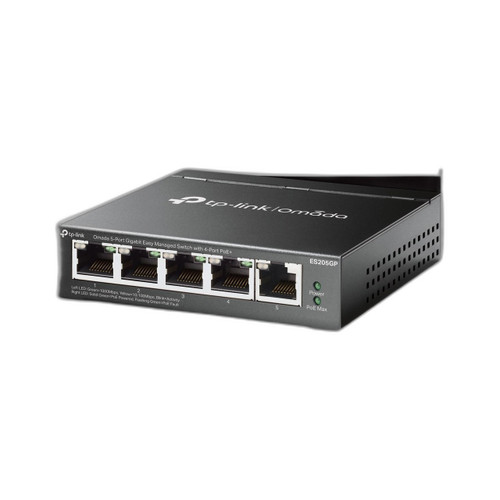
The TP-Link ES205GP provides PoE+ (802.3af/at) on 4 of its 5 ports with a total budget of 65W and a per-port maximum of 30W. The fifth port is a standard uplink with no PoE output. Switching capacity is listed at 10 Gbps with a forwarding rate of 7.4 Mpps.
The Ubiquiti USW-FLEX-3 delivers PoE on all five ports, rated as PoE++ (802.3bt) at 54V/1.11A output voltage per the specs. No total PoE budget wattage figure is provided in the supplied specifications. All five ports operate at 10/100/1000 Mbps. Total switching capacity is not stated in the provided specs.
For installers running a high-draw device on every port, the USW-FLEX-3's 5-port PoE coverage has an architectural advantage. However, without a stated total wattage budget for the USW-FLEX-3, the actual sustained power available across all ports cannot be compared numerically to the ES205GP's documented 65W budget.
Which switch is better suited to harsh or outdoor-adjacent deployments?
The TP-Link ES205GP is rated for 0°C to 40°C operating temperature. No ESD protection rating, IP rating, or storage temperature range is listed in the provided specifications. Dimensions are 99.8 × 98 × 25 mm. Mount options include wall and rack. The power supply input is 53.5 VDC / 1.31A with a maximum power consumption of 65W.
The Ubiquiti USW-FLEX-3 is rated for -20°C to 60°C operating temperature — a 20°C wider cold-end and 20°C wider hot-end range compared to the ES205GP. Storage temperature is rated -30°C to 70°C. ESD protection is specified at ±16kV air and ±16kV contact discharge. Mount options include wall, pole, and rack. Weight is listed at 2.35 lbs. Output voltage is 54V/1.11A; input power source is listed as external AC required.
For deployments in unconditioned spaces, IDF closets with poor HVAC, or outdoor-adjacent enclosures, the USW-FLEX-3's wider operating temperature range and explicit ESD rating represent a documented specification advantage. The ES205GP's 0–40°C range limits it to conditioned indoor environments.
Which switch integrates more cleanly into an existing management platform?
The TP-Link ES205GP is managed via Omada SDN. The spec listing notes DHCP Client as a management feature. It is described as 'Easy Managed' in the product type field, suggesting a simplified — though not necessarily full-featured — SDN experience within the Omada controller ecosystem. Certifications are not listed in the provided specs.
The Ubiquiti USW-FLEX-3 is managed via Web GUI and CLI and integrates with the UniFi controller ecosystem. Certifications listed include CE, FCC, and IC. The product family is listed as UniFi Switching. No VLAN depth, QoS detail, or specific feature list beyond GUI/CLI management is provided in the supplied specs.
Both switches require commitment to their respective proprietary management platforms — Omada (TP-Link) and UniFi (Ubiquiti). Neither spec set provides enough feature-level detail (VLAN count, RSTP, ACL depth) to differentiate management capability beyond platform affiliation. Buyers already invested in one ecosystem will find the matching switch the lower-friction choice.
Which should you choose: the ES205GP or the USW-FLEX-3?
Our take: The USW-FLEX-3 is the stronger choice when the deployment environment is thermally harsh, ESD-exposed, or requires PoE on all five ports, while the ES205GP is the stronger choice when a documented 65W PoE budget and Omada SDN integration matter more than environmental range. Concretely: the USW-FLEX-3 operates from -20°C to 60°C versus the ES205GP's 0°C to 40°C, a 40°C wider total range; it carries a ±16kV ESD rating where the ES205GP lists none; and it delivers PoE on all 5 ports versus 4 of 5 on the ES205GP. Conversely, the ES205GP documents a clear 65W total PoE budget and 30W per-port cap — the USW-FLEX-3 supplies no equivalent total-budget figure in its provided specs. Platform is the overriding qualifier: Omada-managed sites should select the ES205GP; UniFi-managed sites should select the USW-FLEX-3.
Side-by-Side Comparison
Spec-for-spec, from manufacturer data.
| Specification | TP-Link ES205GP | Ubiquiti USW-FLEX-3 |
|---|---|---|
| Total Ports | 5 | 5 |
| PoE-Capable Ports | 4 of 5 | 5 of 5 |
| PoE Standard | 802.3af/at (PoE+) | 802.3bt (PoE++) |
| Total PoE Budget | 65W | — |
| Per-Port PoE Max | 30W | — |
| PoE Output Voltage | — | 54V, 1.11A |
| Port Speed | 10/100/1000 Mbps | 10/100/1000 Mbps |
| Switching Capacity | 10 Gbps | — |
| Packet Forwarding Rate | 7.4 Mpps | — |
| Operating Temperature | 0°C to 40°C | -20°C to 60°C |
| Storage Temperature | — | -30°C to 70°C |
| ESD Protection | — | ±16kV Air / ±16kV Contact |
| Mount Options | Wall, Rack | Wall, Pole, Rack |
| Management Platform | Omada SDN | UniFi (Web GUI, CLI) |
| Certifications | — | CE, FCC, IC |
| Dimensions | 99.8 × 98 × 25 mm | 122.5 × 107.1 × 28.0 mm |
Frequently Asked Questions
Which should you choose: the ES205GP or the USW-FLEX-3?
The USW-FLEX-3 is the stronger choice when the deployment environment is thermally harsh, ESD-exposed, or requires PoE on all five ports, while the ES205GP is the stronger choice when a documented 65W PoE budget and Omada SDN integration matter more than environmental range. Concretely: the USW-FLEX-3 operates from -20°C to 60°C versus the ES205GP's 0°C to 40°C, a 40°C wider total range; it carries a ±16kV ESD rating where the ES205GP lists none; and it delivers PoE on all 5 ports versus 4 of 5 on the ES205GP. Conversely, the ES205GP documents a clear 65W total PoE budget and 30W per-port cap — the USW-FLEX-3 supplies no equivalent total-budget figure in its provided specs. Platform is the overriding qualifier: Omada-managed sites should select the ES205GP; UniFi-managed sites should select the USW-FLEX-3.
Is the ES205GP or USW-FLEX-3 better for powering cameras in an outdoor or unconditioned enclosure?
Based on the provided specifications, the USW-FLEX-3 is better suited to that environment. It is rated -20°C to 60°C with ±16kV ESD protection and includes pole-mount as an option. The ES205GP is rated only 0°C to 40°C and lists no ESD protection rating, making it suitable for conditioned indoor spaces only.
Which switch can power more devices simultaneously — the ES205GP or the USW-FLEX-3?
The ES205GP provides PoE on 4 of 5 ports with a documented 65W total budget and 30W per-port maximum. The USW-FLEX-3 provides PoE on all 5 ports at 54V/1.11A output, but no total PoE budget wattage is stated in its provided specifications. If total power headroom is the deciding factor, the ES205GP's documented 65W budget offers a concrete planning figure the USW-FLEX-3 specs do not.
Can I use the ES205GP or USW-FLEX-3 with a third-party controller, or am I locked into one platform?
Both switches are managed through their respective proprietary ecosystems — the ES205GP through TP-Link Omada SDN and the USW-FLEX-3 through Ubiquiti UniFi (Web GUI and CLI). Neither spec set indicates support for an open or third-party controller standard such as OpenFlow or ONVIF. Buyers should evaluate which platform is already deployed at the site before selecting either unit.
More Network Switch Comparisons
- TP-Link ES205GP vs Ubiquiti USW-FLEX
- TP-Link ES205GP vs Ubiquiti USW-FLEX-MINI
- TP-Link ES205GP vs Ubiquiti USW-FLEX-MINI-3
- TP-Link ES205GP vs TP-Link SG105PP-M2
- TP-Link SG105PP-M2 vs Ubiquiti USW-FLEX
- TP-Link SG105PP-M2 vs Ubiquiti USW-FLEX-MINI
Network Switch Buying Guides
Get a Second Opinion on Your Camera Choice
Share your site layout, coverage goals, and budget. Our team will validate the camera selection, flag anything we would change, and recommend products that match the use case.