
TP-Link ES205GP vs TP-Link SG105PP-M2: Specification Comparison
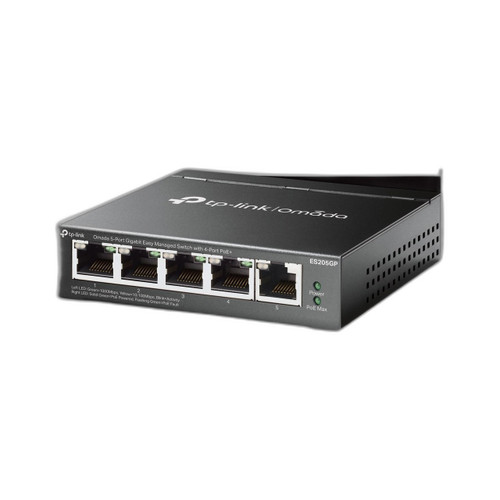
Both products are 5-port PoE desktop/wall-mount switches from TP-Link targeting small-to-medium deployments such as IP cameras, wireless access points, and VoIP devices. The ES205GP is a Gigabit (1G) Easy Managed switch with Omada SDN integration, while the TL-SG105PP-M2 is an unmanaged 2.5G Multi-Gigabit switch with PoE++ support. A buyer choosing between them is trading management capability and a familiar 1G ecosystem against raw port speed and higher per-port PoE delivery on an unmanaged platform.
In This Guide
Which switch delivers more port speed and switching throughput?
The TL-SG105PP-M2 provides five 2.5G RJ45 ports (4 PoE++, 1 uplink) with a stated switching capacity of 19 Gbps and a forwarding rate spec that includes values up to 119.0 Mpps across its variant SKU range. The ES205GP provides five 10/100/1000 Mbps RJ45 ports with a switching capacity of 10 Gbps and a packet forwarding rate of 7.4 Mpps. In raw throughput terms the TL-SG105PP-M2 nearly doubles the switching capacity of the ES205GP (19 Gbps vs. 10 Gbps), and each data port runs at 2.5× the maximum line rate of an ES205GP port. For deployments feeding 2.5G-capable cameras, Wi-Fi 6/6E access points, or NVRs with multi-gig uplinks, this gap is material.
Which switch supplies more PoE power and to which PoE standards?
Both switches carry a 65W total PoE budget across their four powered ports, so aggregate PoE capacity is identical. The key difference is the per-port ceiling and the PoE standard. The ES205GP supports 802.3af/at (PoE+) with a maximum of 30W per port. The TL-SG105PP-M2 supports 802.3af/at/bt (PoE++), which allows up to 90W per port under the 802.3bt standard, though the 65W shared budget limits simultaneous high-draw scenarios. If any single powered device requires more than 30W — such as a PTZ camera with a heater, a high-power Wi-Fi 6E AP, or a video doorstation with an integrated panel — only the TL-SG105PP-M2 can satisfy that device class. For standard PoE+ cameras and APs drawing under 30W, both switches are electrically equivalent in terms of per-port delivery within the shared 65W envelope.
The ES205GP input supply is specified at 53.5 VDC / 1.31A via an external adapter. The TL-SG105PP-M2 accepts 100–240 VAC, 50/60 Hz (universal mains), with a maximum system power consumption stated at 123W.
Which switch offers management, monitoring, and platform integration?
The ES205GP is explicitly specified as a Managed switch with Omada SDN support, including DHCP Client capability. Omada SDN enables centralized controller-based management, VLAN configuration, port isolation, traffic monitoring, and integration with other Omada-compatible network devices. This is directly relevant for multi-site or enterprise-edge deployments where VLANs are used to segment camera traffic from corporate LAN, or where a single pane of glass across switches and access points is required.
The TL-SG105PP-M2 is specified as Unmanaged, with operating modes limited to auto-negotiation and PoE Auto Recovery (the ability to automatically power-cycle a hung PoE device). There is no VLAN, QoS, port mirroring, SNMP, or controller integration available. For an installer who needs plug-and-play simplicity with no ongoing management overhead, this is an advantage; for anyone requiring network segmentation or centralized monitoring, it is a hard limitation.
Which should you choose: the ES205GP or the SG105PP-M2?
Our take: The ES205GP is the stronger choice when network management, VLAN segmentation, or Omada SDN integration is required. The TL-SG105PP-M2 is the stronger choice when port speed or per-port PoE headroom above 30W is the priority. Concretely: the TL-SG105PP-M2 runs 2.5G ports vs. the ES205GP's 1G ports (2.5× line rate), supports PoE++ (802.3bt) vs. PoE+ (802.3at) enabling devices above 30W per port, and carries a 19 Gbps switching fabric vs. 10 Gbps. However, the ES205GP is fully managed with Omada SDN, while the TL-SG105PP-M2 is entirely unmanaged. Both share an identical 65W PoE budget. Choose the ES205GP for managed SMB or enterprise-edge camera/AP deployments requiring VLANs and centralized control. Choose the TL-SG105PP-M2 for unmanaged, plug-and-play installations where 2.5G device connectivity or PoE++ power delivery is the driving requirement.
Side-by-Side Comparison
Spec-for-spec, from manufacturer data.
| Specification | TP-Link ES205GP | TP-Link SG105PP-M2 |
|---|---|---|
| Port Count | 5 | 5 |
| Port Speed | 10/100/1000 Mbps (1G) | 2.5G Multi-Gigabit |
| PoE Ports | 4 PoE+ | 4 PoE++ |
| PoE Standard | 802.3af/at | 802.3af/at/bt |
| Total PoE Budget | 65W | 65W |
| Max PoE per Port | 30W | 90W (802.3bt) |
| Switching Capacity | 10 Gbps | 19 Gbps |
| Forwarding Rate | 7.4 Mpps | Not specified as single value (up to 119.0 Mpps listed across variants) |
| Management | Managed (Omada SDN) | Unmanaged |
| PoE Auto Recovery | — | Yes |
| Power Supply Input | 53.5 VDC / 1.31A (external adapter) | 100–240 VAC, 50/60 Hz (universal mains) |
| Max Power Consumption | 65W | 123W |
| Operating Temperature | 0–40°C (32–104°F) | 0–50°C (32–122°F) |
| Dimensions | 99.8 × 98 × 25 mm | 294 × 180 × 44 mm |
| Flash Memory | 64 Mbit | — |
| MAC Address Table | 8K | — |
Frequently Asked Questions
Which should you choose: the ES205GP or the SG105PP-M2?
The ES205GP is the stronger choice when network management, VLAN segmentation, or Omada SDN integration is required. The TL-SG105PP-M2 is the stronger choice when port speed or per-port PoE headroom above 30W is the priority. Concretely: the TL-SG105PP-M2 runs 2.5G ports vs. the ES205GP's 1G ports (2.5× line rate), supports PoE++ (802.3bt) vs. PoE+ (802.3at) enabling devices above 30W per port, and carries a 19 Gbps switching fabric vs. 10 Gbps. However, the ES205GP is fully managed with Omada SDN, while the TL-SG105PP-M2 is entirely unmanaged. Both share an identical 65W PoE budget. Choose the ES205GP for managed SMB or enterprise-edge camera/AP deployments requiring VLANs and centralized control. Choose the TL-SG105PP-M2 for unmanaged, plug-and-play installations where 2.5G device connectivity or PoE++ power delivery is the driving requirement.
Can either switch handle a PTZ camera or high-power AP that needs more than 30W on a single port?
Only the TL-SG105PP-M2 supports 802.3bt (PoE++), which can deliver above 30W per port. The ES205GP is capped at 30W per port under 802.3at (PoE+). Both share a 65W total PoE budget, so simultaneous high-draw devices on multiple ports will still be constrained by the shared pool.
Is either switch compatible with Omada SDN controller software?
Yes — the ES205GP is specified as Omada SDN managed. The TL-SG105PP-M2 is specified as Unmanaged and has no stated Omada SDN compatibility per the provided specs.
Will either switch support a 2.5G NVR or Wi-Fi 6 access point at full link speed?
The TL-SG105PP-M2 provides 2.5G ports and can link at 2.5 Gbps to compatible devices. The ES205GP is a Gigabit switch and will negotiate at a maximum of 1 Gbps regardless of the connected device's capability.
More Network Switch Comparisons
- TP-Link ES205GP vs Ubiquiti USW-FLEX
- TP-Link ES205GP vs Ubiquiti USW-FLEX-MINI
- TP-Link ES205GP vs Ubiquiti USW-FLEX-3
- TP-Link ES205GP vs Ubiquiti USW-FLEX-MINI-3
- TP-Link SG105PP-M2 vs Ubiquiti USW-FLEX
- TP-Link SG105PP-M2 vs Ubiquiti USW-FLEX-MINI
Network Switch Buying Guides
Get a Second Opinion on Your Camera Choice
Share your site layout, coverage goals, and budget. Our team will validate the camera selection, flag anything we would change, and recommend products that match the use case.