
TP-Link ES205GP vs Ubiquiti USW-FLEX-MINI-3: Specification Comparison
Both the TP-Link ES205GP and the Ubiquiti USW-FLEX-MINI-3 are 5-port gigabit managed switches with PoE+ capability, targeting small-to-medium deployments such as branch offices, retail sites, and edge security installations. This comparison evaluates their PoE budget and port power delivery, physical form factor and operating environment, and management platform integration — the three axes most critical when specifying a compact managed PoE switch for a real installation.

In This Guide
- Which switch delivers more PoE power and how is it distributed across ports?
- How do the two switches compare on physical size, weight, mounting, and operating temperature range?
- What management ecosystems do these switches belong to, and what features are exposed to the administrator?
- Which should you choose: the ES205GP or the USW-FLEX-MINI-3?
- Side-by-Side Specs
- FAQ
Which switch delivers more PoE power and how is it distributed across ports?
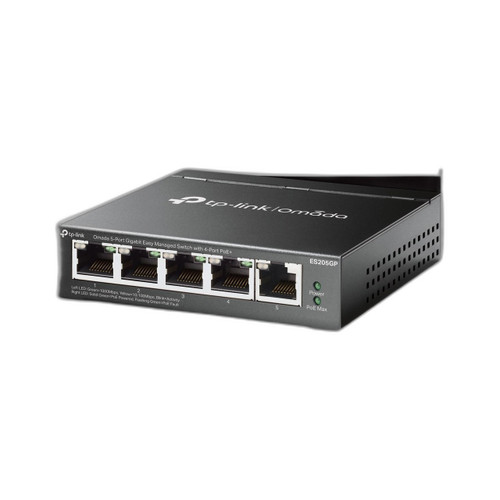
The ES205GP specifies a 65 W total PoE budget with a maximum of 30 W per port, and designates 4 of its 5 RJ45 ports as PoE+ (802.3af/at). The fifth port is non-PoE. This means a single port can power a high-draw device such as a PTZ camera or a dual-radio AP rated up to 30 W, while the remaining three PoE ports share the residual budget.
The USW-FLEX-MINI-3 spec states PoE+ across all 5 ports and lists its power supply as 5 V / 1 A. A 5 V × 1 A supply delivers only 5 W total — which is inconsistent with PoE+ (802.3at up to 30 W per port) operation. The total PoE budget for the USW-FLEX-MINI-3 is not stated in the provided specifications. Buyers should verify the actual PoE budget directly with Ubiquiti before specifying this unit for powered-device loads. The ES205GP's 65 W budget with explicit per-port and total figures is the only model with confirmed, quantified power delivery in these specs.
How do the two switches compare on physical size, weight, mounting, and operating temperature range?
The ES205GP measures 99.8 × 98 × 25 mm (3.9 × 3.9 × 1.0 in) and supports both wall-mount and rack-mount installation via a bracket. Its operating temperature range is 0 °C to 40 °C (32 °F to 104 °F). No weight is listed in the provided specifications.
The USW-FLEX-MINI-3 weighs 0.330 lb and supports desktop or wall-mount form factors. Its operating temperature range is −5 °C to 45 °C (23 °F to 113 °F), giving it a 5-degree advantage at both the cold and hot ends compared to the ES205GP. Note: the spec sheet lists dimensions as 107.16" × 70.15" × 21.17" — values that are physically implausible for a compact switch; the tilde-prefixed marketing copy cites 6.1 × 4.3 × 1.5 inches instead. Buyers should confirm physical dimensions from the official Ubiquiti datasheet before rack or enclosure planning. The ES205GP's dimensions come from a consistent, plausible single source.
What management ecosystems do these switches belong to, and what features are exposed to the administrator?
The ES205GP is managed through TP-Link's Omada SDN platform, which supports centralized controller-based management. The specification lists DHCP Client as a confirmed management feature; switching capacity is 10 Gbps and packet forwarding rate is 7.4 Mpps. The ES205GP carries 64 Mbit Flash, an 8K MAC address table, and 4 Mbit packet buffer — all confirmed in specs.
The USW-FLEX-MINI-3 integrates with Ubiquiti's UniFi Network ecosystem via a web GUI and the UniFi controller. The tilde-sourced (marketing) specs list VLAN, QoS, port mirroring, and IGMP snooping. Switching capacity is 10 Gbps and forwarding rate is 7.44 Mpps per the provided spec fields — essentially equivalent to the ES205GP on raw throughput. MAC table size, Flash, and buffer size are not provided for the USW-FLEX-MINI-3. Certifications CE, FCC, and IC are listed for the Ubiquiti unit; certifications are not stated for the ES205GP in these specs.
Which should you choose: the ES205GP or the USW-FLEX-MINI-3?
Our take: The ES205GP is the stronger choice when a confirmed, quantified PoE budget is required and the site already runs or plans a TP-Link Omada SDN infrastructure. Its 65 W total / 30 W per-port budget is explicitly documented, versus the USW-FLEX-MINI-3 whose total PoE budget is not stated and whose 5 V / 1 A power-supply spec is inconsistent with the claimed all-port PoE+ delivery — a gap that requires vendor verification before deployment. Physical dimensions for the ES205GP are coherent and confirmed at 99.8 × 98 × 25 mm; the Ubiquiti unit's dimension field contains an implausible value that also needs datasheet verification. The USW-FLEX-MINI-3 holds a measurable advantage in operating temperature range (−5 °C to 45 °C vs. 0 °C to 40 °C), making it more suitable for unconditioned edge spaces. Choose the USW-FLEX-MINI-3 only within an established UniFi ecosystem and after confirming its actual PoE budget with Ubiquiti.
Side-by-Side Comparison
Spec-for-spec, from manufacturer data.
| Specification | TP-Link ES205GP | Ubiquiti USW-FLEX-MINI-3 |
|---|---|---|
| Total Ports | 5 | 5 |
| PoE-Capable Ports | 4 (ports 1–4) | 5 (all ports, per marketing spec) |
| PoE Standard | 802.3af/at (PoE+) | 802.3af (per spec field); PoE+ per marketing copy |
| Total PoE Budget | 65 W | — |
| Max PoE per Port | 30 W | — |
| Port Speed | 10/100/1000 Mbps | 10/100/1000 Mbps |
| Switching Capacity | 10 Gbps | 10 Gbps |
| Packet Forwarding Rate | 7.4 Mpps | 7.44 Mpps |
| MAC Address Table | 8K | — |
| Flash / Buffer | 64 Mbit Flash; 4 Mbit buffer | — |
| Operating Temperature | 0 °C to 40 °C | −5 °C to 45 °C |
| Dimensions | 99.8 × 98 × 25 mm | Not confirmed (spec field inconsistent) |
| Weight | — | 0.330 lb |
| Mount Type | Wall; Rack | Desktop; Wall-mount |
| Management Platform | Omada SDN (TP-Link) | UniFi Network (Ubiquiti) |
| Certifications | — | CE, FCC, IC |
Frequently Asked Questions
Which should you choose: the ES205GP or the USW-FLEX-MINI-3?
The ES205GP is the stronger choice when a confirmed, quantified PoE budget is required and the site already runs or plans a TP-Link Omada SDN infrastructure. Its 65 W total / 30 W per-port budget is explicitly documented, versus the USW-FLEX-MINI-3 whose total PoE budget is not stated and whose 5 V / 1 A power-supply spec is inconsistent with the claimed all-port PoE+ delivery — a gap that requires vendor verification before deployment. Physical dimensions for the ES205GP are coherent and confirmed at 99.8 × 98 × 25 mm; the Ubiquiti unit's dimension field contains an implausible value that also needs datasheet verification. The USW-FLEX-MINI-3 holds a measurable advantage in operating temperature range (−5 °C to 45 °C vs. 0 °C to 40 °C), making it more suitable for unconditioned edge spaces. Choose the USW-FLEX-MINI-3 only within an established UniFi ecosystem and after confirming its actual PoE budget with Ubiquiti.
Is the ES205GP or USW-FLEX-MINI-3 better for powering multiple cameras simultaneously?
Based on the provided specifications, the ES205GP is the only unit with a confirmed total PoE budget (65 W) and a per-port maximum (30 W across 4 PoE+ ports). The USW-FLEX-MINI-3 claims all-port PoE+ but does not state a total budget in the provided specs, and its listed power supply (5 V / 1 A) is inconsistent with PoE+ operation. Until Ubiquiti's official datasheet confirms the USW-FLEX-MINI-3's actual power delivery, the ES205GP is the only model whose camera-powering capacity can be planned against real numbers.
Can either switch be installed in a warmer equipment closet or outdoor enclosure?
The USW-FLEX-MINI-3 specifies a wider operating temperature range of −5 °C to 45 °C, compared to the ES205GP's 0 °C to 40 °C. For sites where ambient temperatures approach or exceed 40 °C — such as unventilated closets or outdoor-rated enclosures without active cooling — the USW-FLEX-MINI-3 has a 5-degree upper-end advantage per the provided specs.
Which switch is the right fit if my site already uses a UniFi controller?
The USW-FLEX-MINI-3 is designed for the UniFi Network ecosystem and integrates with the UniFi controller for centralized management, VLAN, QoS, port mirroring, and IGMP snooping per the provided (marketing-tier) specifications. The ES205GP is built for TP-Link's Omada SDN platform and would require a separate Omada controller. If UniFi infrastructure is already in place, adding the ES205GP would introduce a second management plane, whereas the USW-FLEX-MINI-3 would extend the existing one.
More Network Switch Comparisons
- TP-Link ES205GP vs Ubiquiti USW-FLEX
- TP-Link ES205GP vs Ubiquiti USW-FLEX-MINI
- TP-Link ES205GP vs Ubiquiti USW-FLEX-3
- TP-Link ES205GP vs TP-Link SG105PP-M2
- TP-Link SG105PP-M2 vs Ubiquiti USW-FLEX
- TP-Link SG105PP-M2 vs Ubiquiti USW-FLEX-MINI
Network Switch Buying Guides
Get a Second Opinion on Your Camera Choice
Share your site layout, coverage goals, and budget. Our team will validate the camera selection, flag anything we would change, and recommend products that match the use case.