
TP-Link ES205GP vs Ubiquiti USW-FLEX: Specification Comparison
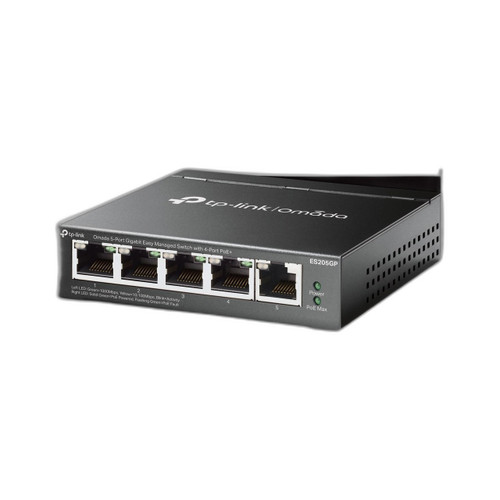
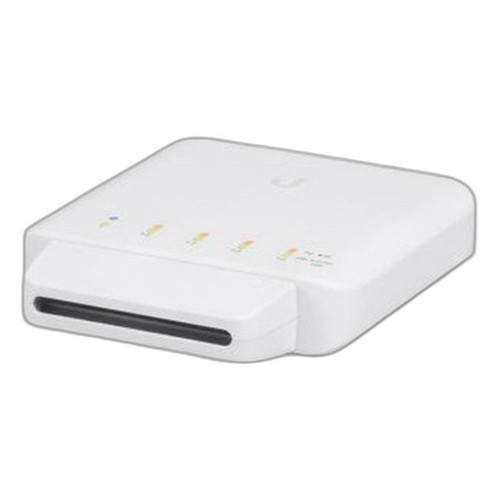
Both the TP-Link ES205GP and Ubiquiti USW-FLEX are 5-port gigabit managed PoE switches targeting small deployments such as security camera clusters, wireless access points, and IP intercoms. They share the same port count, gigabit speeds, and 10 Gbps switching fabric, making them a genuine cross-shop for installers selecting edge switching for compact or remote sites. Key differentiators center on PoE standard and budget, operating temperature range, VLAN depth, and ecosystem management platform — each of which carries real weight depending on the installation environment and existing network stack.
In This Guide
Which switch delivers more PoE headroom and higher per-port power?
The ES205GP provides a 65W total PoE budget across its four PoE-capable ports, with a maximum of 30W per port under the 802.3af/at (PoE/PoE+) standard. This is sufficient to drive most 802.3at cameras, indoor APs, and intercoms simultaneously, though the 30W per-port ceiling means it cannot feed 802.3bt (PoE++) devices at their full draw.
The USW-FLEX is rated at 60W PoE++ output (802.3bt) and lists an output of 54V at 1.11A. Its per-port power ceiling is not individually specified in the provided data, but the PoE++ standard supports up to 60W per port — making it capable of powering high-draw devices such as pan-tilt-zoom cameras, Wi-Fi 6E APs, or multi-radio units that exceed the 30W PoE+ ceiling. Note that the USW-FLEX is itself powered by upstream PoE+ (46W input) or PoE++ (20W input), so the available downstream budget is constrained by what the upstream switch delivers.
Which switch is rated for harsher or outdoor installation environments?
The ES205GP is rated for 0°C to 40°C (32°F to 104°F) operating temperature. This confines it to conditioned indoor spaces — a typical wiring closet or interior wall mount — and excludes unheated enclosures, outdoor cabinets, loading docks, or any site that experiences sub-zero or high-heat ambient conditions. Mount options per spec are wall and rack.
The USW-FLEX carries an operating temperature of -40°C to 55°C (-40°F to 131°F) at 46W PoE output, a dramatically wider envelope that qualifies it for outdoor enclosures, rooftop equipment rooms, unheated warehouses, and cold-climate installations. Its compact form factor (122.5 × 107.1 × 28 mm, 230 g) supports desktop, wall-mount, and pole-mount deployment. It also lists ESD protection of ±16kV air and ±16kV contact discharge, a ruggedization detail absent from the ES205GP spec sheet. NDAA compliance is confirmed for the USW-FLEX; no such claim appears in the ES205GP data.
Which switch offers deeper management and better fits an existing network ecosystem?
The ES205GP is managed via TP-Link's Omada SDN platform. The spec lists DHCP Client as a confirmed management feature. The switch is described as 'Easy Managed,' which in TP-Link's product taxonomy typically implies a subset of full Omada CLI/GUI capabilities. It stores configuration in 64 Mbit Flash with an 8K MAC address table. No explicit VLAN count is stated in the provided specifications.
The USW-FLEX is managed through Ubiquiti's UniFi controller ecosystem and supports 1,000 VLANs per the provided spec — a figure that matters for multi-tenant or highly segmented security deployments where camera VLANs, management VLANs, and guest networks must be isolated without additional hardware. The forwarding rate is listed as 7 Mpps (the ES205GP states 7.4 Mpps). The USW-FLEX's management protocol field lists 'Ethernet,' and no out-of-band management port is specified for either unit. Both products require their respective cloud or on-premise controllers to unlock full SDN capabilities; neither operates in a controller-free fully-managed mode per the provided data.
Which should you choose: the ES205GP or the USW-FLEX?
Our take: The USW-FLEX is the stronger choice when the installation site involves outdoor or thermally extreme conditions, requires PoE++ device support, or operates within an existing UniFi ecosystem. Its -40°C to 55°C rating versus the ES205GP's 0°C to 40°C envelope is a hard disqualifier for outdoor or unheated enclosures. Its 1,000-VLAN support versus no stated VLAN count for the ES205GP matters in segmented multi-zone security designs. The ES205GP edges ahead on PoE budget (65W vs. 60W) and per-port ceiling clarity (30W stated), and its wall/rack mount options suit traditional indoor MDFs. Critically, the USW-FLEX's downstream PoE output is capped by its upstream power input, which installers must account for when sizing the upstream switch. Choose the ES205GP for controlled-environment indoor closets on a TP-Link Omada stack; choose the USW-FLEX for outdoor, ruggedized, or UniFi-managed deployments requiring PoE++ device compatibility.
Side-by-Side Comparison
Spec-for-spec, from manufacturer data.
| Specification | TP-Link ES205GP | Ubiquiti USW-FLEX |
|---|---|---|
| Brand | TP-Link | Ubiquiti |
| Model / MPN | ES205GP | USW-FLEX |
| Total Ports | 5 | 5 |
| Port Speed | 10/100/1000 Mbps | 10/100/1000 Mbps |
| PoE Standard | 802.3af/at (PoE+) | 802.3bt (PoE++) |
| Total PoE Budget | 65W | 60W output (input-constrained) |
| Max PoE Per Port | 30W | Not individually specified |
| Switching Capacity | 10 Gbps | 10 Gbps |
| Forwarding Rate | 7.4 Mpps | 7 Mpps |
| Operating Temp | 0°C to 40°C | -40°C to 55°C |
| Mount Options | Wall, Rack | Desktop, Wall, Pole |
| Dimensions | 99.8 × 98 × 25 mm | 122.5 × 107.1 × 28 mm |
| Weight | — | 230 g (8.1 oz) |
| VLAN Support | — | 1,000 VLANs |
| Management Platform | Omada SDN | UniFi |
| NDAA Compliant | — | Yes |
Frequently Asked Questions
Which should you choose: the ES205GP or the USW-FLEX?
The USW-FLEX is the stronger choice when the installation site involves outdoor or thermally extreme conditions, requires PoE++ device support, or operates within an existing UniFi ecosystem. Its -40°C to 55°C rating versus the ES205GP's 0°C to 40°C envelope is a hard disqualifier for outdoor or unheated enclosures. Its 1,000-VLAN support versus no stated VLAN count for the ES205GP matters in segmented multi-zone security designs. The ES205GP edges ahead on PoE budget (65W vs. 60W) and per-port ceiling clarity (30W stated), and its wall/rack mount options suit traditional indoor MDFs. Critically, the USW-FLEX's downstream PoE output is capped by its upstream power input, which installers must account for when sizing the upstream switch. Choose the ES205GP for controlled-environment indoor closets on a TP-Link Omada stack; choose the USW-FLEX for outdoor, ruggedized, or UniFi-managed deployments requiring PoE++ device compatibility.
Can either switch power a PoE++ device like a high-end PTZ camera or Wi-Fi 6E AP?
Only the USW-FLEX supports PoE++ (802.3bt), which can deliver up to 60W to a single downstream device. The ES205GP is limited to PoE+ (802.3at) with a 30W per-port maximum, which is insufficient for devices that require more than 30W. If your camera or AP specifies 802.3bt or draws more than 30W, the USW-FLEX is the only option of the two.
Is the ES205GP or USW-FLEX suitable for an outdoor camera installation in a cold climate?
The USW-FLEX is rated for -40°C to 55°C and is specified for pole-mount and wall-mount outdoor deployment. The ES205GP is rated only to 0°C at the low end, ruling it out for any site that drops below freezing. For outdoor or unheated enclosures, the USW-FLEX is the appropriate choice based on the provided specifications.
Do both switches require a cloud controller, or can they be managed standalone?
Both switches are described as managed products tied to their respective platforms — Omada SDN for the ES205GP and UniFi for the USW-FLEX. The ES205GP lists DHCP Client as a management feature. Neither spec sheet documents a fully autonomous standalone management mode independent of a controller. Buyers already invested in one ecosystem should select the matching switch; mixing ecosystems requires running two separate management platforms.
More Network Switch Comparisons
- TP-Link ES205GP vs Ubiquiti USW-FLEX-MINI
- TP-Link ES205GP vs Ubiquiti USW-FLEX-3
- TP-Link ES205GP vs Ubiquiti USW-FLEX-MINI-3
- TP-Link ES205GP vs TP-Link SG105PP-M2
- TP-Link SG105PP-M2 vs Ubiquiti USW-FLEX
- TP-Link SG105PP-M2 vs Ubiquiti USW-FLEX-MINI
Network Switch Buying Guides
Get a Second Opinion on Your Camera Choice
Share your site layout, coverage goals, and budget. Our team will validate the camera selection, flag anything we would change, and recommend products that match the use case.