
Ubiquiti USW-FLEX-2.5G-5 vs TP-Link DS105G-M2: Specification Comparison
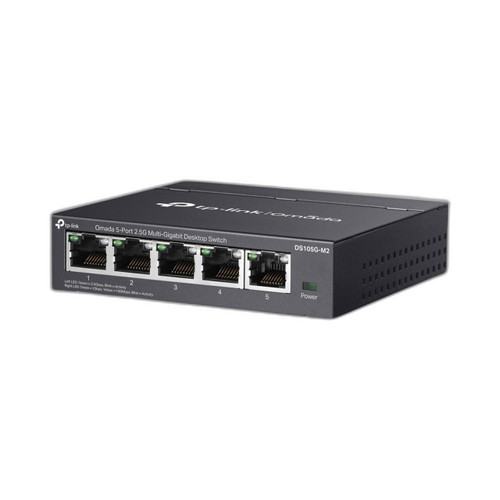
Both the Ubiquiti USW-FLEX-2.5G-5 and the TP-Link DS105G-M2 are 5-port 2.5G multi-gigabit desktop switches targeting the same buyer segment: small offices, home labs, or edge deployments needing throughput beyond legacy 1G without a full rack-mount investment. The core difference is management tier—the Ubiquiti is a Layer 2+ managed switch integrated into the UniFi ecosystem, while the TP-Link is an unmanaged plug-and-play unit. This comparison evaluates throughput and port capability, power input and environmental ratings, and management depth against buyer needs.

In This Guide
- Do both switches deliver the same 2.5G port speeds and aggregate throughput?
- How do power input options and operating environment specifications compare?
- Which switch offers more network management capability, and does management matter for this deployment?
- Which should you choose: the USW-FLEX-2.5G-5 or the DS105G-M2?
- Side-by-Side Specs
- FAQ
Do both switches deliver the same 2.5G port speeds and aggregate throughput?
Both units provide five RJ-45 ports rated at 2.5 Gbps per port. The USW-FLEX-2.5G-5 specifies multi-speed auto-negotiation at 2.5G/1G/100M/10M, enabling backward compatibility with legacy 1G and 100M devices without manual intervention. The DS105G-M2 is listed as 2.5 Gbps Multi-Gigabit; backward-compatibility speeds are not enumerated in the provided specs.
On aggregate switching capacity, the USW-FLEX-2.5G-5 is specified at 25 Gbps switching capacity with 12.5 Gbps non-blocking throughput and a forwarding rate of 19 Mpps. The DS105G-M2 specifies 25 Gbps aggregate non-blocking throughput. The Ubiquiti spec sheet additionally documents a 4,000-entry MAC address table. No MAC table size is provided for the DS105G-M2.
Maximum copper reach on the DS105G-M2 is stated as 100 m via RJ-45. The USW-FLEX-2.5G-5 spec does not explicitly state a maximum cable reach in the provided data.
How do power input options and operating environment specifications compare?
Power input is a meaningful differentiator here. The USW-FLEX-2.5G-5 accepts USB Type-C at 5V DC / 1A (voltage range 4.8–5.2V DC) or 802.3af PoE input, with a stated power budget of 5W on AC/DC input and 6.4W on PoE input. This dual-input design allows deployment without a local AC outlet—useful in edge, AV, or outdoor-adjacent scenarios where PoE from an upstream switch is available. Total power consumption is stated as 5W.
The DS105G-M2 lists PoE as a field entry in the provided specs, but no PoE input wattage, PoE budget, or alternative power input method is specified in the data provided. Power supply type, voltage, and consumption figures are absent from the DS105G-M2 spec set supplied.
On operating temperature, the USW-FLEX-2.5G-5 is rated −20 to 45°C (−4 to 113°F), covering sub-zero environments. The DS105G-M2 is rated −5°C to 40°C (23°F to 104°F) for operation, with a storage range of −40°C to 70°C. The Ubiquiti unit therefore offers a wider operational cold-side margin (15°C lower) and a slightly higher upper limit (45°C vs 40°C). The USW-FLEX-2.5G-5 enclosure is specified as polycarbonate; no enclosure material is stated for the DS105G-M2.
Which switch offers more network management capability, and does management matter for this deployment?
The USW-FLEX-2.5G-5 is a Layer 2+ managed switch. The provided specs confirm 256 VLAN support and a 4,000-entry MAC table. It is controlled via Ubiquiti's UniFi controller ecosystem (referenced as 'Ethernet' management in the spec and confirmed by the UniFi product line designation). This enables centralized configuration, monitoring, traffic segmentation, and policy enforcement across UniFi infrastructure.
The DS105G-M2 is explicitly listed as unmanaged (Managed: No). The only network-intelligence feature noted in the provided specs is loop prevention monitoring described as switchable. No VLAN, QoS, port mirroring, SNMP, or CLI management capability is documented. Configuration is zero-touch plug-and-play.
For buyers already operating a UniFi network, the USW-FLEX-2.5G-5 integrates natively and adds visibility without separate management overhead. For buyers who need a simple, unconfigured uplink expander with no software dependency, the DS105G-M2's unmanaged design removes complexity. Neither unit is documented as supporting PoE output to downstream powered devices in the specs provided—buyers needing PoE-out should verify against full datasheets before purchasing.
Which should you choose: the USW-FLEX-2.5G-5 or the DS105G-M2?
Our take: The USW-FLEX-2.5G-5 is the stronger choice when the deployment requires VLAN segmentation, centralized UniFi management, flexible power input, or operation in sub-zero environments. It supports 256 VLANs and a 4,000-entry MAC table versus the DS105G-M2's zero management features; accepts USB-C or 802.3af PoE input in addition to AC/DC, which the DS105G-M2 does not document; and is rated to −20°C versus the DS105G-M2's −5°C lower limit. The DS105G-M2 is appropriate where zero-configuration simplicity is the priority—no controller, no VLAN setup, immediate plug-and-play deployment. Buyers building or extending a UniFi environment should select the USW-FLEX-2.5G-5. Buyers needing a standalone, unmanaged throughput upgrade on a simple flat network with no management overhead or cold-environment requirement should evaluate the DS105G-M2.
Side-by-Side Comparison
Spec-for-spec, from manufacturer data.
| Specification | Ubiquiti USW-FLEX-2.5G-5 | TP-Link DS105G-M2 |
|---|---|---|
| Device Type | Managed Switch (Layer 2+) | Unmanaged Switch |
| Port Count | 5 | 5 |
| Port Speed | 2.5G / 1G / 100M / 10M (auto) | 2.5 Gbps Multi-Gigabit |
| Switching Capacity | 25 Gbps | 25 Gbps aggregate non-blocking |
| Non-Blocking Throughput | 12.5 Gbps | Not specified |
| Forwarding Rate | 19 Mpps | — |
| MAC Address Table | 4,000 entries | — |
| VLAN Support | 256 VLANs | None (unmanaged) |
| Power Input | USB-C 5V/1A or 802.3af PoE | Not specified in provided specs |
| Power Consumption | 5W | — |
| Operating Temp | −20 to 45°C | −5 to 40°C |
| Storage Temp | — | −40 to 70°C |
| Enclosure Material | Polycarbonate | — |
| Dimensions | 117.1 × 90 × 21.2 mm | — |
| Weight | 206 g (7.3 oz) | — |
| NDAA Compliant | Yes | — |
| Certifications | CE, FCC, IC, Anatel | — |
| Loop Prevention | — | Yes (switchable) |
| Max Copper Reach | — | 100 m (RJ-45) |
Frequently Asked Questions
Which should you choose: the USW-FLEX-2.5G-5 or the DS105G-M2?
The USW-FLEX-2.5G-5 is the stronger choice when the deployment requires VLAN segmentation, centralized UniFi management, flexible power input, or operation in sub-zero environments. It supports 256 VLANs and a 4,000-entry MAC table versus the DS105G-M2's zero management features; accepts USB-C or 802.3af PoE input in addition to AC/DC, which the DS105G-M2 does not document; and is rated to −20°C versus the DS105G-M2's −5°C lower limit. The DS105G-M2 is appropriate where zero-configuration simplicity is the priority—no controller, no VLAN setup, immediate plug-and-play deployment. Buyers building or extending a UniFi environment should select the USW-FLEX-2.5G-5. Buyers needing a standalone, unmanaged throughput upgrade on a simple flat network with no management overhead or cold-environment requirement should evaluate the DS105G-M2.
Can either switch power devices like cameras or APs over PoE?
Based on the specs provided, neither the USW-FLEX-2.5G-5 nor the DS105G-M2 is documented as providing PoE output to downstream devices. The USW-FLEX-2.5G-5 accepts PoE input (802.3af) as a power source for the switch itself; this is not the same as PoE output. Buyers requiring PoE-out ports should consult full product datasheets before purchasing.
Is the USW-FLEX-2.5G-5 or DS105G-M2 better for a network that already uses UniFi gear?
The USW-FLEX-2.5G-5 is the clear fit for an existing UniFi deployment. It is a UniFi-line managed switch and integrates with the UniFi controller for centralized configuration, VLAN management across up to 256 VLANs, and unified visibility. The DS105G-M2 is unmanaged and has no documented integration with any network management platform.
Which switch handles a wider range of operating temperatures?
The USW-FLEX-2.5G-5 is rated for operation from −20°C to 45°C. The DS105G-M2 is rated from −5°C to 40°C. The Ubiquiti unit covers a 15°C wider cold-side range and a 5°C higher upper limit based on the specs provided, making it the better-documented choice for environments subject to cold or elevated ambient temperatures.
More Network Switch Comparisons
- TP-Link SG2005P-PD vs Ubiquiti USW-FLEX-2.5G-5
- TP-Link SG2005P-PD vs TP-Link ES205G
- TP-Link SG2005P-PD vs TP-Link DS105G
- TP-Link ES205G vs Ubiquiti USW-FLEX-2.5G-5
- TP-Link ES205G vs TP-Link DS105G
- Ubiquiti USW-FLEX-2.5G-5 vs TP-Link DS105G
Network Switch Buying Guides
Get a Second Opinion on Your Camera Choice
Share your site layout, coverage goals, and budget. Our team will validate the camera selection, flag anything we would change, and recommend products that match the use case.