
TP-Link ES205G vs Ubiquiti USW-FLEX-2.5G-5: Specification Comparison
Both products are 5-port managed Layer 2 switches targeting edge and small-network deployments, making them a direct cross-shop for installers evaluating compact managed switching. The TP-Link ES205G delivers 1 Gbps per port under the Omada SDN platform, while the Ubiquiti USW-FLEX-2.5G-5 steps up to 2.5G per port with USB-C or PoE power input and UniFi management. This comparison examines port throughput and switching capacity, power input and environmental range, and management ecosystem fit — the three axes that most often drive the buying decision in this segment.

In This Guide
- Which switch delivers more bandwidth per port and total switching headroom?
- How do the two switches differ in power input options and operating environment?
- Which management platform and VLAN / table capacity does each switch support?
- Which should you choose: the ES205G or the USW-FLEX-2.5G-5?
- Side-by-Side Specs
- FAQ
Which switch delivers more bandwidth per port and total switching headroom?
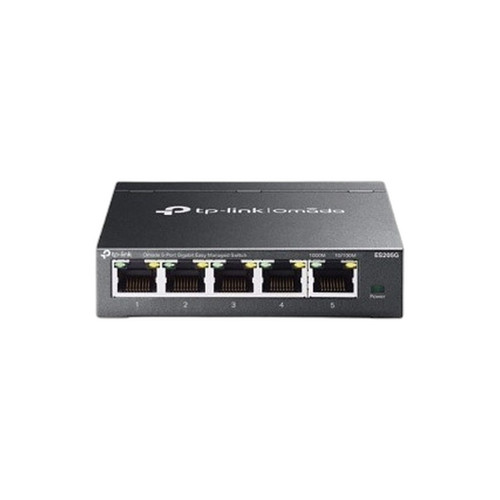
The ES205G provides five 10/100/1000 Mbps RJ45 ports with a switching capacity of 10 Gbps and a forwarding rate of 7.4 Mpps. All five ports are standard Gigabit Ethernet — adequate for current IP cameras, access control panels, and workstations running at 1 Gbps or below.
The USW-FLEX-2.5G-5 equips all five ports with 2.5G multi-speed interfaces (2.5G / 1G / 100M / 10M), doubling per-port bandwidth to 2.5 Gbps. Total switching capacity is 25 Gbps versus the ES205G's 10 Gbps, and the forwarding rate is 19 Mpps versus 7.4 Mpps. For deployments using Wi-Fi 6/6E access points, high-resolution NVR uplinks, or multi-gig workstations, the USW-FLEX-2.5G-5 provides 2.5× the per-port throughput without requiring a switch replacement as device speeds increase.
How do the two switches differ in power input options and operating environment?
The ES205G is powered by a single 5 VDC / 0.6 A supply (3 W), with a desktop or wall-mount form factor measuring 99.8 × 98 × 25 mm. Its operating temperature range is 0 °C to 40 °C (32 °F to 104 °F), limiting it to conditioned indoor spaces. No PoE input capability is specified in the provided data.
The USW-FLEX-2.5G-5 accepts power via USB-C (5 V DC, 1 A) or 802.3af PoE input, enabling deployment without a nearby AC outlet — useful in drop-ceiling edge nodes, solar-backed remote cabinets, or anywhere a PoE injector is more practical than an AC circuit. Its operating temperature spans −20 °C to 45 °C (−4 °F to 113 °F), a 60-degree-Celsius wider cold range than the ES205G. The polycarbonate enclosure measures 117.1 × 90 × 21.2 mm and weighs 206 g. Power consumption at AC/DC input is 5 W.
Which management platform and VLAN / table capacity does each switch support?
The ES205G integrates with TP-Link's Omada SDN platform and provides DHCP Client management. Specific VLAN count and MAC address table size are not stated in the provided specifications.
The USW-FLEX-2.5G-5 operates under Ubiquiti's UniFi ecosystem with Layer 2+ managed features, supporting 256 VLANs and a 4,000-entry MAC address table per the provided specs. NDAA compliance is confirmed, which is relevant for federal, state, and government-adjacent physical-security installations where supply-chain restrictions apply. The ES205G's NDAA status is not stated in the provided specifications. Both carry CE and FCC certifications; the USW-FLEX-2.5G-5 additionally holds IC and Anatel marks.
Which should you choose: the ES205G or the USW-FLEX-2.5G-5?
Our take: The USW-FLEX-2.5G-5 is the stronger choice when future-proofing port bandwidth, flexible power delivery, and wider temperature tolerance are priorities. It delivers 2.5 Gbps per port versus 1 Gbps on the ES205G — a 2.5× throughput advantage — and its 25 Gbps switching capacity and 19 Mpps forwarding rate more than double the ES205G's 10 Gbps / 7.4 Mpps figures. It also operates down to −20 °C compared to the ES205G's 0 °C floor, and accepts PoE input in addition to USB-C, eliminating the need for a local AC circuit. The ES205G remains a cost-relevant option for pure Omada SDN sites already standardized on TP-Link infrastructure where 1 Gbps edge ports are sufficient and all locations are climate-controlled. Buyers in NDAA-regulated environments should note that only the USW-FLEX-2.5G-5 carries confirmed NDAA compliance per the provided specifications.
Side-by-Side Comparison
Spec-for-spec, from manufacturer data.
| Specification | TP-Link ES205G | Ubiquiti USW-FLEX-2.5G-5 |
|---|---|---|
| Port Count | 5 | 5 |
| Port Speed | 1 Gbps (10/100/1000) | 2.5G / 1G / 100M / 10M |
| Interface Type | RJ45 | RJ45 (multi-speed) |
| Switching Capacity | 10 Gbps | 25 Gbps |
| Forwarding Rate | 7.4 Mpps | 19 Mpps |
| Throughput (non-blocking) | 10 Gbps | 12.5 Gbps |
| Power Input | 5 VDC / 0.6 A (external) | USB-C 5V 1A or 802.3af PoE |
| Power Consumption | ~3 W (5V × 0.6A) | 5 W (AC/DC input) |
| Operating Temp | 0 °C to 40 °C | −20 °C to 45 °C |
| Dimensions (mm) | 99.8 × 98 × 25 | 117.1 × 90 × 21.2 |
| VLAN Support | Not specified | 256 VLANs |
| MAC Address Table | Not specified | 4,000 entries |
| Management Ecosystem | TP-Link Omada SDN | Ubiquiti UniFi (Layer 2+) |
| NDAA Compliant | Not specified | Yes |
| Certifications | CE, FCC, RoHS | CE, FCC, IC, Anatel |
| Mount Type | Desktop / Wall | Desktop |
Frequently Asked Questions
Which should you choose: the ES205G or the USW-FLEX-2.5G-5?
The USW-FLEX-2.5G-5 is the stronger choice when future-proofing port bandwidth, flexible power delivery, and wider temperature tolerance are priorities. It delivers 2.5 Gbps per port versus 1 Gbps on the ES205G — a 2.5× throughput advantage — and its 25 Gbps switching capacity and 19 Mpps forwarding rate more than double the ES205G's 10 Gbps / 7.4 Mpps figures. It also operates down to −20 °C compared to the ES205G's 0 °C floor, and accepts PoE input in addition to USB-C, eliminating the need for a local AC circuit. The ES205G remains a cost-relevant option for pure Omada SDN sites already standardized on TP-Link infrastructure where 1 Gbps edge ports are sufficient and all locations are climate-controlled. Buyers in NDAA-regulated environments should note that only the USW-FLEX-2.5G-5 carries confirmed NDAA compliance per the provided specifications.
Is the ES205G or USW-FLEX-2.5G-5 a better fit for a site that already uses UniFi access points and cameras?
The USW-FLEX-2.5G-5 is the native choice for UniFi environments — it is managed through the same UniFi controller used for UniFi APs and cameras, providing a unified dashboard. The ES205G is designed for TP-Link's Omada SDN platform. Mixing ecosystems is technically possible at Layer 2 but eliminates the single-pane-of-glass management benefit.
Can either switch be powered from an existing PoE port on an upstream switch, avoiding a separate power supply?
Yes — the USW-FLEX-2.5G-5 explicitly supports 802.3af PoE input, so it can be powered directly from any 802.3af-capable upstream port. The ES205G's provided specifications list only a 5 VDC / 0.6 A external supply; PoE input capability is not stated in the provided data.
Which switch is appropriate for an outdoor or unheated enclosure installation?
The USW-FLEX-2.5G-5 is rated to −20 °C at the cold end, making it suitable for unheated equipment cabinets in cold climates. The ES205G is rated only down to 0 °C, so it requires a heated or conditioned enclosure in freezing environments. Neither unit's IP ingress-protection rating is provided in the available specifications, so direct outdoor exposure should be verified against the full manufacturer datasheet before installation.
More Network Switch Comparisons
- TP-Link SG2005P-PD vs Ubiquiti USW-FLEX-2.5G-5
- TP-Link SG2005P-PD vs TP-Link ES205G
- TP-Link SG2005P-PD vs TP-Link DS105G
- TP-Link ES205G vs TP-Link DS105G
- Ubiquiti USW-FLEX-2.5G-5 vs TP-Link DS105G
- Ubiquiti USW-FLEX-2.5G-5 vs TP-Link DS105G-M2
Network Switch Buying Guides
Get a Second Opinion on Your Camera Choice
Share your site layout, coverage goals, and budget. Our team will validate the camera selection, flag anything we would change, and recommend products that match the use case.