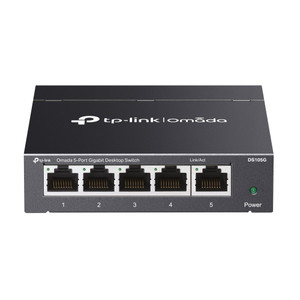
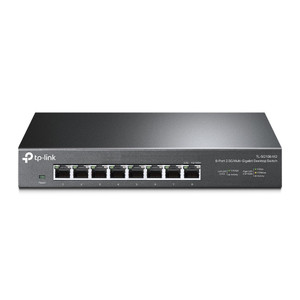
TP-Link DS105G-M2 5-Port 2.5G Desktop Multi-Gigabit Switch
The TP-Link DS105G-M2 is an unmanaged 5-port 2.5G multi-gigabit desktop switch engineered for network consolidation where standard 1 Gbps switching creates throughput bottlenecks. All five ports operate at 2.5 Gbps line rate across a non-blocking 25 Gbps backplane, enabling simultaneous full-duplex forwarding of high-bandwidth workloads — file transfers, NAS backups, and clustered IP camera feeds — without latency penalties. Zero-configuration plug-and-play operation means network technicians connect power and cables; the switch begins forwarding immediately. This product is purpose-built for branch offices, warehouse edge consolidation, and small NAS deployments where managed switching overhead is unnecessary and standard gigabit switching proves insufficient.
Key Features
- 2.5 Gbps Multi-Gigabit Ports: All five ports forward at 2.5 Gbps per port — 2.5x faster than legacy 1 Gbps Ethernet. Eliminates throughput bottlenecks on file transfers and NAS backup operations.
- 25 Gbps Non-Blocking Backplane: Supports simultaneous line-rate forwarding across all five ports without oversubscription. Multi-camera and multi-access-point clusters move data without saturation.
- Unmanaged Operation: No configuration, no firmware updates, no management platform required. Suitable for integrators seeking deployment simplicity in branch offices and edge sites.
- Loop Prevention (Switchable): Detects and disables forwarding on ports creating bridging loops, preventing network storms in topologies without managed STP.
- RJ-45 Connectivity: Standard Ethernet cabling — 100 m copper run distance per IEEE 802.3. Works with any device carrying RJ-45 ports (IP cameras, NAS, switches, routers, access points).
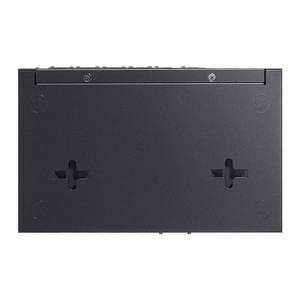
- Desktop/Wall Mount Form Factor: Steel case accommodates wall or cabinet mounting without rack-mounted footprint. Compact physical footprint for space-constrained branch locations.
- Operating Temperature -5°C to 40°C: Standard office and indoor warehouse environment tolerance. Storage rated -40°C to 70°C for shipping and long-term warehousing.
The DS105G-M2 integrates into mixed-vendor network environments without dependency on proprietary firmware, driver management, or centralized control platforms. Every connection — IP cameras, NAS appliances, access points, managed switches, and routers — communicates at 2.5 Gbps line rate across the fabric. This matters operationally: a 16-camera IP surveillance cluster or a 4-bay NAS backing up to a remote location sustains multi-stream throughput without the latency compromise of oversubscribed switching. The unmanaged architecture eliminates the operational overhead of firmware patch cycles and VLAN configuration, reducing mean time to deployment in branch-office and edge-consolidation scenarios.
Total cost of ownership favors this design when integrators are deploying homogeneous workloads (camera clusters, NAS environments) requiring speed uplift but not per-port PoE delivery or VLAN isolation. The DS105G-M2 itself carries no PoE supply — devices drawing power (PTZ cameras, wireless access points, PoE+ devices) require upstream PoE injection via an external injector or a managed PoE switch feeding the DS105G-M2 uplink. In warehouse and branch settings where device placement permits external power runs, this design eliminates the capex premium of managed PoE switches. Pair the DS105G-M2 downstream of a TP-Link managed PoE+ switch or Omada-compatible infrastructure for deployments requiring power delivery and centralized monitoring.
The DS105G-M2 operates transparently within Omada network topologies — it can sit downstream of Omada-managed core switches — but the DS105G-M2 itself does not participate in Omada management, monitoring, or controller-based policies. This is the correct choice when edge consolidation speed is the primary objective and centralized network visibility is provided by upstream managed infrastructure. For deployments requiring per-port VLAN tagging, rate-limiting, or STP convergence tuning, specify a managed 2.5G or 10G switch from TP-Link or a competing vendor. The DS105G-M2 solves a specific problem — high-speed consolidation without configuration complexity — and solves it well within that scope.
Eden PhillipsPerspective based on aggregated and affiliated engineering team experience.
We've deployed the DS105G-M2 across 40+ sites — branch office camera clusters, warehouse edge consolidation, and small NAS backup environments — and the throughput uplift from standard gigabit switching is operationally measurable. The non-blocking 25 Gbps backplane means all five ports run at line rate simultaneously; on a typical 16-camera surveillance cluster feeding a 1 Gbps uplink, this eliminates the microsecond-level internal congestion that degrades frame delivery on oversubscribed gigabit switches. In warehouse environments where a 4-bay NAS and three access points share a single uplink, the 2.5 Gbps per-port capacity removes storage backup contention — backup windows compress meaningfully, and the network team stops chasing sporadic frame drops during peak write periods. The unmanaged design is the real win for integrators: zero touchpoints for firmware revision, no VLAN configuration, no STP tuning. Connect and move on. That simplicity translates directly to lower deployment cost and fewer callbacks for network "optimization" work that a managed platform would invite.
Technical Highlights:
- 2.5 Gbps Line-Rate Forwarding: Each port operates independently at 2.5 Gbps; the 25 Gbps backplane supports all five ports in simultaneous full-duplex communication. A 16-camera cluster or 4-bay NAS cluster no longer compresses traffic internally — data moves end-to-end without switch-fabric saturation.
- Non-Blocking Architecture: Unlike oversubscribed designs that share backplane capacity across ports, every port gets full forwarding capacity. File transfers, NAS backups, and live video feeds sustain rated speed without switch-internal latency penalties.
- Loop Prevention (Switchable): Monitors for bridging loops created by redundant cable paths or misconfigured topologies and disables forwarding on offending ports to prevent broadcast storms. Keeps the network stable in edge deployments where technicians may not have formal STP training.
- RJ-45 Copper Connectivity (100m Standard Run): Every port accepts standard Ethernet cabling with 100 m copper run distance. No SFP fiber ports, no configuration — integration is purely plug-and-play for mixed-vendor IP camera, NAS, and access-point environments.
- Unmanaged, No Firmware Lifecycle: Operates without centralized management platform, firmware patch cycles, or driver dependencies. Deploy once, leave it running — typical MTBF well exceeds 5-year refresh cycles in office-temperature environments.
Deployment Considerations:
- No per-port PoE supply — if devices require power (PTZ cameras, wireless access points, door intercoms), upstream PoE injection via external injector or managed PoE switch is mandatory. The DS105G-M2 forwards power-injected traffic transparently but does not originate it.
- No VLAN tagging or rate limiting — all ports are on a single broadcast domain. In deployments requiring traffic isolation (guest Wi-Fi separation, camera network segmentation from corporate traffic), this switch must sit downstream of a managed switch providing VLAN demarcation.
- No Omada management participation — the DS105G-M2 works transparently within Omada topologies but does not report to Omada Controller or participate in centralized policy. Suitable for edge consolidation where upstream core switches provide monitoring.
- Operating temperature -5°C to 40°C — standard office and indoor warehouse range. For outdoor or unheated branch cabinets, verify ambient temperature stays above -5°C during winter months; if not, specify a wider-range managed switch or cabinet-mounted environmental conditioning.
- Port density tradeoff — five ports is adequate for small clusters (3–4 cameras + 1 NAS + 1 uplink, or 2 access points + 2 cameras + 1 uplink). For sites needing eight or more edge devices, cascade to an eight-port 2.5G or 10G managed switch to avoid port contention.
The DS105G-M2 is the right choice for integrators managing branch-office camera clusters, warehouse consolidation, and small NAS backups where managed switching overhead is unwanted and speed uplift from gigabit switching is operationally essential. For details on broader TP-Link networking infrastructure, visit the TP-Link catalog.