
Ubiquiti USW-ENTERPRISE-48-POE vs Allied Telesis GS980M/52PS-10: Specification Comparison
Both the Ubiquiti USW-ENTERPRISE-48-POE and the Allied Telesis AT-GS980M/52PS-10 are managed 48-port PoE+ rack-mount switches designed for enterprise and surveillance infrastructure. Each offers a 740–720W PoE power budget, four uplink ports, and 1RU form factor, placing them squarely in the same procurement category. This comparison examines port speed and throughput, power delivery and physical build, and management and standards compliance — the three axes that most directly determine fit for a high-density IP camera or enterprise access-layer deployment.
In This Guide
- Which switch delivers more bandwidth per port and higher aggregate throughput?
- How do PoE power budgets, port allocation, and physical construction compare?
- Which switch offers broader management capabilities, standards compliance, and deployment certifications?
- Which should you choose: the USW-ENTERPRISE-48-POE or the GS980M/52PS-10?
- Side-by-Side Specs
- FAQ
Which switch delivers more bandwidth per port and higher aggregate throughput?
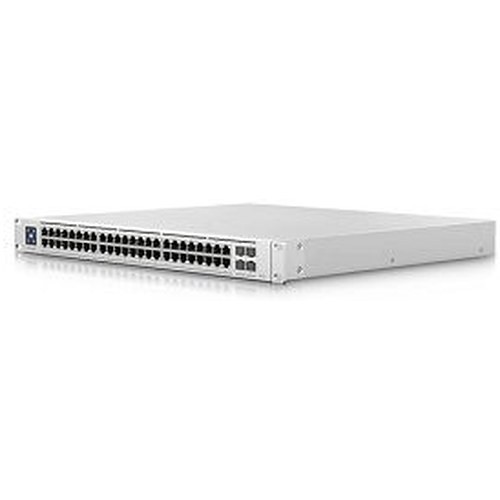
The USW-ENTERPRISE-48-POE runs all 48 access ports at 2.5G (2,500 Mbps per port), with four 10G SFP+ uplinks, yielding a switching capacity of 160 Gbps and a forwarding rate of 238 Mpps. Every connected device — camera, AP, or workstation — has 2.5× the headroom of a standard Gigabit port, which directly reduces congestion in dense multi-stream video environments.
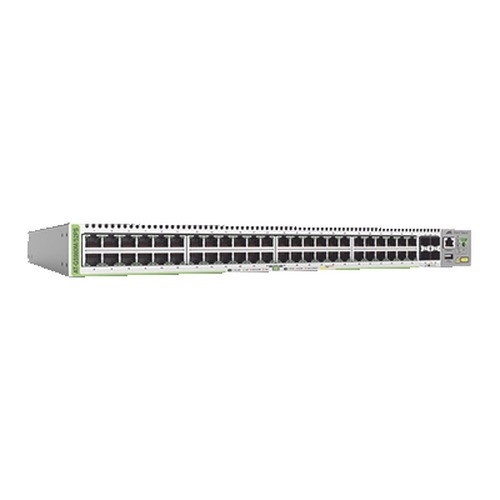
The AT-GS980M/52PS-10 runs all 48 access ports at standard Gigabit (10/100/1000T), with four SFP uplinks rated at 100/1000X — capped at 1G, not 10G. Its switching fabric is 104 Gbps with a forwarding rate of 77.4 Mpps. For deployments where every edge device is a Gigabit-class camera or endpoint, Gigabit access ports are sufficient, but the uplink ceiling of 1G per SFP port is a meaningful constraint when aggregating to a core switch.
In raw throughput terms, the Ubiquiti unit offers 54% more switching fabric (160 Gbps vs. 104 Gbps), 207% more forwarding rate (238 Mpps vs. 77.4 Mpps), and 10× the uplink speed per port (10G vs. 1G SFP). Buyers aggregating high-resolution camera streams or planning 802.11ax Wi-Fi backhaul will feel that delta immediately.
How do PoE power budgets, port allocation, and physical construction compare?
The USW-ENTERPRISE-48-POE provides 720W of PoE+ (802.3at) output across all 48 ports, with a total system draw of up to 870W. The spec does not state a per-port hard cap or a maximum simultaneous port count at full 30W draw; the 720W budget implies approximately 24 ports at 30W or up to 48 ports at 15W assuming even distribution. Base power consumption without PoE load is listed at 150W. The enclosure is SGCC steel and the unit weighs 6.2 kg (13.7 lb). Operating temperature is specified at -5 to 40°C.
The AT-GS980M/52PS-10 provides 740W maximum PoE power. Allied Telesis explicitly specifies two allocation scenarios: 48 ports simultaneously at 15W, or 24 ports at 30W (802.3at). Maximum total system power consumption is 909W, with maximum heat dissipation rated at 3,102 BTU/h. The unit generates up to 42 dBA of audible noise under load — a spec absent from the Ubiquiti listing. Weight is 5.8 kg (12.79 lb). Housing color is listed as white; no enclosure material spec is provided.
The Allied Telesis unit edges out the Ubiquiti on raw PoE budget (740W vs. 720W, a 20W difference). However, Allied Telesis is explicit that only 24 ports can draw 30W simultaneously — the Ubiquiti spec does not publish this constraint, so direct comparison on simultaneous full-power ports is not possible from the provided data. The Ubiquiti enclosure material (SGCC steel) is specified; Allied Telesis enclosure material is not. Noise output is specified only for Allied Telesis (42 dBA).
Which switch offers broader management capabilities, standards compliance, and deployment certifications?
The USW-ENTERPRISE-48-POE lists 1,000 VLAN support, Ethernet management, and includes a 1.3-inch LCM color touchscreen for local status and configuration access. It carries NDAA compliance and certifications including CE, FCC, IC, and Anatel (05485-22-08356). NDAA compliance is a formal statutory requirement for U.S. federal, state, and certain commercial deployments that prohibit equipment from specific manufacturers.
The AT-GS980M/52PS-10 listing references VLAN and QoS support and describes the device as 'enterprise managed,' but the provided specification data does not enumerate a specific VLAN count, management protocol list, or certification body approvals. NDAA compliance status is not stated in the provided specs. No local display or touchscreen is mentioned.
The Ubiquiti unit provides more verifiable management detail (1,000 VLANs, local LCM display) and explicit regulatory certifications from the provided data. The Allied Telesis unit's management depth — while described as enterprise-class — cannot be fully quantified from the specifications provided. Buyers with NDAA procurement requirements have a clear, documented answer only for the Ubiquiti unit.
Which should you choose: the USW-ENTERPRISE-48-POE or the GS980M/52PS-10?
Our take: The USW-ENTERPRISE-48-POE is the stronger choice when port speed, uplink capacity, and NDAA compliance are the primary decision criteria. It delivers 2.5G on all 48 access ports versus Gigabit on the AT-GS980M/52PS-10 — a 2.5× per-port speed advantage that matters in high-density 4K or multi-sensor camera deployments. Its four 10G SFP+ uplinks outperform the Allied Telesis four 1G SFP uplinks by 10× per port, preventing uplink saturation in aggregation scenarios. Switching fabric is 160 Gbps versus 104 Gbps, and forwarding rate is 238 Mpps versus 77.4 Mpps. The AT-GS980M/52PS-10 holds a slight edge in PoE budget (740W vs. 720W) and explicitly rates 48 ports at 15W simultaneously, which may suit standard 802.3af/at camera deployments where Gigabit access is adequate. It also publishes a noise rating (42 dBA) useful for wiring-closet planning. Choose the Allied Telesis unit for Gigabit-sufficient, noise-sensitive environments; choose the Ubiquiti unit for high-throughput, multi-gig, or federally regulated deployments.
Side-by-Side Comparison
Spec-for-spec, from manufacturer data.
| Specification | Ubiquiti USW-ENTERPRISE-48-POE | Allied Telesis GS980M/52PS-10 |
|---|---|---|
| Access Port Speed | 48 x 2.5G (RJ45) | 48 x 1G (10/100/1000T RJ45) |
| Uplink Ports | 4 x 10G SFP+ | 4 x 100/1000X SFP |
| Total Ports | 52 (48 access + 4 uplink) | 52 (48 access + 4 uplink) |
| PoE Standard | 802.3at (PoE+) | 802.3at (PoE+) |
| Max PoE Power Budget | 720W | 740W |
| PoE Port Allocation (15W) | Not specified in provided data | 48 ports simultaneously |
| PoE Port Allocation (30W) | Not specified in provided data | 24 ports simultaneously |
| Switching Fabric | 160 Gbps | 104 Gbps |
| Forwarding Rate | 238 Mpps | 77.4 Mpps |
| Max Total Power Consumption | 870W | 909W |
| Base Power (no PoE) | 150W | — |
| Noise Rating | — | 42 dBA |
| Dimensions (W x D x H mm) | 442 x 400 x 44 | 441 x 359 x 44 |
| Weight | 6.2 kg (13.7 lb) | 5.8 kg (12.79 lb) |
| VLAN Support | 1,000 VLANs | Supported (count not specified) |
| NDAA Compliant | Yes | Not stated in provided specs |
| Local Display | 1.3" LCM color touchscreen | — |
| Operating Temperature | -5 to 40°C | Not specified in provided data |
| Enclosure Material | SGCC steel | Not specified in provided data |
| Certifications | CE, FCC, IC, Anatel | Not specified in provided data |
Frequently Asked Questions
Which should you choose: the USW-ENTERPRISE-48-POE or the GS980M/52PS-10?
The USW-ENTERPRISE-48-POE is the stronger choice when port speed, uplink capacity, and NDAA compliance are the primary decision criteria. It delivers 2.5G on all 48 access ports versus Gigabit on the AT-GS980M/52PS-10 — a 2.5× per-port speed advantage that matters in high-density 4K or multi-sensor camera deployments. Its four 10G SFP+ uplinks outperform the Allied Telesis four 1G SFP uplinks by 10× per port, preventing uplink saturation in aggregation scenarios. Switching fabric is 160 Gbps versus 104 Gbps, and forwarding rate is 238 Mpps versus 77.4 Mpps. The AT-GS980M/52PS-10 holds a slight edge in PoE budget (740W vs. 720W) and explicitly rates 48 ports at 15W simultaneously, which may suit standard 802.3af/at camera deployments where Gigabit access is adequate. It also publishes a noise rating (42 dBA) useful for wiring-closet planning. Choose the Allied Telesis unit for Gigabit-sufficient, noise-sensitive environments; choose the Ubiquiti unit for high-throughput, multi-gig, or federally regulated deployments.
Is the USW-ENTERPRISE-48-POE or the AT-GS980M/52PS-10 better for high-density 4K IP camera deployments?
Based on the provided specs, the USW-ENTERPRISE-48-POE is better suited. All 48 ports run at 2.5G, giving each camera 2.5× the bandwidth of a Gigabit port — critical for multi-stream 4K or high-bitrate cameras. The AT-GS980M/52PS-10 provides Gigabit access ports, which are sufficient for standard 1080p cameras but may bottleneck under simultaneous high-bitrate 4K streams from multiple devices on the same port aggregation path.
Which switch has a higher PoE power budget, and does it matter for my installation?
The AT-GS980M/52PS-10 has the higher PoE budget at 740W versus 720W for the USW-ENTERPRISE-48-POE — a 20W difference. Allied Telesis explicitly documents 48 ports at 15W or 24 ports at 30W simultaneously. The Ubiquiti spec does not publish an explicit simultaneous full-power port count from the provided data. For most 48-camera deployments using standard PoE+ devices drawing 15–25W each, both budgets are comparable. The 20W delta is unlikely to be a deciding factor unless you are operating at the absolute margin of the budget.
Does either switch meet NDAA compliance requirements for government or regulated commercial projects?
Yes — the USW-ENTERPRISE-48-POE is explicitly listed as NDAA Compliant in the provided specifications, with CE, FCC, IC, and Anatel certifications also noted. The AT-GS980M/52PS-10 specifications provided do not state NDAA compliance status. Buyers with NDAA procurement mandates — including U.S. federal agencies, state government projects, or commercial contracts requiring NDAA adherence — should verify Allied Telesis compliance independently, as it cannot be confirmed from the specs provided here.
More Network Switch Comparisons
- NETGEAR GS748PP-100NAS vs Ubiquiti USW-48-POE
- NETGEAR GS748PP-100NAS vs Ubiquiti USW-PRO-MAX-48-POE
- NETGEAR GS748PP-100NAS vs Ubiquiti USW-ENTERPRISE-48-POE
- NETGEAR GS748PP-100NAS vs Ubiquiti ES-48-500W
- NETGEAR GS748PP-100NAS vs NETGEAR GS348PP-100NAS
- Ubiquiti USW-48-POE vs NETGEAR GS348PP-100NAS
Network Switch Buying Guides
Get a Second Opinion on Your Camera Choice
Share your site layout, coverage goals, and budget. Our team will validate the camera selection, flag anything we would change, and recommend products that match the use case.