
Ubiquiti USW-48-POE vs Ubiquiti USW-ENTERPRISE-48-POE: Specification Comparison
Both the USW-48-POE and USW-ENTERPRISE-48-POE are Ubiquiti UniFi 48-port managed PoE+ rack-mount switches in a 1U SGCC steel chassis, targeting access-layer and aggregation roles in IP security and enterprise LAN deployments. The comparison examines how the two differ across port speed and uplink capacity, PoE power budget, and switching throughput — three dimensions that directly determine which switch fits a given camera count, bandwidth requirement, and infrastructure tier.
In This Guide
- Which switch delivers the port speed and uplink capacity my deployment needs?
- How do the PoE power budgets compare, and how many devices can each switch realistically power?
- How do the two switches compare on physical footprint, power draw, and management integration?
- Which should you choose: the USW-48-POE or the USW-ENTERPRISE-48-POE?
- Side-by-Side Specs
- FAQ
Which switch delivers the port speed and uplink capacity my deployment needs?
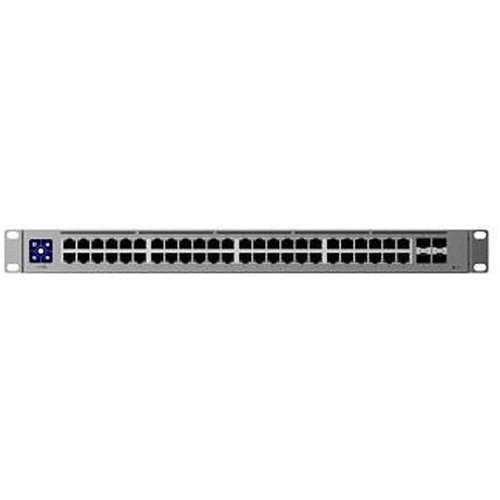
The USW-48-POE provides 48 x 1 GbE access ports with 4 x 1G SFP uplinks, yielding a switching capacity of 104 Gbps and a forwarding rate of 77 Mpps. Every access port is capped at 1 Gbps, making the switch suitable for standard IP cameras and 802.11ac/ax APs that do not exceed that threshold.
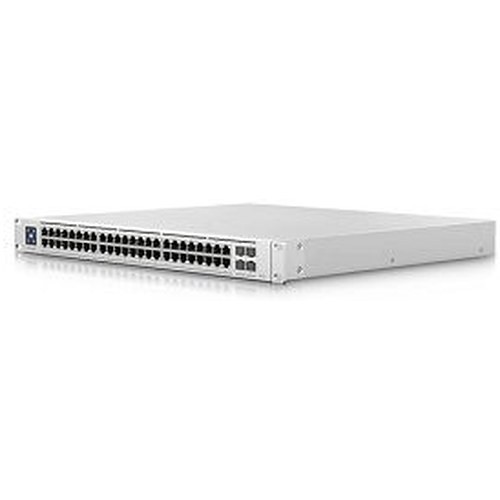
The USW-ENTERPRISE-48-POE raises all 48 access ports to 2.5 GbE and equips the switch with 4 x 10G SFP+ uplinks. Switching capacity reaches 160 Gbps and forwarding rate climbs to 238 Mpps — a 3.1× improvement over the USW-48-POE. The 2.5G access ports eliminate per-port bandwidth ceilings for Wi-Fi 6/6E APs and higher-bitrate multi-sensor cameras, while the 10G uplinks support high-density aggregation or core trunking without creating inter-switch choke points.
How do the PoE power budgets compare, and how many devices can each switch realistically power?
The USW-48-POE allocates a maximum PoE output of 195W across 32 of its 48 ports (the remaining 16 are non-PoE). With each port capable of delivering up to 30W (802.3at PoE+), simultaneous full-load powering is limited: 195W ÷ 30W = 6.5 ports at maximum draw before budget exhaustion. Typical 802.3at cameras drawing 12–15W each allow roughly 13–16 devices at full concurrency. The internal power supply is rated at 240W total.
The USW-ENTERPRISE-48-POE provides 720W of PoE output, with an 870W total internal power supply (150W base consumption + 720W PoE). All 48 ports are PoE-capable per the spec. At a typical camera draw of 15W, the budget supports approximately 48 simultaneous devices — effectively the full port count. The spec states that the 720W budget powers 40–50 802.3at cameras without injectors, a claim consistent with the rated numbers. The USW-ENTERPRISE-48-POE's PoE budget is 3.7× larger than the USW-48-POE's.
How do the two switches compare on physical footprint, power draw, and management integration?
Both switches share the same 442 x 44 mm (W × H) 1U form factor and SGCC steel enclosure, and both operate over an identical -5 to 40°C temperature range. Depth differs: the USW-48-POE measures 285 mm deep versus 400 mm for the USW-ENTERPRISE-48-POE — a 115 mm difference relevant in shallow rack environments. The USW-48-POE weighs 4.5 kg; the USW-ENTERPRISE-48-POE weighs 6.2 kg. Base power consumption (excluding PoE) is 45W for the USW-48-POE versus 150W for the USW-ENTERPRISE-48-POE.
Both units include a 1.3-inch LCM color touchscreen display and are managed via Ethernet (UniFi controller integration implied by Ubiquiti's management architecture). Both support 1,000 VLANs. Both carry NDAA compliance and identical certification sets (CE, FCC, IC, Anatel), differing only in Anatel registration numbers. No additional management protocol differences (e.g., CLI access, SNMP version, spanning tree variants) are specified in the provided data.
Which should you choose: the USW-48-POE or the USW-ENTERPRISE-48-POE?
Our take: The USW-48-POE is the stronger choice when budget is constrained, rack depth is limited to under 300 mm, and the deployment consists of 20 or fewer standard 802.3at PoE+ devices per switch running at 1 Gbps. The USW-ENTERPRISE-48-POE is the stronger choice for high-density or future-proof builds: its 720W PoE budget is 3.7× larger than the USW-48-POE's 195W, its 2.5G access ports deliver 2.5× the per-port bandwidth, and its 10G SFP+ uplinks and 238 Mpps forwarding rate (versus 77 Mpps) handle aggregation-layer loads without queuing. Deployments running Wi-Fi 6/6E APs, multi-sensor high-bitrate cameras, or more than 16 simultaneous PoE devices will hit the USW-48-POE's power and bandwidth ceilings. Both switches require standard rack clearance but the Enterprise model needs 400 mm depth. Both are NDAA-compliant and UniFi-managed, so platform compatibility is not a differentiator.
Side-by-Side Comparison
Spec-for-spec, from manufacturer data.
| Specification | Ubiquiti USW-48-POE | Ubiquiti USW-ENTERPRISE-48-POE |
|---|---|---|
| Access Port Count | 48 | 48 |
| Access Port Speed | 1 GbE | 2.5 GbE |
| PoE-Capable Ports | 32 | 48 (all ports) |
| PoE Standard | 802.3at (PoE+) | 802.3at (PoE+) |
| Max PoE Output | 195W | 720W |
| Max PoE Per Port | 30W | 30W |
| Uplink Ports | 4 x 1G SFP | 4 x 10G SFP+ |
| Switching Capacity | 104 Gbps | 160 Gbps |
| Forwarding Rate | 77 Mpps | 238 Mpps |
| Throughput (non-blocking) | 52 Gbps | 160 Gbps |
| VLAN Support | 1,000 | 1,000 |
| Base Power Consumption | 45W (excl. PoE) | 150W (excl. PoE) |
| Internal PSU Rating | 240W | 870W |
| Dimensions (W × D × H mm) | 442 × 285 × 44 | 442 × 400 × 44 |
| Weight (without brackets) | 4.5 kg (10 lb) | 6.2 kg (13.7 lb) |
| NDAA Compliant | Yes | Yes |
Frequently Asked Questions
Which should you choose: the USW-48-POE or the USW-ENTERPRISE-48-POE?
The USW-48-POE is the stronger choice when budget is constrained, rack depth is limited to under 300 mm, and the deployment consists of 20 or fewer standard 802.3at PoE+ devices per switch running at 1 Gbps. The USW-ENTERPRISE-48-POE is the stronger choice for high-density or future-proof builds: its 720W PoE budget is 3.7× larger than the USW-48-POE's 195W, its 2.5G access ports deliver 2.5× the per-port bandwidth, and its 10G SFP+ uplinks and 238 Mpps forwarding rate (versus 77 Mpps) handle aggregation-layer loads without queuing. Deployments running Wi-Fi 6/6E APs, multi-sensor high-bitrate cameras, or more than 16 simultaneous PoE devices will hit the USW-48-POE's power and bandwidth ceilings. Both switches require standard rack clearance but the Enterprise model needs 400 mm depth. Both are NDAA-compliant and UniFi-managed, so platform compatibility is not a differentiator.
Is the USW-48-POE or USW-ENTERPRISE-48-POE better for powering a full 48-camera installation?
The USW-ENTERPRISE-48-POE is the correct choice for a full 48-camera installation. Its 720W PoE budget can sustain 40–50 simultaneous 802.3at devices per the spec. The USW-48-POE provides only 195W across 32 PoE-capable ports, which limits simultaneous full-draw devices to roughly 6 at 30W each or 13–16 at typical camera draw — insufficient for a 48-camera load without external injectors or midspan devices.
Will the USW-48-POE bottleneck Wi-Fi 6E access points or high-bitrate multi-sensor cameras?
Yes, potentially. The USW-48-POE caps every access port at 1 Gbps. Wi-Fi 6E APs and multi-sensor cameras that aggregate traffic beyond 1 Gbps per device will be constrained at the port level. The USW-ENTERPRISE-48-POE's 2.5G access ports and 10G SFP+ uplinks eliminate that ceiling for the currently specified product class.
Can either switch fit in a shallow rack or wall-mount enclosure with less than 400 mm depth?
Only the USW-48-POE fits a shallow enclosure: it is 285 mm deep. The USW-ENTERPRISE-48-POE requires 400 mm of rack depth per its specified dimensions. Both are 1U (44 mm) tall and 442 mm wide. No wall-mount configuration is specified for either model in the provided data.
More Network Switch Comparisons
- NETGEAR GS748PP-100NAS vs Ubiquiti USW-48-POE
- NETGEAR GS748PP-100NAS vs Ubiquiti USW-PRO-MAX-48-POE
- NETGEAR GS748PP-100NAS vs Ubiquiti USW-ENTERPRISE-48-POE
- NETGEAR GS748PP-100NAS vs Ubiquiti ES-48-500W
- NETGEAR GS748PP-100NAS vs NETGEAR GS348PP-100NAS
- Ubiquiti USW-48-POE vs NETGEAR GS348PP-100NAS
Network Switch Buying Guides
Get a Second Opinion on Your Camera Choice
Share your site layout, coverage goals, and budget. Our team will validate the camera selection, flag anything we would change, and recommend products that match the use case.