
Ubiquiti ES-48-500W vs Ubiquiti USW-48-POE: Specification Comparison
Both the Ubiquiti ES-48-500W and the USW-48-POE are 1U rackmount, Layer-managed, 48-port Gigabit PoE+ switches targeted at access-layer deployments in enterprise, campus, and physical-security environments. The comparison centers on three dimensions that most directly drive purchase decisions in this class: PoE capacity and port distribution, switching throughput and uplink architecture, and management ecosystem and compliance posture. Neither product is an accessory or a different device class; a buyer sizing a wiring-closet switch for IP cameras and wireless APs would legitimately evaluate both.

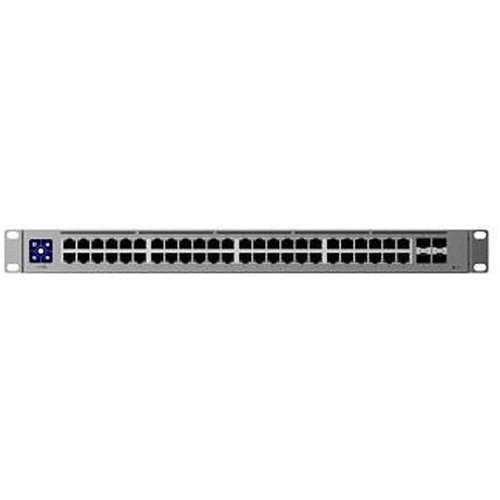
In This Guide
- Which switch delivers more PoE power, and how is that budget distributed across ports?
- How do the two switches compare on switching fabric, forwarding rate, and uplink speed?
- How do the two switches differ in management capabilities, ecosystem integration, and compliance certifications?
- Which should you choose: the ES-48-500W or the USW-48-POE?
- Side-by-Side Specs
- FAQ
Which switch delivers more PoE power, and how is that budget distributed across ports?
The ES-48-500W provides a 500W shared PoE budget across all 48 RJ45 ports, each capable of delivering up to 34.2W (PoE+ / 802.3at). This budget is more than 2.5× that of the USW-48-POE and allows the integrator to power high-draw devices—PTZ cameras, dual-radio Wi-Fi 6 access points, or PoE-powered intercoms—without manual power planning on a per-port basis.
The USW-48-POE caps its PoE output at 195W and restricts PoE+ delivery to only 32 of its 48 RJ45 ports; the remaining 16 ports are data-only. Per-port maximum on PoE+ ports is stated at 30W. A deployment requiring more than 195W aggregate or PoE on all 48 ports will exceed this switch's capacity without supplemental injectors or an additional switch.
For security installations where every port may terminate a PoE IP camera or access-control reader, the ES-48-500W's full-48-port PoE coverage and 500W ceiling materially reduces the risk of budget exhaustion. The USW-48-POE's 195W ceiling is adequate for lighter mixed loads but requires careful load planning beyond roughly six to seven simultaneously active high-draw PoE+ devices.
How do the two switches compare on switching fabric, forwarding rate, and uplink speed?
The ES-48-500W is specified with a 140 Gbps switching capacity in product-level specs and 70 Gbps non-blocking throughput in the datasheet-derived fields, at 104.16 Mpps forwarding rate. It provides four uplink ports: two SFP+ at 10 Gbps each and two SFP at 1 Gbps each. The dual 10G SFP+ uplinks support LAG (link aggregation), allowing up to 20 Gbps of bonded upstream bandwidth to a distribution or core layer.
The USW-48-POE is specified at 104 Gbps switching capacity and 52 Gbps non-blocking throughput at 77 Mpps forwarding rate. Its four uplink ports are all 1G SFP—there are no 10G uplinks available on this model. For uplink-bound deployments, maximum upstream bandwidth is limited to 4 Gbps with LAG across all four SFP ports.
Note: the ES-48-500W's switching capacity figure is inconsistent across the provided spec fields (140 Gbps vs. 70 Gbps vs. 20 Gbps appear in different fields). The most conservative confirmed non-blocking figure cited in datasheet-derived data is 70 Gbps. In either case, the 10G SFP+ uplinks are a hardware architectural advantage the USW-48-POE cannot match, making the ES-48-500W better suited to high-density camera deployments where aggregated stream traffic must be handed off to a core at 10G speeds.
How do the two switches differ in management capabilities, ecosystem integration, and compliance certifications?
The ES-48-500W is managed via Ubiquiti's USIP/EdgeMax platform. Management interfaces include a web GUI, CLI, SNMP, and a hardware RJ45 serial console port—making it compatible with traditional enterprise network operations workflows that rely on out-of-band console access. The spec does not list a display or touchscreen interface.
The USW-48-POE is a UniFi-platform device, managed natively through the Ubiquiti UniFi controller (cloud or on-premises). It includes a 1.3-inch LCM color touchscreen on the chassis for local status visibility. VLAN support is specified at 1,000 VLANs. The spec lists management interface as 'Ethernet' only; CLI and SNMP are not confirmed in the provided specifications for this model.
On compliance, the USW-48-POE carries an NDAA-compliant designation, which is a procurement requirement for U.S. federal, state, and municipal government projects as well as many enterprise security programs. The ES-48-500W's provided specs do not include an NDAA-compliant designation. Both carry CE, FCC, and IC certifications. The USW-48-POE additionally holds Anatel certification (Brazil). For government-funded physical-security deployments subject to NDAA Section 889, the USW-48-POE is the only option of the two with a documented compliant status.
Platform lock-in is a real consideration: the ES-48-500W is EdgeMax-based and will not appear in a UniFi controller, while the USW-48-POE is invisible to EdgeMax tooling. Shops standardizing on UniFi must choose the USW-48-POE; shops using EdgeOS or mixed enterprise management prefer the ES-48-500W.
Which should you choose: the ES-48-500W or the USW-48-POE?
Our take: The ES-48-500W is the stronger choice when PoE power headroom, 10G uplinks, and EdgeMax management are the primary requirements. Its 500W PoE budget—versus 195W on the USW-48-POE—supports 2.5× more aggregate device power, covering 48 PoE+ ports rather than 32. Its dual 10G SFP+ uplinks eliminate the 1G uplink bottleneck present on the USW-48-POE, which is limited to four 1G SFP ports. However, the USW-48-POE carries a documented NDAA-compliant designation that the ES-48-500W's specs do not confirm, making it the required option for government or federally funded security projects. The USW-48-POE also integrates natively with the UniFi controller ecosystem and includes a local LCM touchscreen. Installers building high-density camera or AP deployments on an EdgeMax or hybrid network should favor the ES-48-500W; UniFi-standardized or government-contract sites should select the USW-48-POE.
Side-by-Side Comparison
Spec-for-spec, from manufacturer data.
| Specification | Ubiquiti ES-48-500W | Ubiquiti USW-48-POE |
|---|---|---|
| Total RJ45 Ports | 48 × 1G | 48 × 1G |
| PoE+ Ports | 48 (all ports) | 32 of 48 |
| Max PoE per Port | 34.2W (PoE+) | 30W (PoE+) |
| Total PoE Budget | 500W | 195W |
| PoE Standard | 802.3af/at (PoE+) | 802.3at (PoE+) |
| Uplink Ports | 2× 10G SFP+ + 2× 1G SFP | 4× 1G SFP |
| Max Uplink Speed | 10G (SFP+) | 1G (SFP) |
| Non-Blocking Throughput | 70 Gbps | 52 Gbps |
| Forwarding Rate | 104.16 Mpps | 77 Mpps |
| Management Platform | EdgeMax (Web GUI, CLI, SNMP, Serial) | UniFi Controller (Ethernet) |
| Serial Console | RJ45 serial console | — |
| Local Display | — | 1.3" LCM color touchscreen |
| VLAN Support | — | 1,000 VLANs |
| NDAA Compliant | — | Yes |
| Certifications | CE, FCC, IC | CE, FCC, IC, Anatel |
| Weight | 16.25 lb (7.37 kg) | 10 lb (4.5 kg) |
Frequently Asked Questions
Which should you choose: the ES-48-500W or the USW-48-POE?
The ES-48-500W is the stronger choice when PoE power headroom, 10G uplinks, and EdgeMax management are the primary requirements. Its 500W PoE budget—versus 195W on the USW-48-POE—supports 2.5× more aggregate device power, covering 48 PoE+ ports rather than 32. Its dual 10G SFP+ uplinks eliminate the 1G uplink bottleneck present on the USW-48-POE, which is limited to four 1G SFP ports. However, the USW-48-POE carries a documented NDAA-compliant designation that the ES-48-500W's specs do not confirm, making it the required option for government or federally funded security projects. The USW-48-POE also integrates natively with the UniFi controller ecosystem and includes a local LCM touchscreen. Installers building high-density camera or AP deployments on an EdgeMax or hybrid network should favor the ES-48-500W; UniFi-standardized or government-contract sites should select the USW-48-POE.
Is the ES-48-500W or USW-48-POE better for a large IP camera deployment with PTZ cameras?
The ES-48-500W is better suited for large camera deployments that include high-draw devices. Its 500W PoE budget and 48 full PoE+ ports (up to 34.2W each) provide over twice the aggregate power of the USW-48-POE's 195W across only 32 PoE+ ports. PTZ cameras often draw 25–30W continuously; the ES-48-500W can sustain more simultaneous high-draw ports before budget exhaustion.
Which switch do I need if my project is subject to NDAA Section 889 compliance requirements?
Based on the provided specifications, only the USW-48-POE carries a documented NDAA-compliant designation. The ES-48-500W's specs do not include this certification. For U.S. federal, state, or municipal projects—or any contract that mandates NDAA Section 889 compliance—the USW-48-POE is the only option of the two with a confirmed compliant status.
Can I manage both switches from a single Ubiquiti controller?
No. The ES-48-500W is part of the Ubiquiti USIP/EdgeMax platform and is managed via the EdgeMax web GUI, CLI, or SNMP. The USW-48-POE is a UniFi-platform device managed through the Ubiquiti UniFi controller. The two platforms are separate and do not share a unified management interface. Integrators should select the switch that matches their existing Ubiquiti platform to avoid managing two separate ecosystems.
More Network Switch Comparisons
- NETGEAR GS748PP-100NAS vs Ubiquiti USW-48-POE
- NETGEAR GS748PP-100NAS vs Ubiquiti USW-PRO-MAX-48-POE
- NETGEAR GS748PP-100NAS vs Ubiquiti USW-ENTERPRISE-48-POE
- NETGEAR GS748PP-100NAS vs Ubiquiti ES-48-500W
- NETGEAR GS748PP-100NAS vs NETGEAR GS348PP-100NAS
- Ubiquiti USW-48-POE vs NETGEAR GS348PP-100NAS
Network Switch Buying Guides
Get a Second Opinion on Your Camera Choice
Share your site layout, coverage goals, and budget. Our team will validate the camera selection, flag anything we would change, and recommend products that match the use case.