
Ubiquiti ES-48-500W vs Allied Telesis GS980M/52PS-10: Specification Comparison
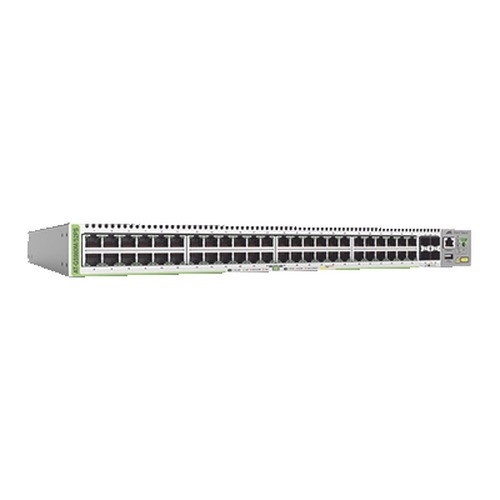
Both the Ubiquiti ES-48-500W and the Allied Telesis AT-GS980M/52PS-10 are 1U rackmount, Layer 2 managed switches offering 48 Gigabit PoE+ access ports intended for enterprise and campus deployments — a direct cross-shop pair for network installers evaluating access-layer switches for IP camera, access control, and wireless AP infrastructure. The comparison centers on three axes most critical to this product class: PoE power budget and port density, switching performance and uplink architecture, and management depth and physical specifications.

In This Guide
- Which switch delivers more PoE headroom and how is the power distributed across ports?
- How do the two switches compare on switching capacity, forwarding rate, and uplink architecture?
- What are the differences in management capability and physical/environmental specifications?
- Which should you choose: the ES-48-500W or the GS980M/52PS-10?
- Side-by-Side Specs
- FAQ
Which switch delivers more PoE headroom and how is the power distributed across ports?
The Allied Telesis AT-GS980M/52PS-10 holds a decisive advantage in total PoE power budget: 740W maximum versus the Ubiquiti ES-48-500W's 500W. On a fully loaded 48-port deployment, that translates to an average of approximately 15.4W per port for the Allied Telesis versus approximately 10.4W per port for the Ubiquiti when shared equally — a meaningful gap for mixed PTZ camera and dual-radio AP environments where individual devices routinely draw 25–30W.
The ES-48-500W specifies a maximum of 34.2W per port under IEEE 802.3at (PoE+), and supports passive PoE at 17W per port. The AT-GS980M/52PS-10 spec states 15W per port across all 48 ports or 30W per port across 24 ports simultaneously — confirming the 740W budget is real but constrained by a 24-port ceiling at the 30W tier. Installers powering more than 24 high-draw PoE+ devices will need to account for that ceiling on the Allied Telesis unit. Neither spec discloses per-port PoE+ allocation logic (first-come vs. priority-based), so field verification is advised for both.
Maximum power consumption figures also diverge sharply: the AT-GS980M/52PS-10 is rated at 909W total draw (including PoE output), while the ES-48-500W is rated at 500W PoE budget with a 150W internal supply spec — indicating the Ubiquiti unit's total wall draw will be meaningfully lower, relevant for rack power planning and circuit sizing.
How do the two switches compare on switching capacity, forwarding rate, and uplink architecture?
The Allied Telesis AT-GS980M/52PS-10 leads on both switching fabric and forwarding rate: 104 Gbps switching fabric and 77.4 Mpps forwarding rate versus the Ubiquiti ES-48-500W's figures, which are inconsistent across spec sources. The ES-48-500W product spec fields cite 20 Gbps switching capacity and 14.88 Mpps forwarding rate, while the datasheet-derived fields cite 70 Gbps non-blocking and 104.16 Mpps. Given the internal contradiction in the Ubiquiti spec data provided, the lower figures (20 Gbps / 14.88 Mpps) should be treated as the conservative baseline until the manufacturer datasheet is independently verified. The AT-GS980M/52PS-10 figures are internally consistent across all spec fields at 104 Gbps / 77.4 Mpps.
Uplink architecture is where the ES-48-500W differentiates itself: it provides two 10G SFP+ ports plus two 1G SFP ports, enabling 10-Gigabit uplinks to aggregation or core switches — critical for high-density video surveillance backhaul. The AT-GS980M/52PS-10 offers only four SFP ports rated at 100/1000X (1G maximum), with no 10G uplink capability specified. For deployments aggregating 48 simultaneous HD or 4K camera streams, a 1G uplink ceiling on the Allied Telesis unit may become a bottleneck; the ES-48-500W's 10G uplinks directly address that constraint. LAG (Link Aggregation) support is noted for the ES-48-500W; the AT-GS980M/52PS-10 spec does not explicitly list LAG support as provided.
What are the differences in management capability and physical/environmental specifications?
The Ubiquiti ES-48-500W specifies Web GUI, CLI, SNMP, and an RJ45 serial console for out-of-band access. The AT-GS980M/52PS-10 spec references VLAN and QoS management features but does not enumerate a specific management protocol list (no SNMP, CLI, or serial console specification is provided in the data supplied). Buyers requiring documented SNMP integration with NMS platforms or guaranteed out-of-band serial access should verify the AT-GS980M/52PS-10 management stack directly with Allied Telesis before specifying.
Physically, both units are 1U rackmount. The ES-48-500W weighs 16.25 lbs; the AT-GS980M/52PS-10 weighs 12.79 lbs — the Allied Telesis unit is approximately 3.5 lbs lighter. Depth differs: the AT-GS980M/52PS-10 is 359 mm (14.13 in) deep; the ES-48-500W's depth spec as listed (235 inches) appears to be a data entry error and cannot be used as a reliable figure. The AT-GS980M/52PS-10 specifies an acoustic noise rating of 42 dBA; no noise figure is provided for the ES-48-500W. Operating temperature range is not provided for either unit in the spec data supplied. The ES-48-500W carries CE, FCC, and IC certifications; AT-GS980M/52PS-10 certifications are not listed in the data provided.
The AT-GS980M/52PS-10 is listed in white housing, which is atypical for rack deployments and may be a spec field error; the ES-48-500W has no housing color noted. Country of origin is specified only for the ES-48-500W (China); not provided for the AT-GS980M/52PS-10.
Which should you choose: the ES-48-500W or the GS980M/52PS-10?
Our take: The ES-48-500W is the stronger choice when 10G uplink capacity is required or total power draw and circuit budget are tightly constrained. Its dual 10G SFP+ uplinks are a concrete architectural advantage the AT-GS980M/52PS-10 cannot match — the Allied Telesis unit tops out at 1G SFP uplinks. The ES-48-500W also draws less wall power (500W PoE budget vs. 909W max consumption on the AT-GS980M/52PS-10), easing circuit planning. Conversely, the AT-GS980M/52PS-10 delivers a larger PoE budget — 740W versus 500W — making it preferable when powering a full rack of high-draw PoE+ devices at 30W, provided no more than 24 ports simultaneously require that tier. The Ubiquiti switching capacity spec is internally contradictory and must be independently verified before specifying for high-throughput applications. Specify the ES-48-500W for Ubiquiti-ecosystem or 10G-backhaul-dependent installations; specify the AT-GS980M/52PS-10 where maximum PoE budget and Allied Telesis enterprise management stack alignment take priority.
Side-by-Side Comparison
Spec-for-spec, from manufacturer data.
| Specification | Ubiquiti ES-48-500W | Allied Telesis GS980M/52PS-10 |
|---|---|---|
| Access Ports | 48× Gigabit RJ45 (PoE+) | 48× Gigabit RJ45 (PoE+) |
| Uplink Ports | 2× SFP+ (10G) + 2× SFP (1G) | 4× SFP (100/1000X, 1G max) |
| Max 10G Uplinks | 2 | 0 |
| Total PoE Budget | 500W | 740W |
| Max PoE per Port (PoE+) | 34.2W | 30W (up to 24 ports simultaneously) |
| PoE Standard | IEEE 802.3af/at (PoE+) | PoE+ (spec does not cite IEEE number) |
| Switching Fabric | 20 Gbps (spec field) / 70 Gbps (datasheet — conflicting) | 104 Gbps |
| Forwarding Rate | 14.88 Mpps (spec field) / 104.16 Mpps (datasheet — conflicting) | 77.4 Mpps |
| Form Factor | 1U Rackmount | 1RU Rack-mount |
| Weight | 16.25 lbs (7.37 kg) | 12.79 lbs (5.8 kg) |
| Max Power Consumption | Not specified (150W internal supply listed) | 909W |
| Noise | Not specified | 42 dBA |
| Management Protocols | Web GUI, CLI, SNMP, RJ45 Serial Console | VLAN, QoS noted; SNMP/CLI not specified |
| Certifications | CE, FCC, IC | Not specified |
| Country of Origin | China | Not specified |
| Warranty | Manufacturer Warranty (duration not specified) | Not specified |
Frequently Asked Questions
Which should you choose: the ES-48-500W or the GS980M/52PS-10?
The ES-48-500W is the stronger choice when 10G uplink capacity is required or total power draw and circuit budget are tightly constrained. Its dual 10G SFP+ uplinks are a concrete architectural advantage the AT-GS980M/52PS-10 cannot match — the Allied Telesis unit tops out at 1G SFP uplinks. The ES-48-500W also draws less wall power (500W PoE budget vs. 909W max consumption on the AT-GS980M/52PS-10), easing circuit planning. Conversely, the AT-GS980M/52PS-10 delivers a larger PoE budget — 740W versus 500W — making it preferable when powering a full rack of high-draw PoE+ devices at 30W, provided no more than 24 ports simultaneously require that tier. The Ubiquiti switching capacity spec is internally contradictory and must be independently verified before specifying for high-throughput applications. Specify the ES-48-500W for Ubiquiti-ecosystem or 10G-backhaul-dependent installations; specify the AT-GS980M/52PS-10 where maximum PoE budget and Allied Telesis enterprise management stack alignment take priority.
Is the ES-48-500W or AT-GS980M/52PS-10 better for powering a full deployment of PTZ cameras drawing 25–30W each?
For deployments where all 48 ports need to deliver close to 30W simultaneously, the AT-GS980M/52PS-10's 740W total PoE budget is larger than the ES-48-500W's 500W. However, the AT-GS980M/52PS-10 spec limits the 30W-per-port tier to 24 ports at a time. If more than 24 ports must simultaneously deliver 30W, neither switch's spec as documented guarantees that. The ES-48-500W specifies 34.2W max per port under PoE+ but its 500W shared budget will be exhausted faster under heavy uniform load. Verify actual per-port power allocation logic with each manufacturer before specifying for dense PTZ deployments.
Can either switch feed a 10G aggregation or core switch without an intermediate device?
Yes, but only the Ubiquiti ES-48-500W. It provides two 10G SFP+ uplink ports capable of directly connecting to a 10G aggregation switch or NVR with a 10G interface. The Allied Telesis AT-GS980M/52PS-10 specifies only four 100/1000X SFP ports (1G maximum) — no 10G uplink capability is listed in the specifications provided. For high-density video or data backhaul where 1G uplinks would be saturated, the ES-48-500W's 10G ports are the differentiating factor.
Which switch is easier to integrate into an existing enterprise network management system using SNMP?
Based on the specifications provided, the ES-48-500W explicitly lists SNMP as a supported management protocol alongside Web GUI, CLI, and RJ45 serial console. The AT-GS980M/52PS-10 spec references VLAN and QoS capabilities but does not enumerate SNMP or other specific management protocols in the data available. Buyers requiring confirmed SNMP support on the AT-GS980M/52PS-10 should request the full management feature list from Allied Telesis before purchasing.
More Network Switch Comparisons
- NETGEAR GS748PP-100NAS vs Ubiquiti USW-48-POE
- NETGEAR GS748PP-100NAS vs Ubiquiti USW-PRO-MAX-48-POE
- NETGEAR GS748PP-100NAS vs Ubiquiti USW-ENTERPRISE-48-POE
- NETGEAR GS748PP-100NAS vs Ubiquiti ES-48-500W
- NETGEAR GS748PP-100NAS vs NETGEAR GS348PP-100NAS
- Ubiquiti USW-48-POE vs NETGEAR GS348PP-100NAS
Network Switch Buying Guides
Get a Second Opinion on Your Camera Choice
Share your site layout, coverage goals, and budget. Our team will validate the camera selection, flag anything we would change, and recommend products that match the use case.