
Transition Networks XSDR22000-01 vs Transition Networks OCA-1BA1A0: Specification Comparison
Both the Transition Networks XSDR22000-01 and OCA-1BA1A0 are 10-port, unmanaged, single-mode fiber DIN rail switches from the same manufacturer — a pairing a systems integrator would legitimately cross-shop for industrial edge or field-cabinet deployments. The key axes of comparison are throughput tier (10G versus Gigabit), operating environment certification (industrial temperature rating versus outdoor cabinet assembly), and deployment context. Neither unit is PoE-capable per the provided specs, and both carry lifetime warranties.
In This Guide
- Which switch delivers the higher per-port throughput for backbone or aggregation runs?
- How do the two units differ in environmental hardening and physical deployment format?
- Do the two switches differ in management capability or what is included in the box?
- Which should you choose: the XSDR22000-01 or the OCA-1BA1A0?
- Side-by-Side Specs
- FAQ
Which switch delivers the higher per-port throughput for backbone or aggregation runs?
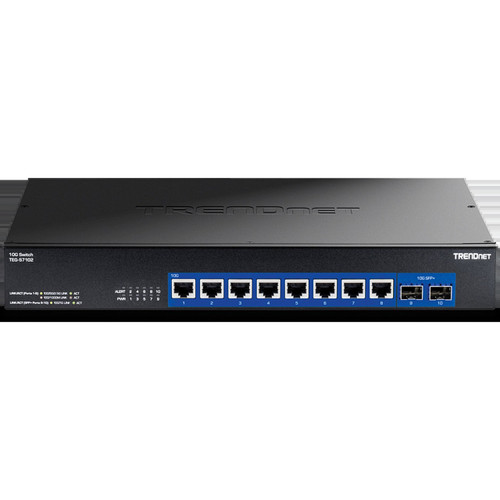
The XSDR22000-01 is specified at 10G across all 10 ports, making it a 10-Gigabit Ethernet switch. This positions it for backbone aggregation, high-density video surveillance uplinks, or any segment where camera streams or access-control data must traverse a single link without creating a throughput bottleneck.
The OCA-1BA1A0 is specified at Gigabit speed across all 10 ports — one-tenth the per-port bandwidth of the XSDR22000-01. For deployments where individual endpoints do not exceed Gigabit line rate and no 10G uplink is required, this is often sufficient, but it cannot serve as a 10G aggregation node.
Both switches use single-mode fiber connectivity, so distance reach over fiber is not a differentiator between them; throughput tier is the sole bandwidth-related distinction the provided specs support.
How do the two units differ in environmental hardening and physical deployment format?
The XSDR22000-01 carries an explicit industrial operating temperature rating. The provided specs do not state a numeric temperature range, but the 'Industrial' classification indicates suitability for field panels, outdoor enclosures, and environments with wide ambient swings beyond commercial-grade limits. It is specified for DIN rail mount on a 35mm rail.
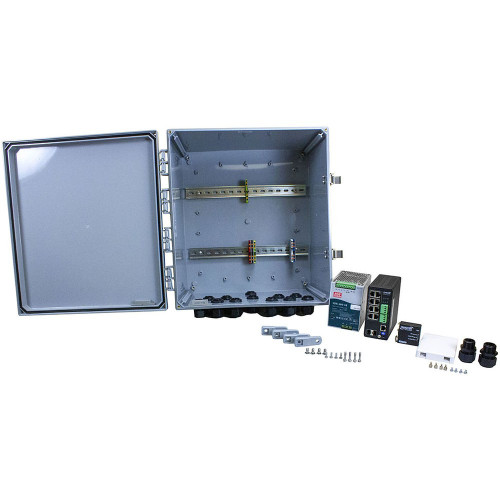
The OCA-1BA1A0 is specified with an outdoor cabinet assembly included in the package contents and carries an 'Outdoor' environment rating. Its environmental class is described as hardened for industrial and telecom infrastructure. It also mounts on DIN rail. The outdoor cabinet designation suggests the unit ships with an enclosure solution rather than requiring a separately sourced housing.
Neither unit's specific operating temperature range in degrees Celsius is provided in the available specs. Installers requiring exact thermal limits should consult Transition Networks datasheets before specifying either unit for extreme-temperature sites.
Do the two switches differ in management capability or what is included in the box?
Both switches are unmanaged — plug-and-play with no configuration interface, CLI, SNMP, or VLAN support per the provided specs. Neither offers managed features such as QoS, port mirroring, or storm control. For deployments that require traffic segmentation or monitoring, a managed alternative from either product line would be required.
The OCA-1BA1A0 package contents are explicitly listed: the switch unit, an outdoor cabinet assembly, and DIN rail mounting hardware. This bundled cabinet differentiates it from a bare-switch purchase and is relevant to total installed cost when an outdoor enclosure would otherwise be sourced separately.
The XSDR22000-01 package contents are not enumerated in the provided specs beyond the switch itself. Installers should verify whether DIN rail hardware ships in the box or must be ordered separately.
Which should you choose: the XSDR22000-01 or the OCA-1BA1A0?
Our take: The XSDR22000-01 is the stronger choice when backbone throughput is the primary constraint — its 10G per-port specification delivers ten times the bandwidth of the OCA-1BA1A0's Gigabit ports, which matters on aggregation links feeding NVRs or high-channel-count camera segments. The OCA-1BA1A0, running at Gigabit across all 10 ports, is better suited to edge access layers where endpoint bandwidth does not exceed 1G and where the bundled outdoor cabinet assembly reduces procurement steps and installed cost for exposed-site deployments. Both carry lifetime warranties and share single-mode fiber connectivity and unmanaged operation, so those factors do not drive the decision. Choose the XSDR22000-01 for 10G fiber backbone runs in industrial panels; choose the OCA-1BA1A0 when Gigabit suffices and an integrated outdoor enclosure is operationally advantageous.
Side-by-Side Comparison
Spec-for-spec, from manufacturer data.
| Specification | Transition Networks XSDR22000-01 | Transition Networks OCA-1BA1A0 |
|---|---|---|
| Product Type | Switch | Switch |
| Ports | 10 | 10 |
| Port Speed | 10G | Gigabit |
| Fiber Type | Single Mode | Single Mode |
| Managed | Unmanaged | Unmanaged |
| Mount Type | DIN Rail | DIN Rail |
| Operating Temperature | Industrial | — |
| Environment Rating | — | Outdoor |
| Outdoor Cabinet Included | — | Yes |
| DIN Rail Hardware Included | — | Yes (per package contents) |
| Warranty | Lifetime | Lifetime |
| Package Contents | Switch unit (hardware not enumerated in specs) | Switch unit; Outdoor cabinet assembly; DIN rail mounting hardware |
| Form Factor | DIN Rail mount | DIN Rail mount with outdoor cabinet |
Frequently Asked Questions
Which should you choose: the XSDR22000-01 or the OCA-1BA1A0?
The XSDR22000-01 is the stronger choice when backbone throughput is the primary constraint — its 10G per-port specification delivers ten times the bandwidth of the OCA-1BA1A0's Gigabit ports, which matters on aggregation links feeding NVRs or high-channel-count camera segments. The OCA-1BA1A0, running at Gigabit across all 10 ports, is better suited to edge access layers where endpoint bandwidth does not exceed 1G and where the bundled outdoor cabinet assembly reduces procurement steps and installed cost for exposed-site deployments. Both carry lifetime warranties and share single-mode fiber connectivity and unmanaged operation, so those factors do not drive the decision. Choose the XSDR22000-01 for 10G fiber backbone runs in industrial panels; choose the OCA-1BA1A0 when Gigabit suffices and an integrated outdoor enclosure is operationally advantageous.
Is the XSDR22000-01 or OCA-1BA1A0 better for high-density IP camera aggregation?
The XSDR22000-01 is better suited for aggregation roles because its 10G per-port speed can handle the combined throughput of many high-resolution camera streams without becoming a bottleneck. The OCA-1BA1A0 operates at Gigabit speed, which is adequate for access-layer edge connections but limits its use as a backbone aggregation point when upstream bandwidth exceeds 1G.
Which unit is appropriate for a curbside or pole-mounted outdoor installation?
The OCA-1BA1A0 is the spec-supported choice for outdoor installation — it carries an explicit outdoor environment rating and ships with an outdoor cabinet assembly included. The XSDR22000-01 is rated for industrial temperature range but is not specified with an outdoor cabinet; deploying it outdoors would require a separately sourced weatherproof enclosure.
Do either of these switches support VLANs or remote management?
No. Both the XSDR22000-01 and OCA-1BA1A0 are unmanaged switches per their provided specifications. Neither supports VLANs, SNMP, port mirroring, QoS, or any configuration interface. If traffic segmentation or network monitoring is required, a managed switch from another product line must be specified instead.
More Network Switch Comparisons
- TP-Link IES210GPP vs Transition Networks OCA-1AB201-NA
- TP-Link IES210GPP vs Transition Networks OCA-1BA1A0
- TP-Link IES210GPP vs Transition Networks OCA-1BA101
- TP-Link IES210GPP vs TP-Link DS110GMP
- TP-Link IES210GPP vs TP-Link SG1210PP
- TP-Link DS110GMP vs Transition Networks OCA-1AB201-NA
Network Switch Buying Guides
Get a Second Opinion on Your Camera Choice
Share your site layout, coverage goals, and budget. Our team will validate the camera selection, flag anything we would change, and recommend products that match the use case.