
Transition Networks EDS3016PR1NS vs TP-Link SG3210X-M2: Specification Comparison
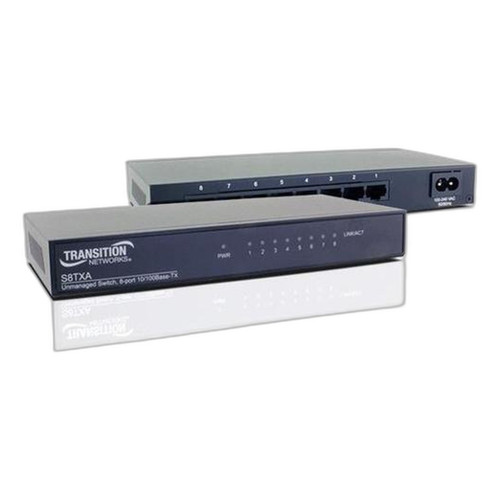
Both the Transition Networks EDS3016PR1NS and the TP-Link SG3210X-M2 are 8-port network switches, but they occupy meaningfully different segments of the market. The EDS3016PR1NS is an unmanaged, DIN-rail-mounted industrial Gigabit switch aimed at hardened edge deployments inside control panels and enclosures. The SG3210X-M2 is a rack/wall-mount L2+ managed switch with 2.5G copper ports and dual 10G SFP+ uplinks, targeting structured wiring closets and SDN-managed enterprise or surveillance LAN cores. A buyer evaluating one against the other is weighing industrial ruggedness and simplicity versus throughput, management depth, and uplink density.
In This Guide
- Which switch delivers higher port speed and aggregate throughput for bandwidth-intensive deployments?
- Which switch supports advanced network management, VLAN segmentation, and SDN integration?
- Which switch is better suited to industrial enclosures, harsh environments, and mounting constraints?
- Which should you choose: the EDS3016PR1NS or the SG3210X-M2?
- Side-by-Side Specs
- FAQ
Which switch delivers higher port speed and aggregate throughput for bandwidth-intensive deployments?
The EDS3016PR1NS provides 8 ports at Gigabit (1G) speed. No aggregate switching capacity or packet-forwarding rate is listed in the supplied specifications, so those figures cannot be stated.
The SG3210X-M2 offers 8 ports at 2.5GBASE-T plus 2 × 10G SFP+ uplink slots, yielding a specified switching capacity of 80 Gbps and a forwarding rate of 59.52 Mpps. Each copper port runs 2.5× faster than a Gigabit port, and the SFP+ slots support single-mode or multimode fiber modules (sold separately, max range specified as 64 m for the tested module).
For high-density IP camera backbones, NVR uplinks, or any segment where bandwidth headroom matters, the SG3210X-M2's 2.5G copper and 10G fiber uplinks provide substantially more capacity. The EDS3016PR1NS's 1G ports are adequate for standard HD camera streams but offer no headroom specification beyond Gigabit.
Which switch supports advanced network management, VLAN segmentation, and SDN integration?
The EDS3016PR1NS is explicitly unmanaged. It provides plug-and-play operation with no configuration interface, no VLAN support, no SNMP, and no CLI. This is by design for industrial simplicity, but it means zero traffic segmentation, QoS, or remote monitoring capability.
The SG3210X-M2 is L2+ managed, supporting Web GUI, CLI, SNMP, and RMON. Its feature set includes 802.1Q VLAN and QinQ, STP/RSTP/MSTP, IGMP snooping, ERPS ring protection, ACL, 802.1p/DSCP QoS, LACP, DDM, OAM, and 802.1x with RADIUS/TACACS+ authentication. It integrates with TP-Link's Omada SDN controller platform. Memory is 32 MB Flash and 256 MB DRAM.
Any deployment requiring network segmentation (e.g., isolating camera VLANs from access-control VLANs), centralized policy management, or audit-ready authentication must use the SG3210X-M2. The EDS3016PR1NS cannot fulfill these requirements.
Which switch is better suited to industrial enclosures, harsh environments, and mounting constraints?
The EDS3016PR1NS mounts on a standard DIN rail, the universal mounting format for industrial control panels, junction boxes, and field enclosures. Its fiber type is listed as multimode. Operating temperature range and power supply specifications are not provided in the supplied data, so environmental ratings cannot be confirmed.
The SG3210X-M2 mounts via wall, ceiling, or rack (19-inch rack form factor, 294 × 180 × 44 mm / 11.6 × 7.1 × 1.7 in). Operating temperature is −5 °C to +50 °C (23 °F to 122 °F). Power input is 100–240 V AC 50/60 Hz; maximum consumption is 15.3 W at 220 V/50 Hz. MTBF is 340,091 hours at 25 °C. It has no DIN rail capability per the supplied specs.
For installation inside industrial electrical enclosures—common in access control panels, gate controllers, and factory-floor camera nodes—the EDS3016PR1NS's DIN rail form factor is directly compatible while the SG3210X-M2 is not. Conversely, for IT-room or structured-cabling deployments the SG3210X-M2's rack mount and documented environmental ratings are appropriate. Operating temperature limits for the EDS3016PR1NS are absent from the provided specifications and should be confirmed with Transition Networks before specifying in high-temperature environments.
Which should you choose: the EDS3016PR1NS or the SG3210X-M2?
Our take: The EDS3016PR1NS is the stronger choice when the deployment requires DIN rail mounting inside an industrial enclosure and plug-and-play simplicity with no configuration overhead. The SG3210X-M2 is the stronger choice for virtually every other dimension: its 2.5G copper ports run 2.5× faster than the EDS3016PR1NS's 1G ports; its dual 10G SFP+ uplinks (80 Gbps switching capacity, 59.52 Mpps) provide a backbone capability the unmanaged switch cannot match; and its L2+ feature set—VLAN, 802.1x/RADIUS, IGMP snooping, ERPS, QoS, Omada SDN—addresses segmentation and security requirements the EDS3016PR1NS cannot address at all. Warranty is Lifetime on the EDS3016PR1NS; warranty duration for the SG3210X-M2 is not stated in the provided specifications. Specify the EDS3016PR1NS for hardened industrial edge nodes where DIN rail fit and zero-config operation are mandatory. Specify the SG3210X-M2 for managed LAN cores, high-bandwidth camera aggregation switches, or any site requiring VLAN-segmented, SDN-managed infrastructure.
Side-by-Side Comparison
Spec-for-spec, from manufacturer data.
| Specification | Transition Networks EDS3016PR1NS | TP-Link SG3210X-M2 |
|---|---|---|
| Product Type | Industrial Unmanaged Switch | L2+ Managed Access Switch |
| Managed / Unmanaged | Unmanaged | L2+ Managed |
| Copper Port Count | 8 | 8 |
| Copper Port Speed | 1G (Gigabit) | 2.5GBASE-T |
| Uplink / SFP+ Slots | — | 2 × 10G SFP+ |
| Switching Capacity | — | 80 Gbps |
| Forwarding Rate | — | 59.52 Mpps |
| Mount Type | DIN Rail | Wall; Ceiling; Rack |
| Dimensions | — | 11.6 × 7.1 × 1.7 in (294 × 180 × 44 mm) |
| Operating Temp | — | −5 °C to +50 °C (23 °F to 122 °F) |
| Power Supply | — | 100–240 V AC 50/60 Hz |
| Max Power Consumption | — | 15.3 W |
| MTBF | — | 340,091 h @ 25 °C |
| Fiber Support | Multimode | Single-mode or multimode (SFP+ modules sold separately) |
| VLAN / QoS / ACL | None (unmanaged) | 802.1Q, QinQ, 802.1p/DSCP QoS, ACL |
| Warranty | Lifetime | — |
Frequently Asked Questions
Which should you choose: the EDS3016PR1NS or the SG3210X-M2?
The EDS3016PR1NS is the stronger choice when the deployment requires DIN rail mounting inside an industrial enclosure and plug-and-play simplicity with no configuration overhead. The SG3210X-M2 is the stronger choice for virtually every other dimension: its 2.5G copper ports run 2.5× faster than the EDS3016PR1NS's 1G ports; its dual 10G SFP+ uplinks (80 Gbps switching capacity, 59.52 Mpps) provide a backbone capability the unmanaged switch cannot match; and its L2+ feature set—VLAN, 802.1x/RADIUS, IGMP snooping, ERPS, QoS, Omada SDN—addresses segmentation and security requirements the EDS3016PR1NS cannot address at all. Warranty is Lifetime on the EDS3016PR1NS; warranty duration for the SG3210X-M2 is not stated in the provided specifications. Specify the EDS3016PR1NS for hardened industrial edge nodes where DIN rail fit and zero-config operation are mandatory. Specify the SG3210X-M2 for managed LAN cores, high-bandwidth camera aggregation switches, or any site requiring VLAN-segmented, SDN-managed infrastructure.
Can the EDS3016PR1NS or SG3210X-M2 be mounted inside an electrical control panel?
Only the EDS3016PR1NS supports DIN rail mounting, which is the standard method for installing equipment inside electrical control panels and industrial enclosures. The SG3210X-M2 is rated for wall, ceiling, or rack mounting only and has no DIN rail capability per the provided specifications. If your installation requires a control-panel fit, the EDS3016PR1NS is the correct choice.
Is the EDS3016PR1NS or SG3210X-M2 better for a deployment with multiple VLANs separating cameras from access control traffic?
The SG3210X-M2 is the only option here. It supports 802.1Q VLAN, QinQ, ACL, and 802.1x with RADIUS/TACACS+ authentication. The EDS3016PR1NS is unmanaged and has no VLAN, ACL, or authentication capability whatsoever. Any requirement for traffic segmentation or network-layer security policy mandates the SG3210X-M2.
Which switch carries a longer warranty, and does that affect long-term TCO?
The EDS3016PR1NS carries a Lifetime warranty per the provided specifications. The SG3210X-M2's warranty duration is not stated in the supplied data and should be confirmed directly with TP-Link before making a total-cost-of-ownership comparison. The EDS3016PR1NS's Lifetime warranty may offset its lower per-unit feature set for cost-sensitive long-term deployments where replacement cost is a primary concern.
More Network Switch Comparisons
- TP-Link SG2210XMP-M2 vs Ubiquiti USW-FLEX-2.5G-8
- TP-Link SG2210XMP-M2 vs Comnet CNGE8MS
- TP-Link SG2210XMP-M2 vs Lantronix S2220-1014-NA
- TP-Link SG2210XMP-M2 vs TP-Link S4500-8GP
- TP-Link SG2210XMP-M2 vs TP-Link SG2008P
- TP-Link S4500-8GP vs Ubiquiti USW-FLEX-2.5G-8
Network Switch Buying Guides
Get a Second Opinion on Your Camera Choice
Share your site layout, coverage goals, and budget. Our team will validate the camera selection, flag anything we would change, and recommend products that match the use case.