
TP-Link SL2428P vs TP-Link SG3428XPP-M2: Specification Comparison
Both the TP-Link SL2428P and SG3428XPP-M2 are 24-port Omada-managed PoE switches in a 1U rackmount form factor, making them legitimate cross-shop candidates for physical security and enterprise LAN deployments. The comparison spans three generations of PoE and Ethernet speed technology: the SL2428P operates at Fast Ethernet (10/100 Mbps) access speeds with Gigabit uplinks, while the SG3428XPP-M2 delivers 2.5 Gbps per access port with 10 Gbps fiber uplinks. Buyers will weigh port throughput, PoE budget and per-port wattage, and switching fabric capacity against deployment scale and budget.

In This Guide
- How do the port speeds, uplinks, and switching capacity compare between the SL2428P and SG3428XPP-M2?
- Which switch delivers more PoE power per port, and how do their operating environments differ?
- How do the two switches compare for management, security features, and integration with IP security ecosystems?
- Which should you choose: the SL2428P or the SG3428XPP-M2?
- Side-by-Side Specs
- FAQ
How do the port speeds, uplinks, and switching capacity compare between the SL2428P and SG3428XPP-M2?
The SL2428P provides 24 access ports running at 10/100 Mbps — Fast Ethernet, not Gigabit — supplemented by 4 Gigabit uplink ports (2× RJ45 and 2× Combo RJ45/SFP). Its switching capacity is 12.8 Gbps with a forwarding rate of 9.52 Mpps. The Combo SFP slots accept single-mode or multi-mode fiber transceivers at Gigabit speeds.
The SG3428XPP-M2 runs every one of its 24 access ports at 2.5 Gbps (2.5GBASE-T) and adds 4× 10 Gbps SFP+ uplink slots, supporting single-mode or multimode fiber. Its switching capacity is 200 Gbps at 148.80 Mpps — roughly 15.6× greater fabric than the SL2428P. For deployments feeding multi-gig Wi-Fi 6/6E APs, high-resolution IP cameras at sustained high bitrates, or aggregating multiple downstream switches, the SG3428XPP-M2's fabric headroom is substantially larger.
Which switch delivers more PoE power per port, and how do their operating environments differ?
The SL2428P carries a 250W total PoE budget, capped at 30W per port via 802.3af/at (PoE+). This supports standard IP cameras, access control panels, and 802.3at Wi-Fi APs but cannot power high-draw devices requiring 802.3bt.
The SG3428XPP-M2 carries a 770W total PoE budget — 3.08× the SL2428P — and delivers up to 90W per port via 802.3bt (PoE++), with the spec noting support for perpetual PoE and fast PoE. This enables powering PTZ cameras with heaters, 802.3bt Wi-Fi 6E APs, video intercoms, and thin clients from a single cable. Its maximum power consumption is listed at 500W versus the SL2428P's 250W typical under full PoE load (8.9W standby).
On operating environment, the SL2428P is rated −5°C to 50°C (23°F to 122°F); the SG3428XPP-M2 has a narrower upper limit at −5°C to 45°C (23°F to 113°F). Installers in high-ambient-temperature environments — uncooled IDF closets, outdoor enclosures — should note the SL2428P's 5°C thermal advantage. Both units are 1U rackmount (440 × 44 mm high), though the SG3428XPP-M2 is deeper at 330 mm versus 180 mm.
How do the two switches compare for management, security features, and integration with IP security ecosystems?
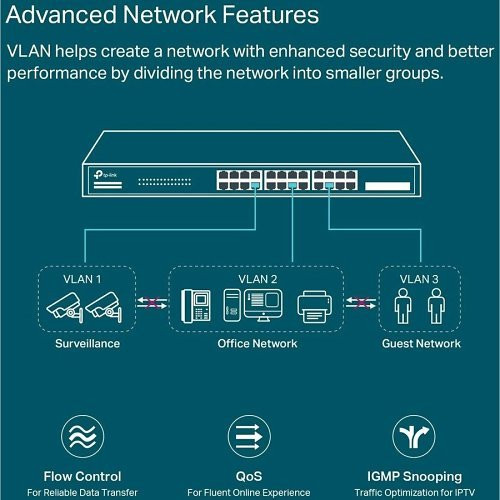
Both switches share the Omada cloud management platform and support standalone web GUI management. Both list ONVIF compatibility. Both carry 32 MB Flash and 256 MB DRAM. Both support VLAN, ACL, QoS (including 802.1p/DSCP on the SL2428P), IGMP Snooping, STP/RSTP/MSTP, and static routing as L2+ features.
The SL2428P's spec additionally lists CLI, SNMP, RMON, LACP, Jumbo Frame (9 KB), and 802.1x / RADIUS / TACACS+ authentication explicitly. The SG3428XPP-M2 spec lists OAM and DDM (optical monitoring for SFP+ slots) explicitly. Neither spec documents TACACS+ or RADIUS for the SG3428XPP-M2, and neither spec documents OAM/DDM for the SL2428P — buyers requiring those specific features should verify against the full datasheet for the respective model.
The SG3428XPP-M2's 10 Gbps SFP+ uplinks allow direct fiber connection to a core switch or NVR at 10G speeds, which is a meaningful integration advantage in larger VMS or hyperconverged deployments where camera bitrate aggregation is a constraint.
Which should you choose: the SL2428P or the SG3428XPP-M2?
Our take: The SL2428P is the stronger choice when budget is the primary constraint and all powered devices require no more than 30W per port on a 100 Mbps or Gigabit link. Against the SG3428XPP-M2, three concrete spec deltas define the decision: (1) PoE budget — 250W vs. 770W, a 520W difference that determines how many high-draw 802.3bt devices a single switch can feed; (2) per-port maximum wattage — 30W (802.3at) vs. 90W (802.3bt), which gates compatibility with PTZ camera heaters, Wi-Fi 6E APs, and intercoms; (3) switching fabric — 12.8 Gbps vs. 200 Gbps, a 15.6× difference that matters when aggregating multi-gig endpoints or connecting 10G uplinks. The SG3428XPP-M2 suits mid-to-large security deployments running 802.3bt devices and multi-gig APs; the SL2428P suits smaller, cost-sensitive installations with legacy 100 Mbps cameras and standard PoE+ endpoints where the 5°C wider thermal tolerance (50°C vs. 45°C max) may also be a factor.
Side-by-Side Comparison
Spec-for-spec, from manufacturer data.
| Specification | TP-Link SL2428P | TP-Link SG3428XPP-M2 |
|---|---|---|
| Product Type | 24-Port 10/100 Mbps + 4-Port Gigabit PoE+ Managed Switch | 24-Port 2.5GBASE-T + 4-Port 10GE PoE++ Managed Switch |
| Access Port Speed | 24× 10/100 Mbps | 24× 2.5 Gbps |
| Uplink Ports | 2× Gigabit RJ45 + 2× Combo RJ45/SFP | 4× 10 Gbps SFP+ |
| Switching Capacity | 12.8 Gbps | 200 Gbps |
| Forwarding Rate | 9.52 Mpps | 148.80 Mpps |
| PoE Standard | 802.3af/at (PoE+) | 802.3af/at/bt (PoE++) + perpetual PoE + fast PoE |
| Max PoE Per Port | 30W | 90W |
| Total PoE Budget | 250W | 770W |
| Max Power Consumption | 250W (full PoE load); 8.9W standby | 500W max |
| Flash / DRAM | 32 MB Flash / 256 MB DRAM | 32 MB Flash / 256 MB DRAM |
| Operating Temp | −5°C to 50°C (23°F to 122°F) | −5°C to 45°C (23°F to 113°F) |
| Dimensions (W×D×H) | 440 × 180 × 44 mm (17.3 × 7.1 × 1.7 in) | 440 × 330 × 44 mm (17.3 × 13.0 × 1.7 in) |
| Mount Type | Wall / Ceiling / Rack | Wall / Ceiling / Rack |
| Management Platforms | Omada cloud, standalone web, CLI, SNMP, RMON | Omada cloud, standalone web |
| Authentication (per spec) | 802.1x, RADIUS, TACACS+ | Not specified in provided specs |
| ONVIF | Yes | Yes |
Frequently Asked Questions
Which should you choose: the SL2428P or the SG3428XPP-M2?
The SL2428P is the stronger choice when budget is the primary constraint and all powered devices require no more than 30W per port on a 100 Mbps or Gigabit link. Against the SG3428XPP-M2, three concrete spec deltas define the decision: (1) PoE budget — 250W vs. 770W, a 520W difference that determines how many high-draw 802.3bt devices a single switch can feed; (2) per-port maximum wattage — 30W (802.3at) vs. 90W (802.3bt), which gates compatibility with PTZ camera heaters, Wi-Fi 6E APs, and intercoms; (3) switching fabric — 12.8 Gbps vs. 200 Gbps, a 15.6× difference that matters when aggregating multi-gig endpoints or connecting 10G uplinks. The SG3428XPP-M2 suits mid-to-large security deployments running 802.3bt devices and multi-gig APs; the SL2428P suits smaller, cost-sensitive installations with legacy 100 Mbps cameras and standard PoE+ endpoints where the 5°C wider thermal tolerance (50°C vs. 45°C max) may also be a factor.
Can the SL2428P power high-wattage devices like PTZ cameras with heaters or Wi-Fi 6E access points?
No. The SL2428P's PoE standard is 802.3af/at (PoE+), with a maximum of 30W per port. Devices requiring 802.3bt (PoE++) — such as high-wattage PTZ cameras, heated enclosures, or Wi-Fi 6E APs drawing 60–90W — are not supported at those power levels. The SG3428XPP-M2 supports 802.3bt at up to 90W per port and a 770W total budget, making it the appropriate choice for such devices.
Is the SG3428XPP-M2 or SL2428P better for larger deployments with many cameras and APs?
The SG3428XPP-M2 is better suited for larger deployments. Its 200 Gbps switching fabric (vs. 12.8 Gbps) handles higher aggregate throughput without bottlenecking, its 4× 10 Gbps SFP+ uplinks support high-speed fiber runs to core infrastructure, and its 770W PoE budget can sustain more simultaneously powered devices. The SL2428P's 250W budget and 12.8 Gbps fabric are more appropriate for smaller edge deployments of 10–20 standard PoE cameras or APs.
Do both switches work with the same Omada management platform, and does either have an advantage in security authentication features?
Yes, both the SL2428P and SG3428XPP-M2 use TP-Link's Omada cloud and standalone web management platforms. The SL2428P's specifications explicitly list CLI, SNMP, RMON, 802.1x port authentication, and RADIUS/TACACS+ support. The SG3428XPP-M2 spec lists Omada and standalone management but does not explicitly document RADIUS/TACACS+ — buyers with strict AAA requirements should verify that detail against the full SG3428XPP-M2 datasheet before specifying it.
More Network Switch Comparisons
- TP-Link S5500-24GP4XF vs NETGEAR GS728TP-300NAS
- TP-Link S5500-24GP4XF vs Comnet CNGE24FX12TX12MSPOE
- TP-Link S5500-24GP4XF vs Ubiquiti USW-24
- TP-Link S5500-24GP4XF vs Ubiquiti USW-ENTERPRISEXG-24
- TP-Link S5500-24GP4XF vs TP-Link SL2428P
- TP-Link S5500-24GP4XF vs TP-Link SG3428XPP-M2
Network Switch Buying Guides
Get a Second Opinion on Your Camera Choice
Share your site layout, coverage goals, and budget. Our team will validate the camera selection, flag anything we would change, and recommend products that match the use case.