
TP-Link S5500-24GP4XF vs TP-Link SL2428P: Specification Comparison
Both the TP-Link S5500-24GP4XF and SL2428P are Omada-managed, rack-mountable PoE+ switches built around a 24-port access layer with uplink ports — a configuration commonly evaluated for IP camera, access control, and wireless AP deployments. The S5500-24GP4XF is an L2+ managed switch with full gigabit access ports and 10GE SFP+ uplinks, while the SL2428P is a smart-managed switch with 10/100 Mbps access ports and gigabit uplinks. This comparison covers port speed and throughput, PoE budget and power envelope, and management depth and feature set.

In This Guide
- Which switch delivers more bandwidth at the access layer and uplinks?
- How do the PoE budgets and power envelopes compare for powering edge devices?
- Which switch offers deeper management capabilities and feature parity for enterprise or surveillance deployments?
- Which should you choose: the S5500-24GP4XF or the SL2428P?
- Side-by-Side Specs
- FAQ
Which switch delivers more bandwidth at the access layer and uplinks?
The S5500-24GP4XF provides 24 × Gigabit RJ45 access ports plus 4 × 10GE SFP+ uplink slots, yielding a switching capacity of 160 Gbps. Every access port runs at 1 Gbps, making it capable of handling high-bitrate 4K or multi-stream IP cameras, and the 10GE uplinks allow non-blocking aggregation to a core switch or NVR at 10 Gbps per port.
The SL2428P provides 24 × 10/100 Mbps access ports — capped at 100 Mbps per port — with only 4 gigabit uplink ports (2 × RJ45 + 2 × Combo RJ45/SFP). Its switching capacity is 12.8 Gbps with a forwarding rate of 9.52 Mpps. The 100 Mbps access ceiling is adequate for standard-definition or lower-resolution IP cameras but will bottleneck high-bitrate streams (typically 25–50 Mbps for 4K) if multiple such devices share the backplane.
For bandwidth-intensive deployments — high-resolution cameras, multi-stream encoders, or dense wireless APs — the S5500-24GP4XF's gigabit access ports and 160 Gbps fabric represent a significant structural advantage. The SL2428P's 12.8 Gbps fabric is sufficient for lighter loads where per-device throughput stays well under 100 Mbps.
How do the PoE budgets and power envelopes compare for powering edge devices?
The S5500-24GP4XF carries a total PoE+ budget of 240 W across its 24 access ports, with a maximum system power draw of 384 W. It supports 802.3af/at on all PoE ports and, per the specs, includes dynamic PoE allocation to prevent port oversubscription. Per-port maximum is 30 W (802.3at).
The SL2428P carries a total PoE+ budget of 250 W across its 24 × 10/100 Mbps access ports, with a maximum system power draw of 250 W and a standby draw of 8.9 W. It also supports 802.3af/at at up to 30 W per port. The SL2428P's PoE budget of 250 W slightly exceeds the S5500-24GP4XF's 240 W.
In practice, 10 W separates the two PoE pools — a marginal difference equivalent to roughly one additional PoE (802.3af) device. The more notable difference is total system wattage: the S5500-24GP4XF draws up to 384 W total (reflecting its higher-capacity switching silicon and 10GE interfaces), while the SL2428P's maximum draw is 250 W. For deployments where rack power budget or heat load is constrained, the SL2428P has a lower power ceiling.
Operating temperature ranges differ: the S5500-24GP4XF is rated 0 °C to 45 °C, while the SL2428P is rated −5 °C to 50 °C. The SL2428P tolerates a wider thermal range, which may matter in outdoor enclosures or unconditioned spaces.
Which switch offers deeper management capabilities and feature parity for enterprise or surveillance deployments?
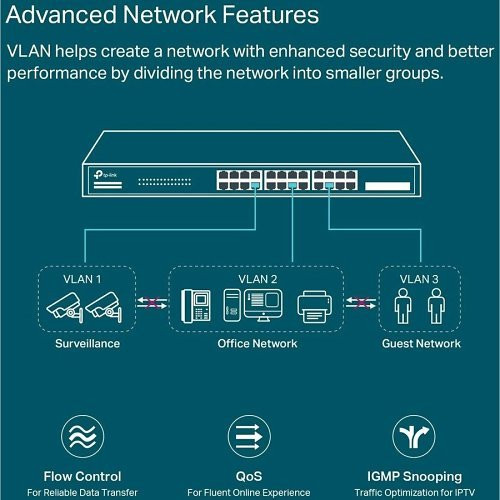
The S5500-24GP4XF is classified as an L2+ Managed switch. Its specified management interfaces include CLI, SNMP (v1/v2c/v3), and RMON. Feature support listed in the specs includes static routing, 802.1Q VLAN, QinQ, STP/RSTP/MSTP, IGMP snooping, ACL, 802.1X authentication, and LACP. It integrates with the Omada Pro platform. The '10GE' class and L2+ designation indicate support for inter-VLAN static routing — relevant for segmenting camera, management, and user traffic without a dedicated router.
The SL2428P is managed via Omada cloud, standalone web UI, CLI, SNMP, and RMON. Its feature set per the specs includes VLAN, STP/RSTP/MSTP, IGMP Snooping, QoS (802.1p/DSCP), ACL, LACP, static routing, and jumbo frames (9 KB). Security includes 802.1X and RADIUS/TACACS+ authentication. The SL2428P also carries an ONVIF designation per the provided specs, which may simplify integration with ONVIF-compliant NVR and VMS platforms. Its memory spec is more detailed: 32 MB Flash and 256 MB DRAM, versus the S5500-24GP4XF's listed 32 MB (DRAM not specified).
Both switches support a comparable L2+ feature set including static routing, IGMP snooping, ACL, and 802.1X. The SL2428P adds an explicit RADIUS/TACACS+ spec and ONVIF flag; the S5500-24GP4XF adds QinQ per its spec. The S5500-24GP4XF sits on the Omada Pro platform while the SL2428P is on the standard Omada platform — buyers already committed to one ecosystem should verify controller compatibility before selecting.
Which should you choose: the S5500-24GP4XF or the SL2428P?
Our take: The S5500-24GP4XF is the stronger choice when per-port bandwidth, uplink speed, and switching fabric capacity are the primary criteria. Its 24 gigabit access ports and 4 × 10GE SFP+ uplinks produce a 160 Gbps switching capacity versus the SL2428P's 12.8 Gbps — a 12.5× difference driven by the access-port speed gap (1 Gbps vs. 100 Mbps). The SL2428P counters with a marginally higher PoE pool (250 W vs. 240 W), a wider operating temperature range (−5 °C to 50 °C vs. 0 °C to 45 °C), a lower maximum power draw (250 W vs. 384 W), and an explicit ONVIF specification. For high-resolution IP camera deployments, multi-stream encoders, or dense AP environments where device bitrates approach or exceed 50 Mbps, the SL2428P's 100 Mbps access ceiling is a hard constraint. The SL2428P is appropriate for cost-sensitive, lower-bitrate installations — standard-definition or sub-10 Mbps cameras — particularly where rack power is limited or the deployment site runs warm.
Side-by-Side Comparison
Spec-for-spec, from manufacturer data.
| Specification | TP-Link S5500-24GP4XF | TP-Link SL2428P |
|---|---|---|
| Access Port Speed | 24 × 1 Gbps RJ45 | 24 × 10/100 Mbps RJ45 |
| Uplink Ports | 4 × 10GE SFP+ | 2 × 1GbE RJ45 + 2 × Combo RJ45/SFP (1GbE) |
| Total Ports | 28 (24 RJ45 + 4 SFP+) | 28 (24 RJ45 + 2 RJ45 + 2 Combo) |
| Switching Capacity | 160 Gbps | 12.8 Gbps |
| Forwarding Rate | — | 9.52 Mpps |
| PoE Standard | 802.3af/at (PoE+) | 802.3af/at (PoE+) |
| PoE Budget | 240 W | 250 W |
| Max Per-Port PoE | 30 W | 30 W |
| Max Power Draw | 384 W | 250 W |
| Standby Power | — | 8.9 W |
| Operating Temp | 0 °C to 45 °C | −5 °C to 50 °C |
| Flash Memory | 32 MB | 32 MB |
| DRAM | — | 256 MB |
| Management Platform | Omada Pro | Omada |
| ONVIF | — | Yes (per spec) |
| Mount Type | Rack | Wall / Ceiling / Rack |
Frequently Asked Questions
Which should you choose: the S5500-24GP4XF or the SL2428P?
The S5500-24GP4XF is the stronger choice when per-port bandwidth, uplink speed, and switching fabric capacity are the primary criteria. Its 24 gigabit access ports and 4 × 10GE SFP+ uplinks produce a 160 Gbps switching capacity versus the SL2428P's 12.8 Gbps — a 12.5× difference driven by the access-port speed gap (1 Gbps vs. 100 Mbps). The SL2428P counters with a marginally higher PoE pool (250 W vs. 240 W), a wider operating temperature range (−5 °C to 50 °C vs. 0 °C to 45 °C), a lower maximum power draw (250 W vs. 384 W), and an explicit ONVIF specification. For high-resolution IP camera deployments, multi-stream encoders, or dense AP environments where device bitrates approach or exceed 50 Mbps, the SL2428P's 100 Mbps access ceiling is a hard constraint. The SL2428P is appropriate for cost-sensitive, lower-bitrate installations — standard-definition or sub-10 Mbps cameras — particularly where rack power is limited or the deployment site runs warm.
Is the S5500-24GP4XF or SL2428P better for connecting high-resolution 4K IP cameras?
The S5500-24GP4XF is the more suitable option for 4K cameras. Its 24 access ports each run at 1 Gbps, which accommodates the 25–50 Mbps bitrates typical of 4K streams with headroom to spare. The SL2428P's 24 access ports are capped at 100 Mbps, which can become a bottleneck when multiple high-bitrate cameras share the same port or when traffic bursts during motion events. The S5500-24GP4XF also provides 4 × 10GE SFP+ uplinks for high-speed aggregation to an NVR or core switch.
Which switch is more power-efficient for a rack where total wattage is limited?
The SL2428P draws a maximum of 250 W total (including its full 250 W PoE budget), with a standby draw of 8.9 W per the provided specs. The S5500-24GP4XF draws up to 384 W maximum. If rack power allocation or heat dissipation is a constraint, the SL2428P has a lower power ceiling. Note that the S5500-24GP4XF's higher draw reflects its faster switching silicon and 10GE interfaces, not a less efficient PoE implementation.
Can either switch be used in an outdoor enclosure or unconditioned space?
Per the provided specs, the SL2428P is rated for −5 °C to 50 °C, giving it a slight advantage in environments that run cold (below freezing) or warm (above 45 °C). The S5500-24GP4XF is rated 0 °C to 45 °C. Neither unit is specified as an outdoor or ruggedized device; both require an enclosure if deployed outside. For borderline-temperature installations, the SL2428P's wider thermal range per spec offers more margin.
More Network Switch Comparisons
- TP-Link S5500-24GP4XF vs NETGEAR GS728TP-300NAS
- TP-Link S5500-24GP4XF vs Comnet CNGE24FX12TX12MSPOE
- TP-Link S5500-24GP4XF vs Ubiquiti USW-24
- TP-Link S5500-24GP4XF vs Ubiquiti USW-ENTERPRISEXG-24
- TP-Link S5500-24GP4XF vs TP-Link SG3428XPP-M2
- TP-Link SL2428P vs NETGEAR GS728TP-300NAS
Network Switch Buying Guides
Get a Second Opinion on Your Camera Choice
Share your site layout, coverage goals, and budget. Our team will validate the camera selection, flag anything we would change, and recommend products that match the use case.