
TP-Link S5500-24GP4XF vs NETGEAR GS728TP-300NAS: Specification Comparison
Both the TP-Link S5500-24GP4XF and the NETGEAR GS728TP-300NAS are rack-mountable, 24-port Gigabit PoE+ managed switches aimed at SMB and enterprise-edge surveillance and wireless deployments. The comparison examines three decision-critical axes for this product class: port density, uplink speed, and PoE budget; switching capacity and management depth; and physical build, power draw, and environmental ratings. Buyers choosing between these two are typically equipping a security camera infrastructure, a multi-AP wireless network, or a converged IP voice and data environment.

In This Guide
- Which switch delivers more PoE headroom and faster uplinks for growing camera or AP deployments?
- How do the switching fabric size and management feature sets compare for segmented surveillance networks?
- What are the physical footprint, power consumption, and environmental tolerance differences between these two switches?
- Which should you choose: the S5500-24GP4XF or the GS728TP-300NAS?
- Side-by-Side Specs
- FAQ
Which switch delivers more PoE headroom and faster uplinks for growing camera or AP deployments?
The TP-Link S5500-24GP4XF provides 24 Gigabit RJ45 PoE+ access ports and 4 SFP+ 10GbE uplink slots, yielding a total port count of 28. Its PoE budget is specified at 240 W across those 24 ports under the 802.3af/at standard, with individual port output up to 30 W. The four 10GbE SFP+ uplinks allow direct aggregation to a core switch or NVR server at ten times the bandwidth of a standard Gigabit uplink.
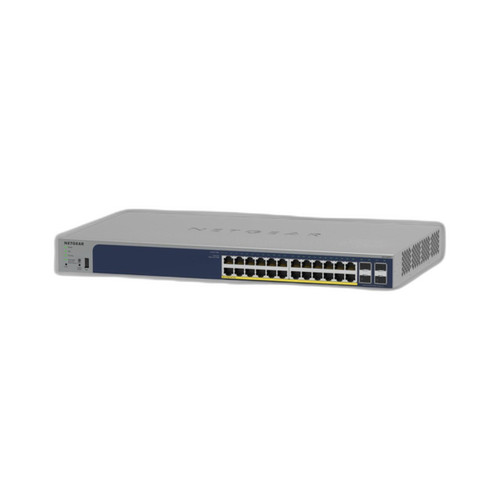
The NETGEAR GS728TP-300NAS offers 24 Gigabit PoE+ access ports and, per the provided specifications, a PoE budget of 190 W under 802.3at (the spec sheet also lists '802.3bt' in one field, but the confirmed power budget figure is 190 W). The GS728TP-300NAS uplink speed is specified at 1G in the Speed field; no 10GbE uplink capability is listed in the provided specifications. At 190 W total, the switch can realistically support 12–15 cameras drawing 13–15 W each before budget exhaustion.
The S5500-24GP4XF holds a 50 W advantage in total PoE budget (240 W vs. 190 W) and adds four 10GbE SFP+ uplinks not present in the GS728TP-300NAS spec sheet. Installers aggregating multiple switches or feeding a high-throughput NVR will find the 10GbE uplinks material.
How do the switching fabric size and management feature sets compare for segmented surveillance networks?
The S5500-24GP4XF is rated at 160 Gbps switching capacity (the spec lists both 160 Gbps and 320 Gbps; 160 Gbps is the non-duplex figure and is used here as the conservative, comparable value). It is classified as an L2+ Managed switch, supporting static routing, 802.1Q VLAN and QinQ stacking, STP/RSTP/MSTP, IGMP snooping, ACL, 802.1X port authentication, and LACP link aggregation. Management interfaces include CLI, SNMP v1/v2c/v3, and RMON, integrated into the TP-Link Omada Pro SDN controller ecosystem.
The NETGEAR GS728TP-300NAS is specified with 48 Gbps switching throughput. It is described in the provided specs as both 'Smart-managed' and, in a separate field, 'Unmanaged'—these are contradictory; the 'Smart-managed; Web GUI; SNMP' management field and the 'Form_Factor: Managed Switch' field are treated as authoritative here. VLAN support is listed as 'Yes'; specific VLAN types, STP variants, or routing capabilities are not itemized in the provided specifications.
The S5500-24GP4XF's 160 Gbps fabric is more than three times the GS728TP-300NAS's 48 Gbps, providing substantial headroom for high-camera-count or multi-switch uplink scenarios. The L2+ designation and explicit static routing, QinQ, and MSTP support give the TP-Link a deeper feature set than can be confirmed for the NETGEAR from the available spec data.
What are the physical footprint, power consumption, and environmental tolerance differences between these two switches?
The S5500-24GP4XF is a 1U rack-mount unit measuring 17.3 × 7.1 × 1.7 in (440 × 180 × 44 mm). Maximum power consumption is stated at 384 W. Operating temperature range is 0 °C to 45 °C (32 °F to 113 °F). The power supply accepts 100–240 V AC, 50/60 Hz. Onboard flash storage is 32 MB. The chassis material is not specified in the provided data.
The GS728TP-300NAS mounting options are listed as Wall and Ceiling in the provided specs; Rack is not listed. The enclosure is specified as Plastic. Maximum power consumption (wattage) is listed at 190 W. Operating temperature range is not provided in the supplied specifications. Power supply input voltage is not specified in the supplied data.
The S5500-24GP4XF is confirmed as a rack-mount unit; the GS728TP-300NAS is specified for wall or ceiling mounting—rack compatibility cannot be confirmed from the provided data. The TP-Link draws up to 384 W versus the NETGEAR's 190 W, a reflection of its higher PoE budget and 10GbE uplink circuitry. Installers in IDF closets with standard rack infrastructure should verify GS728TP-300NAS mounting options against the full product datasheet.
Which should you choose: the S5500-24GP4XF or the GS728TP-300NAS?
Our take: The S5500-24GP4XF is the stronger choice when deploying 20 or more IP cameras or wireless APs that require PoE+ power, high-throughput uplinks to a core switch or NVR, and deep L2+ management controls. Key spec deltas: the TP-Link provides a 240 W PoE budget versus the NETGEAR's 190 W—a 50 W advantage that supports roughly three to four additional 13 W cameras at full draw; its 160 Gbps switching fabric outpaces the NETGEAR's 48 Gbps by more than 3×, preventing congestion under simultaneous HD-stream aggregation; and four 10GbE SFP+ uplinks are present on the TP-Link versus no confirmed 10GbE uplink on the NETGEAR. The GS728TP-300NAS may suit smaller, cost-sensitive deployments with wall or ceiling mounting constraints and lighter management requirements, but critical specs including operating temperature and rack-mount compatibility are absent from the provided data and should be confirmed from the manufacturer datasheet before purchase.
Side-by-Side Comparison
Spec-for-spec, from manufacturer data.
| Specification | TP-Link S5500-24GP4XF | NETGEAR GS728TP-300NAS |
|---|---|---|
| Product Type | L2+ Managed Switch | Smart-Managed Switch |
| Access Ports | 24 × Gigabit RJ45 | 24 × Gigabit RJ45 |
| Uplink Slots | 4 × SFP+ (10GbE) | Not specified in provided specs |
| Total Ports | 28 (24 RJ45 + 4 SFP+) | 24 |
| PoE Standard | 802.3af/at (PoE+) | 802.3at (PoE+) |
| PoE Budget | 240 W | 190 W |
| Max Port PoE Output | 30 W | 30 W |
| Switching Capacity | 160 Gbps | 48 Gbps |
| Management | CLI, SNMP v1/v2c/v3, RMON, Omada Pro SDN | Web GUI, SNMP |
| VLAN Support | 802.1Q, QinQ | Yes (type not specified) |
| Routing | Static routing (L2+) | Not specified in provided specs |
| Mount Type | Rack (1U) | Wall, Ceiling |
| Enclosure Material | Not specified in provided specs | Plastic |
| Max Power Consumption | 384 W | 190 W |
| Operating Temperature | 0 °C to 45 °C (32 °F to 113 °F) | Not specified in provided specs |
| Memory / Storage | 32 MB flash | — |
Frequently Asked Questions
Which should you choose: the S5500-24GP4XF or the GS728TP-300NAS?
The S5500-24GP4XF is the stronger choice when deploying 20 or more IP cameras or wireless APs that require PoE+ power, high-throughput uplinks to a core switch or NVR, and deep L2+ management controls. Key spec deltas: the TP-Link provides a 240 W PoE budget versus the NETGEAR's 190 W—a 50 W advantage that supports roughly three to four additional 13 W cameras at full draw; its 160 Gbps switching fabric outpaces the NETGEAR's 48 Gbps by more than 3×, preventing congestion under simultaneous HD-stream aggregation; and four 10GbE SFP+ uplinks are present on the TP-Link versus no confirmed 10GbE uplink on the NETGEAR. The GS728TP-300NAS may suit smaller, cost-sensitive deployments with wall or ceiling mounting constraints and lighter management requirements, but critical specs including operating temperature and rack-mount compatibility are absent from the provided data and should be confirmed from the manufacturer datasheet before purchase.
Is the S5500-24GP4XF or the GS728TP-300NAS better for larger camera deployments?
Based on the provided specifications, the S5500-24GP4XF is better suited to larger deployments. Its 240 W PoE budget exceeds the GS728TP-300NAS's 190 W by 50 W, and its 160 Gbps switching capacity is more than three times the NETGEAR's 48 Gbps, providing more headroom as camera counts and video bitrates grow.
Can the GS728TP-300NAS be rack-mounted like the S5500-24GP4XF?
The provided specifications for the GS728TP-300NAS list Wall and Ceiling as mounting options; rack mounting is not listed in the supplied spec data. The S5500-24GP4XF is explicitly specified as a Rack mount unit in a 1U form factor. Buyers requiring rack installation should verify GS728TP-300NAS rack-mount compatibility against the full NETGEAR datasheet before purchasing.
Does either switch support 10GbE uplinks for connecting to a core switch or NVR?
Yes, the S5500-24GP4XF includes four SFP+ slots supporting 10GbE uplinks, which can connect to a core switch or a high-throughput NVR at ten times Gigabit speed. The provided specifications for the GS728TP-300NAS do not list any 10GbE uplink capability; its Speed field is listed as 1G. This is a significant differentiator for multi-switch or high-bandwidth NVR environments.
More Network Switch Comparisons
- TP-Link S5500-24GP4XF vs Comnet CNGE24FX12TX12MSPOE
- TP-Link S5500-24GP4XF vs Ubiquiti USW-24
- TP-Link S5500-24GP4XF vs Ubiquiti USW-ENTERPRISEXG-24
- TP-Link S5500-24GP4XF vs TP-Link SL2428P
- TP-Link S5500-24GP4XF vs TP-Link SG3428XPP-M2
- TP-Link SL2428P vs NETGEAR GS728TP-300NAS
Network Switch Buying Guides
Get a Second Opinion on Your Camera Choice
Share your site layout, coverage goals, and budget. Our team will validate the camera selection, flag anything we would change, and recommend products that match the use case.