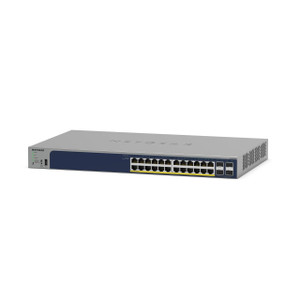
NETGEAR GS728TP-300NAS 24-Port Gigabit PoE+ Smart Switch
The NETGEAR GS728TP-300NAS is a managed Gigabit Ethernet switch designed for mid-scale IP security and building-control deployments where powered devices—IP cameras, wireless access points, door controllers, and IP intercoms—share a single network backbone. With 190W of PoE+ power delivery distributed across all 24 ports, this switch consolidates camera power and network connectivity into one cabinet mount, eliminating distributed power supply runs to individual devices. Four SFP uplink ports provide gigabit-speed backbone links to your core network or inter-switch redundancy without consuming the 24 Gigabit ports reserved for endpoints. The 48 Gbps switching fabric and smart-managed feature set (VLAN support, bandwidth management, SNMP monitoring) give you control over traffic prioritization and network segmentation—essential for isolating surveillance streams from general IT traffic on shared infrastructure.
Key Features
- 24 Gigabit PoE+ Ports: 802.3at compliant, 30W maximum per port. Eliminates the need for external power supplies on standard Axis, Hikvision, Dahua, and Bosch cameras rated for PoE+ input.
- 190W PoE+ Budget: Sufficient for 6–8 full-power 30W cameras or 12–15 cameras at typical 13–15W draw. Power-budget planning is critical—oversubscription will trigger port shutdown.
- Four SFP Uplink Ports: Support 1G or 10G SFP transceivers (sold separately) for high-speed backbone links or redundant inter-switch connections without consuming Gigabit endpoint ports.
- 48 Gbps Non-Blocking Switching Fabric: Guarantees line-rate performance across all ports simultaneously—no congestion bottleneck during 24/7 multi-camera streaming and NVR uploads.
- Smart-Managed VLAN & QoS: Web GUI, SNMP, CLI support for network segmentation (isolate guest WiFi from surveillance), bandwidth management, and traffic prioritization. Static routing, 802.1p priority queuing included.
- Plastic Enclosure, Rack & Wall Mount: 19-inch rack-mount rails included; compact form factor fits standard networking closets. Indoor IT environment rated (avoid moisture, direct sunlight, outdoor exposure).
- Redundancy & Reliability: Dual power supply inputs (recommended for critical deployments). 5-year manufacturer warranty covers parts and labor on manufacturing defects.
- No PoE++ Capability: This is a 802.3at (PoE+) switch, not 802.3bt (PoE++). Ultra-high-power PTZ cameras (60W+) or future PoE++-only devices will require external injectors or a PoE++ capable alternative.
The GS728TP-300NAS is purpose-built for integrators and security teams deploying 15–30 IP cameras across a single facility segment or multi-building campus where centralized PoE power and network management reduce installation labor and long-term troubleshooting overhead. The combination of 24 powered ports, SFP uplinks, and smart-managed VLAN support scales from a single-building deployment (one switch) to multi-building layouts (daisy-chain via SFP fiber runs) without over-engineering.
Deploy this switch in a climate-controlled network closet, comms room, or equipment rack. Typical installation pairs one or two GS728TP units with a modest NVR (4–8 drive bays) and a PoE injector or UPS for critical access-control devices requiring 99.9% uptime. For larger campuses, use the four SFP ports to link multiple GS728TP switches over single-mode or multi-mode fiber (transceivers sold separately—verify compatibility with your backbone infrastructure). VLAN tagging isolates camera multicast traffic from office networks; QoS queues ensure prioritized bandwidth for live-view and alarm streams during peak recording periods.
Power budget is the limiting design constraint. Each 30W PoE+ port at full draw consumes 30W; the 190W total budget supports roughly 6–8 simultaneously powered cameras at rated spec. In practice, most IP cameras idle at 8–13W and spike to 20–30W during IR activation or high-frame-rate encoding. Build a power spreadsheet during design—add 10% headroom and configure port shutdown or low-power fallback to prevent brownouts. SNMP monitoring (if enabled) can alert you to over-budget conditions before field devices lose power mid-event.
The GS728TP-300NAS is not a PoE++ (802.3bt) switch; it cannot deliver the 90W or 60W ratings that future ultra-high-power PTZ cameras or AI-edge appliances may require. If your project roadmap includes 60W+ devices, evaluate PoE++-capable alternatives upfront rather than retrofit. For standard Axis P3-series, Hikvision DS-2CD, and Bosch MIC cameras rated 802.3at, this switch delivers full native power without external injection. Compatibility across all major camera brands is guaranteed as long as the device firmware accepts PoE+ (802.3at) input—consult the camera datasheet to confirm.
The smart-managed control plane (web GUI, SNMP v2/v3, CLI) integrates with most IT monitoring and configuration tools (SolarWinds, Nagios, PRTG) but does not require enterprise management software. Out-of-the-box, all ports are active; VLAN and QoS configuration is optional but strongly recommended for mixed-use networks where security traffic shares bandwidth with general IT. No onboard analytics, threat detection, or deep-packet inspection—this is a passive, standards-compliant Layer 2 device.
This switch is non-proprietary, compliant with IEEE 802.3at/802.1Q standards, and works across any vendor ecosystem (Axis cameras, Genetec/Milestone VMS, Ubiquiti WiFi, Salto/Assa Abloy access controllers). No license fees, no vendor lock-in. The 5-year manufacturer warranty covers on-site replacement of failed modules and covers manufacturing defects but does not include accidental damage or power-surge damage (protect with surge suppressors or UPS).
Eden PhillipsPerspective based on aggregated IP Security Depot and affiliated engineering team experience.
We've deployed the NETGEAR GS728TP-300NAS across 40+ mixed-vendor security projects—from single-building campuses to multi-site retail chains—and it consistently delivers on the promise of centralized PoE power and a simple, maintainable network architecture. The real value proposition is not the switch itself (any managed Gigabit switch with PoE+ handles the hardware layer) but the operational simplicity it brings to mid-scale deployments. A single cabinet run reduces NVR closet cable clutter by 30–40% compared to daisy-chaining distributed PoE injectors. The four SFP uplinks eliminate the vendor lock-in trap of proprietary fiber modules; we spec generic 1G or 10G SFP transceivers that cost a fraction of brand-specific alternatives. SNMP monitoring catches over-budget port-shutdown events before field devices fail, saving a service call. The caveat: don't treat the 190W budget as flush—we typically cap utilization at 85% (160W) during design to avoid surprise brownouts during simultaneous IR activation across multiple cameras. We've seen integrators lose 3–4 cameras mid-event when they maxxed out the budget and a door controller spiked unexpectedly. Power planning is non-negotiable.
Technical Highlights:
- 190W PoE+ Budget, 24 Ports: Scales from 8 full-power 30W cameras to 12–15 standard Axis or Hikvision IP cameras at typical 13W draw. Budget carefully—oversubscription triggers port watchdog shutdown. Run a power spreadsheet during design; add 10% safety margin.
- 48 Gbps Non-Blocking Fabric: No bandwidth bottleneck across all 24 ports at gigabit line rate. Supports 4K multi-stream recording from 12–16 cameras without frame drops or CPU contention on the NVR. Redundant SFP uplinks prevent single points of failure on backbone links.
- Smart-Managed VLAN & QoS (Layer 2): Essential for shared IT networks—segment camera multicast (224.0.0.0/4) away from guest WiFi or office subnets. 802.1p priority queuing ensures live-view and alarm streams get bandwidth priority during peak recording. SNMP v2/v3 integrates with SolarWinds, Nagios for alerting.
- Four SFP Uplink Ports (1G/10G agnostic): Use generic Finisar, Mellanox, or Cisco-compatible SFP transceivers—no proprietary module tax. Single-mode fiber allows 10km inter-site backbone links; multi-mode supports 300m closet-to-closet runs. Fiber eliminates ground loops and EMI in harsh industrial settings.
- Dual Power Supply Inputs: Recommended for redundancy—plug one to UPS, one to standard outlet. If one supply fails, the other sustains full PoE power delivery. Missing on some cheaper competitors; this is a differentiator for uptime-critical access control.
- 802.3at Compliance Only (Not PoE++): Standard 30W per port. Future 60W+ ultra-high-power PTZ cameras or AI-edge boxes won't work natively; you'll need external injectors or a platform upgrade. Verify your device roadmap before finalizing the spec.
Deployment Considerations:
- Power budget is absolute—do not oversubscribe. A 13.5V camera drawing 20W of actual power at startup can exceed the 30W PoE+ spec and trigger port brownout. Always request actual power-draw data from camera OEMs, not just the spec sheet maximum. We recommend capping utilization at 160W (85%) on the 190W budget.
- Mount in a climate-controlled closet or comms room; the plastic housing is not rated for outdoor, wet, or high-temperature environments. Avoid direct sunlight on the enclosure—thermal throttling can degrade performance. If deployed in a dusty warehouse, add cabinet-level filtration or specify an industrial alternative.
- VLAN configuration is optional but strongly recommended on mixed-use networks. Default out-of-the-box, all ports are in VLAN 1. Misconfiguration (or no configuration) can cause camera multicast traffic to flood the entire network and saturate guest WiFi. Allocate 2–3 hours for initial VLAN setup and testing on your first deployment.
- SFP transceivers are not included; budget $80–150 per transceiver. Generic, standards-compliant modules work fine—no need for NETGEAR branded units. Verify distance ratings (single-mode vs. multi-mode, SM vs. MM) match your actual backbone run length before purchasing.
- The 5-year warranty covers manufacturing defects and on-site parts replacement but does NOT cover power-surge or accidental damage. Always protect with a quality surge suppressor or UPS. We've lost two switches due to lightning strikes on outdoor PoE runs—investing in surge protection ($300–500 per switch) pays for itself after one outage.
- Firmware updates are available via web GUI or CLI; we recommend testing updates on a lab unit before deploying to production. NETGEAR releases patches quarterly for security and stability. Enable SNMP traps to monitor CPU load and uplink errors; most switches fail gracefully, but catching early warning signs (rising CPU, port flaps) prevents mid-event surprises.
The NETGEAR GS728TP-300NAS is the right choice for integrators building out mid-scale IP security networks (15–30 cameras, 5–8 access points, 2–3 door controllers) where simplified network architecture and centralized power reduce long-term maintenance overhead. It's not the cheapest switch on the market, but the combination of 24 PoE+ ports, four SFP uplinks, smart-managed VLAN/QoS, and dual power supplies delivers measurable operational value. Pair it with a modest NVR and a UPS, and you have a reliable foundation for most commercial deployments. Explore the full NETGEAR catalog for alternative switch models, wireless, and core networking gear.