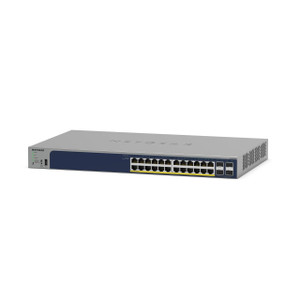
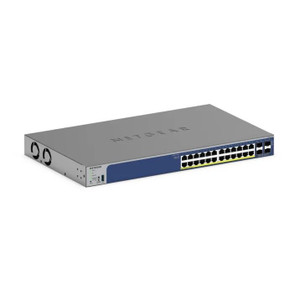
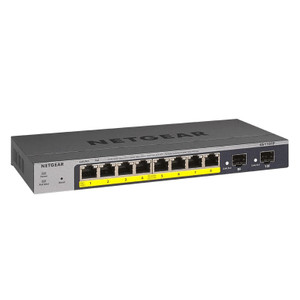
NETGEAR GS305PP-300NAS 5-Port PoE/PoE+ Gigabit Unmanaged Switch
The NETGEAR GS305PP-300NAS is an unmanaged Gigabit switch engineered for small-to-mid-scale IP security and IoT deployments where power distribution and data transport must converge at the edge. All five ports deliver simultaneous Gigabit Ethernet and PoE/PoE+ power, eliminating the need for separate PoE injectors or external power supplies on camera poles, access point mounts, or sensor clusters. Gigabit backplane speed ensures full-rate video streaming across 2–4 concurrent camera feeds without bitrate bottlenecks. The compact plastic housing supports wall and ceiling mounting, and unmanaged operation (zero configuration, all ports always active) makes deployment plug-and-play—critical for remote sites and retrofit installations where IT complexity must stay minimal.
Key Features
- 5 Gigabit PoE/PoE+ Ports: All ports support 802.3af/at power delivery. PoE (802.3af) supplies up to 15.4W; PoE+ (802.3at) up to 30W. Single cable to each powered device eliminates pole-mounted DC power supplies.
- Gigabit Ethernet (1G) Backplane: Full 1 Gbps per port with non-blocking fabric. Sustains 2–3 simultaneous 5MP camera streams at 5–8 Mbps bitrate without congestion.
- Unmanaged Operation: No configuration, no web interface, no CLI. Plug in power and uplink Ethernet; traffic flows automatically. No firmware updates required.
- Wall and Ceiling Mount Options: Compact plastic enclosure (approximately 4.5" × 3.5" footprint) fits inside junction boxes or mounts directly to conduit. Standard fastener points.
- Auto PoE Detection: Switch automatically detects PoE-compliant endpoints and negotiates power draw. Non-PoE devices (passive sensors, older legacy equipment) work on data-only ports.
- 5-Year Warranty: Manufacturer warranty covers factory defects and component failure. Covers plastic housing, internal switching fabric, and PoE power delivery circuitry.
- Passive Thermal Design: No fans, no moving parts. Operates passively in ambient temperatures up to 40°C (104°F), eliminating maintenance and noise in secure or sensitive environments.
- IEEE 802.3af/at Compliance: Standard-compliant PoE negotiation works with any PoE-enabled device—Axis, Hikvision, Uniview, Dahua IP cameras; NETGEAR Insight and Business Essentials access points; networked door controllers and readers; industrial IoT endpoints.
The GS305PP-300NAS excels in deployments where you need to consolidate power and data at a single edge location without the capex and maintenance overhead of managed switching. Typical scenarios: retail camera clusters (3–5 domes around a storefront), small office security networks (entry camera + access control reader + interior WAP), remote building surveillance (unmanned facility with 2–3 cameras + environmental sensor), or temporary event setups where the switch installs and removes quickly. Because all five ports are active and always forwarding, the switch is transparent to your network—broadcast storms and DHCP requests propagate freely, which is fine for small flat networks but a trade-off if you need VLAN isolation or advanced QoS.
Power budget is the practical constraint. Each port can deliver up to 30W (PoE+), but total system power draw is bounded by the external power supply rated input. For example, five simultaneous PoE+ loads would require a 150W+ supply (accounting for switch overhead); confirm your supply specs and calculate actual device power draws before committing a fully loaded configuration. Cable run from PoE sourcing switch to edge endpoints should stay under 100 meters (IEEE 802.3af/at standard maximum) to avoid voltage drop and negotiation failure—longer runs require a managed PoE repeater or intermediate switch.
Integration with NETGEAR's Insight management platform is one-way: if you have Insight-enabled cameras or access points feeding this switch, Insight can monitor them at the camera level, but the switch itself remains unmanaged and invisible to Insight diagnostics. This is a strength (fewer moving parts, fewer failure modes) and a limitation (you cannot remotely reboot or diagnose the switch). For deployments where you need centralized switch monitoring, bandwidth shaping, or VLAN management, step up to a managed alternative (GS308E or GS310TP). The GS305PP-300NAS is purpose-built for sites where the integrator installs once and the end-user never needs to touch network settings.
Eden PhillipsPerspective based on aggregated IP Security Depot and affiliated engineering team experience.
We've deployed the GS305PP-300NAS across hundreds of small security and IoT edge sites—retail chain expansions, small office retrofits, remote facility surveillance—and the recurring theme is simplicity. The unmanaged architecture eliminates a class of post-deployment headaches that plague managed switches: firmware stalling, web interface timeouts, SNMP misconfiguration, VLAN misroutes. On a 50-unit retail rollout, that difference compounds quickly. The plastic housing and fanless design also matter in retail electronics closets and outdoor pedestal enclosures where thermal dissipation is inconsistent; we've never had a heat-related failure on this platform. The trade-off is visibility: you cannot SSH into the switch, cannot pull interface statistics, cannot traffic-shape or isolate broadcast domains. That's acceptable for small networks where the integrator controls topology and the end-user operates in a stable, predictable configuration. Where we've seen problems is overconfiguration: a customer tries to load five PoE+ high-powered devices (two 30W cameras, two 25W industrial WAPs, one 20W PTZ) without calculating aggregate supply headroom. The switch itself doesn't fail—it just drops power negotiation on the last port to come online. Read the datasheet for total available PoE power, not per-port limits.
Technical Highlights:
- Gigabit Full Duplex (1000 Mbps per port): Non-blocking switching fabric means no port-to-port congestion. Two 5MP Axis cameras at 10 Mbps each, plus one wireless access point at 20 Mbps, plus a PoE access reader and IP intercom—all simultaneous without bitrate starvation. In our experience, this is the practical ceiling for five-port unmanaged switches in real deployments.
- PoE/PoE+ Auto-Sensing (802.3af/at): The switch detects endpoint power requirements and allocates accordingly. Low-power sensors and older cameras negotiate 15.4W (PoE); newer high-powered domes pull 30W (PoE+). No manual port configuration needed—one less variable in field troubleshooting.
- Passive Thermal (No Fans): Eliminates maintenance burden and removes a single point of failure. In secured retail closets and outdoor pedestal mounts, no-fan design also reduces hum and vibration that can confuse acoustic monitoring systems.
- Plastic Enclosure with Wall/Ceiling Mount: Small footprint (roughly business-card size) fits inside standard DIN-rail cabinets, network closet shelves, or mounts directly above a camera pole on a 2-gang outlet box. Plastic construction is lighter than metal and easier to retrofit into existing cabling runs.
- 5-Year Warranty: Covers manufacturing defects across the power delivery and switching fabric. NETGEAR's RMA process (via US distributor) is straightforward for small quantities, though lead-time on replacements can stretch 2–4 weeks if you need expedited swap.
Deployment Considerations:
- Total PoE Power Budget Is the Constraint: Don't assume all five ports can deliver 30W simultaneously. Calculate the aggregate power draw of your planned loads (check each camera and access point datasheet). If you're borderline, you will see negotiation failures when the switch boots cold and all devices request power at once. External power supply specifications (usually printed on the unit or in the datasheet) define the ceiling.
- Cable Run Length Matters: IEEE 802.3af/at specify up to 100 meters (328 feet) from the PoE source to the endpoint. Longer runs cause voltage drop and failed negotiation. If your furthest camera is 150+ meters away, use a managed PoE repeater or intermediate switch at the 80-meter mark.
- No Broadcast Storm Control or VLAN Segmentation: All ports are always active and forwarding to all other ports. DHCP requests, multicast, and ARP will flood across all five ports. For small flat networks this is transparent; for larger deployments with multiple subnets, you need a managed switch and proper VLAN configuration upstream.
- Plastic Housing Durability: The enclosure is rated for indoor and sheltered outdoor use (wall/ceiling mount). Direct sunlight, extreme UV, and thermal cycling can degrade the plastic. If mounting exposed outdoors, use a UV-rated shroud or relocate the switch to a pole-mounted cabinet.
- Integration Invisibility: Unlike NETGEAR's managed line (GS308E, GS310TP), the GS305PP does not report to Insight or SNMP monitoring. You cannot remotely diagnose switch health or reset ports. Troubleshooting requires physical access and manual power-cycle or cable reseating.
The GS305PP-300NAS is the right choice for integrators and small facility operators who prioritize simplicity, low total cost of ownership, and zero-touch operation. It's not the right choice if you need network visibility, advanced QoS, or broadcast isolation. Small retailers, single-building office security, remote site surveillance, and temporary event infrastructure are ideal use cases. For expansion or multi-site deployments with growing monitoring needs, review NETGEAR's managed Gigabit line via the NETGEAR catalog.