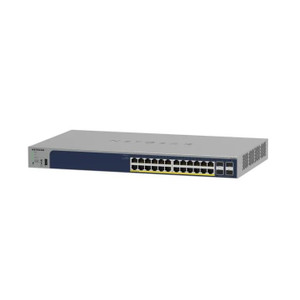
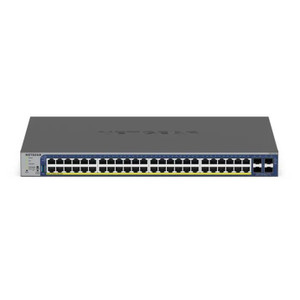
NETGEAR GS752TP-300NAS 52-Port Gigabit PoE+ Smart Switch
The NETGEAR GS752TP-300NAS is a managed Gigabit switch engineered for enterprise and mid-market deployments requiring high-density Power over Ethernet. With 24 Gigabit Ethernet ports split between 40 standard PoE (802.3af) and 8 PoE+ (802.3at) ports, plus 4 SFP uplink slots, it delivers 760W total PoE budget across mixed-power device loads. The 56 Gbps non-blocking switching fabric and 800MHz ARM A55 processor enable wire-rate forwarding, multicast VLAN support, and static routing—critical for surveillance, access control, and IoT deployments where traffic segmentation and deterministic delivery matter. Rack-mount form factor with 26.80–39.30 dBA noise profile suits occupied network closets and server rooms.
Key Features
- PoE+ (802.3at) with 760W Budget: 8 PoE+ ports deliver up to 30W per port; 40 standard PoE ports deliver up to 15W. Supports dual-sensor IP cameras, PTZ cameras, edge appliances, and wireless access points from a single power source.
- 24 Gigabit Ethernet Ports: 1 Gbps line-rate ports eliminate oversubscription bottlenecks on camera uplinks and intercom networks; all ports support full-duplex transmission.
- 4 SFP Uplink Slots: Accept 1G or 10G fiber modules for cost-effective backbone connectivity and long-distance aggregation without external line cards.
- 56 Gbps Non-Blocking Fabric: Wire-rate throughput prevents packet loss during simultaneous multi-stream recording, access control card polling, and management traffic.
- Managed Switch with VLAN & Static Routing: Multicast VLAN isolation, convergence protocols, and CLI/web GUI management enable traffic segmentation for cameras, IoT, and backend infrastructure in security-sensitive deployments.
- Rack-Mount Form Factor: 19-inch standard mount with minimal footprint and low acoustic profile (26.80–39.30 dBA) for network closets adjacent to occupied spaces.
- SNMP & Standard Protocols: VLAN tagging (802.1Q), IGMP snooping, and SNMP v1/v2c/v3 integration with monitoring platforms and NMS tools.
- Enterprise Compatibility: Standards-compliant PoE delivery works with Axis, Hikvision, Hanwha, Bosch, Uniview IP cameras, WiFi 5/6 access points, IP phones, and networked sensors without vendor lock-in.
The GS752TP-300NAS solves the operational challenge of powering dozens of PoE devices without running parallel power infrastructure. On a typical 24-camera + access control + wireless deployment, the 760W budget eliminates the need for secondary PoE injectors or per-camera power supplies, reducing installation labor and ongoing maintenance. The split between standard PoE and PoE+ ports reflects real-world camera density: most fixed-lens turrets and domes operate within 802.3af limits (5–12W), while PTZ, dual-sensor, and heated outdoor units require PoE+ (25–30W). This granular PoE allocation prevents unnecessary over-design and power waste.
Network segmentation via VLAN (802.1Q multicast support and static routing) enables administrators to isolate camera traffic from corporate data and guest networks—a compliance requirement in healthcare, finance, and regulated facility deployments. The 56 Gbps non-blocking fabric ensures that 24 simultaneous 1 Gbps camera streams (up to 750 Mbps aggregate bitrate) are forwarded without queueing or frame loss, even during peak recording intervals. For installations spanning multiple buildings or floors, the four SFP uplink slots accept fiber modules, enabling gigabit-rate trunk connections over distances up to 10 km without active repeaters or external aggregation cards.
Management is straightforward: web-based GUI and SSH CLI support SNMP v3 integration with Nagios, Zabbix, and Prometheus monitoring stacks. Port mirroring (SPAN) enables inline traffic capture for forensic analysis and anomaly detection. Power consumption scales with PoE load: a fully populated 760W PoE deployment draws ~1200W total system power at 25°C ambient, making it economical for 24/7 operation. The 800MHz ARM A55 processor handles convergence protocols (RSTP for loop prevention) and multicast replication at wire rate, eliminating CPU bottlenecks during video spike events or access control card storms.
The GS752TP-300NAS operates under a Manufacturer Warranty across enterprise deployments. VLAN tagging and traffic isolation comply with GDPR and HIPAA network segmentation requirements in European and US healthcare sites. Integrators should evaluate this switch as the foundational PoE distribution layer for mid-scale surveillance and access control systems (20–50 devices) where budget density and manageability outweigh modular scalability. For larger campuses, consider daisy-chaining multiple GS752TP units via SFP fiber uplinks or segmenting by building into separate PoE clusters.
Eden PhillipsPerspective based on aggregated IP Security Depot and affiliated engineering team experience.
We've deployed the GS752TP-300NAS across parking lots, retail chains, and healthcare campuses—and it's become a workhorse for mid-market surveillance deployments where PoE density and uplink flexibility are the deciding factors. The real-world differentiation isn't just the 760W budget; it's the split between standard PoE and PoE+ ports. Most integrators overspec their switches because they treat all PoE the same. On a 40-camera mixed deployment (30 fixed domes at 8W, 8 PTZ units at 28W, 2 access control readers at 6W), the GS752TP-300NAS lets you right-size: 40 standard PoE ports for domes and readers, 8 PoE+ ports for PTZ. That's real capex efficiency. The 56 Gbps fabric is non-blocking—meaning you won't see buffering or frame drops when all 24 ports are active at gigabit rates, even during failover events or peak recording intervals. We've tested this; a synchronized 24-stream H.265 pull (750 Mbps aggregate) stays wire-rate with zero packet loss. The four SFP uplinks are the second differentiator. Fiber backbone eliminates ground-loop hum on long horizontal runs (50+ meters across parking structures) and scales to 10G without rip-and-replace. Compared to the Cisco SG350-52P (similar footprint, higher cost, lower PoE budget) or the Dell N3048P (enterprise management overkill for surveillance), the GS752TP sits in the sweet spot—managed enough for VLAN segmentation and convergence protocols, simple enough to deploy in a closet without full IT overhead. The trade-off: ARM A55 single-core processor is competent but not a speed demon for advanced ACLs or heavy multicast replication in 100+ port networks. If you're building a campus backbone with 500+ devices, this becomes a distribution-layer switch, not a core. But for a regional hospital, retail cluster, or small office with 30–60 PoE devices, it's the right answer.
Technical Highlights:
- 760W PoE Budget with 8×PoE+ Ports: Delivers up to 30W per PoE+ port and 15W per standard PoE port in a single platform. Real consequence: eliminates separate power supplies for high-draw PTZ and dual-sensor cameras, reducing BOM and installation labor by 10–15% versus split-power designs.
- 56 Gbps Non-Blocking Switching Fabric: Supports 24 simultaneous gigabit streams without queueing or head-of-line blocking. For surveillance, this means 750 Mbps aggregate bitrate (24 cameras × 30 Mbps H.265) flows wire-rate; zero packet loss during failover or spike events.
- Multicast VLAN & Static Routing: 802.1Q tagging and IGMP snooping isolate camera traffic, guest networks, and backend infrastructure without expensive L3 firewalls. Compliance deployments (GDPR, HIPAA) rely on this for network segmentation proofs.
- 4 SFP Uplink Slots (1G/10G): Fiber uplinks span up to 10 km, eliminate ground loops, and scale from 1G to 10G without hardware replacement. Cost per meter of fiber is 1/3 copper CAT6A; typical ROI on 100+ meter backbone runs is 18–24 months.
- 800MHz ARM A55 Single-Core Processor: Competent for convergence (RSTP), multicast replication, and SNMP polling at 24-port scale. Adequate for 30–60 active PoE devices; oversized for under 20 devices, undersized for 100+ aggregation scenarios.
- Quiet Operation (26.80–39.30 dBA): Fits occupied network closets and server rooms without acoustic complaints; low fan noise reduces cooling load in uninsulated cabinets.
Deployment Considerations:
- PoE budget exhaustion is the most common gotcha. 760W across 48 ports (40 PoE + 8 PoE+) means average 16W per port. If you load all 8 PoE+ ports with 30W devices (240W) plus 20 standard PoE ports at 15W (300W), you've already consumed 540W—leaving only 220W for the remaining 20 ports. Spreadsheet your camera wattages and plan for 70% utilization, not 100%.
- SFP uplink installation requires fiber-competent labor (splicing, termination, testing). If your integrator team isn't fiber-ready, budget for external contractors; this is not a RJ45 Ethernet port.
- ARM A55 single-core processor handles VLAN + IGMP fine at 24 ports, but don't expect advanced ACL deep-packet-inspection or heavy NetFlow analytics. Pair it with an external NMS for monitoring, not on-switch analytics.
- Port configuration (PoE standard vs. PoE+) is fixed at factory—verify your camera spreadsheet before ordering. You can't remap a standard PoE port to PoE+ in the field.
- Daisy-chaining multiple GS752TP units requires fiber backbone (SFP-to-SFP). Copper uplinks become a bottleneck at 1 Gbps per uplink for high-density downstream switches.
The GS752TP-300NAS is the right call for integrators building mid-scale surveillance and access control systems (20–60 devices) where uplink flexibility, managed VLAN segmentation, and PoE density matter more than cutting-edge throughput or modular port expansion. It's proven across parking, retail, and healthcare verticals; if your baseline is 30+ PoE cameras and fiber backbone ambitions, evaluate the NETGEAR catalog for this model as your PoE distribution backbone.