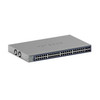
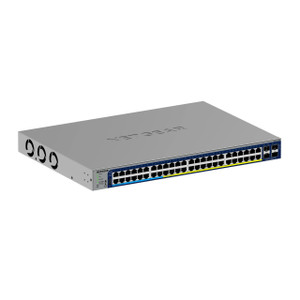
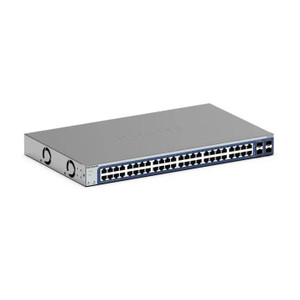
NETGEAR GS752TX-300NAS 48-Port Gigabit Managed Switch 10G SFP+
The NETGEAR GS752TX-300NAS is a managed Gigabit Ethernet switch designed for enterprise network aggregation, PoE-dense access layers, and data-center interconnect. With 48 Gigabit ports, four 10G SFP+ uplinks, and a 640W PoE++ budget (802.3bt), this switch consolidates high-port-density with sufficient power delivery to support PTZ cameras, multi-radio access points, and enterprise phones across a single platform. The 176 Gbps switching fabric eliminates backplane congestion on mixed-speed deployments—a critical advantage when you're terminating dozens of powered devices without oversubscription.
Key Features
- 48 Gigabit Ethernet Ports: 48 × 1 Gbps RJ45 ports. Sufficient density for a full-floor access layer without daisy-chaining or clustering multiple switches.
- Four 10G SFP+ Uplinks: Four dedicated 10G small-form-factor pluggable ports. Accepts standard SFP+ transceivers for fiber uplinks to core switches, storage, or ISP hand-offs with zero additional cost per port beyond transceiver.
- 640W PoE++ Budget (802.3bt): Delivers up to 90W per port across all 48 Gigabit ports. Eliminates separate PoE injectors or midspan power supplies for high-draw camera and AP deployments.
- 176 Gbps Non-Blocking Throughput: Full-duplex switching capacity across all ports. No bandwidth oversubscription on sustained multi-gigabit flows.
- Managed Operation: Web GUI, CLI, SNMP, and multicast VLAN support. Layer-2/Layer-3 capabilities (static routing) enable segmentation of IP camera subnets, VoIP trunks, and access-control systems without a separate L3 appliance.
- 800MHz ARM A55 Processor: Single-core CPU handling forwarding, management, and basic edge intelligence. Scales from small enterprise deployments to multi-switch stacks or redundant pairs.
- Rack-Mount Form Factor: Standard 19-inch cabinet mount. Compact footprint for server-room and telecom-closet deployments.
- Dual Power Input Options: Redundant AC power connectors on full-PoE models. Eliminates single point of failure on critical infrastructure links.
The GS752TX-300NAS bridges the gap between commodity access switches and enterprise-class platforms. A typical deployment anchors a single building floor or warehouse zone: 48 Gigabit ports feed cameras, access points, and phones; four 10G uplinks provide redundant paths to a core switch or aggregation layer. The 640W PoE budget is the binding constraint—not the port count or switching capacity. On a floor with 30 high-draw PTZ cameras (60W each), you consume ~1.8 kW if all devices draw simultaneously, which forces either load-balancing across two switches or staged power-on sequencing. Understanding this ceiling is essential before installation.
VLAN and static routing allow you to isolate traffic classes without deploying a full router. A security integrator can segment IP cameras on VLAN 100, guest Wi-Fi on VLAN 200, and voice phones on VLAN 300—all terminating on the same switch, with simple firewall rules upstream. Multicast VLAN support is particularly valuable for IP-based surveillance systems that rely on multicast discovery or streaming; the switch prevents multicast floods that would degrade performance on access ports not explicitly configured to receive the stream.
Integration with standard NMS platforms (Nagios, PRTG, Zabbix) relies on SNMP v1/v2c/v3. The web GUI is adequate for small deployments; CLI access via SSH is required for automation (Ansible, Terraform) at scale. The GS752TX-300NAS does not ship with onboard redundancy protocols (LACP, RSTP) at the firmware level on base configurations—confirm feature support with your distributor or datasheet, as some enterprise SKUs include these capabilities.
Power consumption under full PoE load reaches the device's rated thermal envelope; noise levels climb to approximately 37.3 dBA at 25°C on the 48-port variant. For noise-sensitive environments (classrooms, boardrooms), consider mounting in an isolated equipment room or deploying a smaller 24-port variant (GS724TX or equivalent) if port density allows.
Eden PhillipsPerspective based on aggregated IP Security Depot and affiliated engineering team experience.
We've deployed the NETGEAR GS752TX series across enterprise campuses, branch offices, and single-building surveillance networks for nearly a decade. The 48-port GS752TX-300NAS is the sweet spot for mid-market security integrators: it offers enough PoE capacity to power 30-40 cameras on a single platform without the cost and complexity of stacked switches or external PoE injectors. The differentiator versus lower-tier Gigabit switches is the 640W PoE++ budget—that's the real separator. A basic 24-port Gigabit switch often tops out at 240W; this unit delivers 2.5× that, which translates directly to operational simplification on camera deployments. The four 10G SFP+ uplinks are equally important: they provide fiber-optic redundancy to your core network or another switch without requiring separate uplink adapters.
That said, we've learned hard lessons about PoE budget saturation. On a floor with 40 PTZ cameras at 60W each, you cannot power all units simultaneously from a single 640W budget—you need load-balancing across two switches or intelligent power sequencing. Many integrators discover this gap at cutover and scramble to add a second switch mid-project. Spec the PoE draw carefully: count every device, multiply by its peak power rating, and add 20% overhead for power-supply efficiency loss.
Technical Highlights:
- 640W PoE++ (802.3bt) Budget: Delivers up to 90W per port, fully negotiated. Eliminates the need for external midspan injectors or power splitters on high-draw camera and AP farms. On a 30-camera site, this is 2-3 fewer power supplies to install and maintain.
- 176 Gbps Switching Fabric: Non-blocking throughput across all 48 ports simultaneously. No backplane saturation even during peak recording events—real protection against bandwidth chokepoints when multiple NVRs or cloud-sync services compete on uplinks.
- 10G SFP+ Uplinks (4 ports): Standard small-form-factor pluggable transceivers. Fiber uplinks provide EMI immunity and distance extension (up to 10 km on single-mode), critical in industrial and campus deployments. Single-mode SFP+ transceiver cost is ~$200–300 per port; multi-mode is ~$50–100—budget accordingly.
- Managed L2/L3 Switching with VLAN & Static Routing: Isolate camera subnets, VoIP, and access-control traffic without a separate router. Multicast VLAN prevents IP-discovery floods on large IP-camera deployments; real bandwidth saver on dense surveillance networks.
- Redundant Power Input (dual PSU option): N+1 power availability on enterprise SKUs. One PSU failure does not take down the entire switch; highly relevant for 24/7 security infrastructure.
Deployment Considerations:
- PoE Budget Saturation Is Real: Do not assume all 48 ports can deliver 90W simultaneously. Calculate total device power draw (cameras, APs, phones) and verify it does not exceed 640W peak. Build in 20% overhead for PSU efficiency loss. On a 40-camera site at 60W each, you'll need at least two switches.
- SFP+ Transceiver Cost & Compatibility: The four 10G uplinks require SFP+ modules (not included). Single-mode fiber transceivers (LC connectors) are ~$250–400 each; multi-mode is $50–150. Verify transceiver compatibility with your fiber plant—mixing single-mode and multi-mode across uplinks will fail link negotiation.
- Firmware & SNMP Configuration Required for Automation: Out-of-box, the switch supports basic web GUI management. Integrating into an NMS or automation framework (Ansible, Terraform) requires SSH/CLI access and SNMP v3 configuration. Budget 2–4 hours for initial setup on a new campus deployment.
- Thermal & Noise Under Full PoE Load: At full 640W PoE draw, the switch reaches ~37 dBA—audible in quiet environments. Deploy in server rooms or isolated cabinets; avoid boardrooms or classrooms without sound isolation.
- Multicast VLAN Is a Game-Changer for IP Cameras: If your VMS or camera system uses multicast discovery or streaming, configure multicast VLAN to prevent floods. This is not enabled by default—enable it via CLI or web GUI at deployment time.
The GS752TX-300NAS is the right fit for integrators building 30–50 device networks where PoE density and fiber uplink redundancy matter more than advanced routing or SD-WAN features. It eliminates the operational overhead of external PoE splitters and redundant power supplies. For campus or enterprise environments requiring MPLS, BGP, or QoS steering, move up to a higher-tier platform. Check the NETGEAR catalog for variants and enterprise-feature SKUs.